Quick Answer: Most gifts owe no gift tax at all because they fall under the $19,000-per-recipient annual exclusion or get absorbed by your $15,000,000 lifetime exemption; actual tax is only due once that lifetime exemption is fully used up.
Overview
The federal gift tax exists to stop people from avoiding the estate tax by simply giving everything away before they die. In practice, almost nobody ever pays it. The tax code gives every person two separate shields: an annual exclusion that resets every year, and a lifetime exemption that only shrinks when you use it.
For 2026, the annual exclusion is $19,000 per recipient. You can give $19,000 to your daughter, another $19,000 to your son, another $19,000 to a friend, and another $19,000 to anyone else, all in the same calendar year, with zero paperwork and zero effect on your lifetime exemption. A married couple can double this to $38,000 per recipient by electing to "split" gifts on IRS Form 709, even if only one spouse actually writes the check.
Anything above the annual exclusion for a given recipient counts as a taxable gift, but that does not mean tax is due. Every US citizen has a lifetime gift and estate tax exemption of $15,000,000 in 2026, following the permanent increase enacted by the One Big Beautiful Bill Act (OBBBA) in 2025. Taxable gifts are subtracted from this exemption first. Only once the entire $15,000,000 is exhausted, whether through gifts during life or through your estate at death, does the IRS actually collect gift or estate tax, at a flat top rate of 40%.
This calculator walks through that exact sequence: how much of your gift is shielded by the annual exclusion, how much eats into your lifetime exemption, how much exemption you have left afterward, and whether any of it crosses into taxable territory.
How This Is Calculated
The math follows the same order the IRS uses on Form 709, the United States Gift (and Generation-Skipping Transfer) Tax Return.
- Apply the annual exclusion per recipient. Each person you give to in 2026 gets their own $19,000 shield ($38,000 if you and your spouse elect gift splitting). Only the amount above that floor, per recipient, is a taxable gift.
- Sum the taxable gifts across all recipients. If you gave $30,000 to three different people, each one has $11,000 in taxable gift after the exclusion, for $33,000 total.
- Apply remaining lifetime exemption. The IRS tracks a running total of your lifetime exemption use, starting at $15,000,000. This year's taxable gift is subtracted from whatever exemption you have left after prior years' gifts.
- Tax only the amount that exceeds remaining exemption. If the taxable gift is smaller than what is left of your exemption, gift tax owed is $0, and the exemption balance simply drops. Only the portion that overflows the remaining exemption is actually taxed, at the flat 40% top rate, because by the time someone has used up a $15,000,000 exemption they are already well past the $1,000,000 cumulative-gift threshold where the unified rate schedule tops out.
The engine performs every step in exact decimal arithmetic through the shared money primitive used across this platform's tax calculators, so there is no floating-point drift when exemption balances run into the millions. There is no bracket walk here: above the exemption the federal gift tax is a flat 40%, so the computation is a single multiplication rather than a progressive schedule.
Worked Example
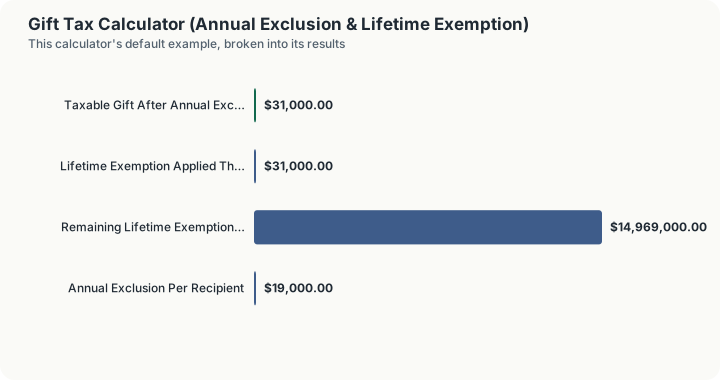
Take the "modest gift" scenario: a $50,000 gift to one recipient, with no gift-splitting election and no prior lifetime gifts used.
- Annual exclusion per recipient: $19,000
- Taxable gift this year: $50,000 − $19,000 = $31,000
- Remaining lifetime exemption before this gift: $15,000,000
- Lifetime exemption applied: min($31,000, $15,000,000) = $31,000
- Remaining lifetime exemption after: $15,000,000 − $31,000 = $14,969,000
- Gift tax owed: $0
Now take the "large gift" scenario: a single $16,000,000 gift to one recipient.
- Taxable gift this year: $16,000,000 − $19,000 = $15,981,000
- Remaining lifetime exemption applied: min($15,981,000, $15,000,000) = $15,000,000
- Amount exceeding the exemption: $15,981,000 − $15,000,000 = $981,000
- Gift tax owed: $981,000 × 40% = $392,400
And the "exemption nearly exhausted" scenario, where the donor already reported $14,990,000 of prior taxable gifts on earlier Form 709 filings, then gives $100,000 to one recipient this year:
- Taxable gift this year: $100,000 − $19,000 = $81,000
- Remaining exemption before this gift: $15,000,000 − $14,990,000 = $10,000
- Exemption applied: min($81,000, $10,000) = $10,000
- Amount exceeding exemption: $81,000 − $10,000 = $71,000
- Gift tax owed: $71,000 × 40% = $28,400
What This Does Not Account For
This calculator models the core federal gift tax mechanics, but a handful of real-world complications sit outside its scope:
- State gift taxes. No state currently imposes a standalone gift tax, but a few states have inheritance or estate taxes with much lower exemptions than the federal $15,000,000, which matters for planning around large lifetime gifts.
- Gifts of future interests. The annual exclusion only applies to "present interest" gifts, meaning the recipient can use or enjoy the gift right away. Gifts into certain trusts, or gifts where access is delayed, may not qualify for the annual exclusion even if they are the same dollar amount.
- Valuation discounts. Gifts of hard-to-value assets, such as shares in a family business or fractional real estate interests, are often eligible for minority-interest or lack-of-marketability discounts that reduce the reported gift value below simple fair market value. This calculator assumes the gift amount you enter is already the final, agreed-upon taxable value.
- Portability and estate tax interaction. This tool only models the gift tax side. The same $15,000,000 exemption also covers your estate at death, and a surviving spouse can inherit any unused exemption from a deceased spouse through portability elections, which this calculator does not simulate.
- Non-citizen spouses. Gifts to a spouse who is not a US citizen do not qualify for the unlimited marital deduction and instead have a much higher annual exclusion ($194,000 for 2026) rather than an unlimited one; this calculator does not model that special case.
Common Pitfalls
- Assuming any gift over $19,000 means writing a check to the IRS. In reality, the lifetime exemption absorbs almost every taxable gift most people will ever make. Gift tax is only owed after $15,000,000 in cumulative taxable gifts.
- Forgetting that a Form 709 is still required. Even when no tax is due because the lifetime exemption covers the gift, the IRS still requires a gift tax return to be filed for any gift above the annual exclusion, to keep an accurate running total of exemption used.
- Confusing the annual exclusion with a per-donor limit. The $19,000 exclusion applies per recipient, not per gift or per donor. Giving $19,000 to each of five different people uses no lifetime exemption at all.
- Ignoring gift splitting when married. Couples who do not elect gift splitting on Form 709 leave half of their available annual exclusion and lifetime exemption unused on gifts made from joint or one spouse's separate funds.
- Overlooking non-cash gifts. Forgiven loans, below-market sales, and additions to jointly held property can all count as gifts for tax purposes, even though no cash changed hands.
Frequently Asked Questions
Do I have to pay gift tax on a $50,000 gift to my child?
Who is responsible for paying gift tax, the giver or the recipient?
What happens if I do not report a taxable gift on Form 709?
Does the lifetime exemption reset every year like the annual exclusion?
Is the $15,000,000 lifetime exemption permanent now?
Sources
- Internal Revenue Service, "IRS releases tax inflation adjustments for tax year 2026, including amendments from the One, Big, Beautiful Bill," Revenue Procedure 2025-32. irs.gov/newsroom/irs-releases-tax-inflation-adjustments-for-tax-year-2026-including-amendments-from-the-one-big-beautiful-bill
- Internal Revenue Service, Instructions for Form 709, United States Gift (and Generation-Skipping Transfer) Tax Return. irs.gov/forms-pubs/about-form-709
- Internal Revenue Code §2503(b) (annual exclusion), §2010(c) (basic exclusion amount), §2001(c) (unified rate schedule), §2513 (gift splitting). law.cornell.edu/uscode/text/26/2503
- Internal Revenue Service, "Frequently Asked Questions on Gift Taxes." irs.gov/businesses/small-businesses-self-employed/frequently-asked-questions-on-gift-taxes