Quick Answer: Georgia has no state-level estate tax, so a $5,000,000 estate owes $0 in Georgia estate tax. Federal exemption rules apply separately.
Georgia's Zero, and What Still Applies
Georgia charges no estate tax and no inheritance tax, and neither does any of the five states it borders. Georgia is among the 38 states levying no separate state estate tax today.
Nor does Georgia levy a separate inheritance tax on beneficiaries, so heirs here face no state-level death tax of either kind, regardless of how the estate is structured or how many beneficiaries ultimately share in it.
The only number that matters for a Georgia estate, then, is the federal exemption (currently above $15,000,000 per individual for 2026), since nothing at the state level reduces what beneficiaries ultimately receive.
That simplicity is one reason retirees and high-net-worth households have historically relocated to no-tax states like Georgia, though residency for tax purposes turns on where someone is actually domiciled, not just where they own a vacation home.
Georgia is a Deep South state anchored by metro Atlanta, but that has no bearing on the calculation here: a Georgia resident's estate is unaffected by changes to other states' exemption thresholds, since only Georgia and federal law govern property held within it.
How This Is Calculated
There is no Georgia estate tax statute, so there is no exemption to clear and no rate schedule to walk. The calculator confirms that rather than computing against a threshold, and the state tax line is $0 at every estate size.
- Value the gross estate. Fair market value at the date of death of all real property, business interests, securities, cash, and life insurance proceeds the decedent owned.
- Subtract allowable deductions. Debts, administrative expenses, qualifying charitable bequests, and the unlimited marital deduction come off the gross figure. This is bookkeeping here rather than tax math, since no state rate is applied to the result.
- Look Georgia up in the state table. It is not among the twelve states that impose an estate tax, so no exemption threshold or bracket schedule is loaded.
- Return $0. The net estate passes to beneficiaries with no Georgia reduction, whether it is $500,000 or $50,000,000.
The federal estate tax is a separate return with its own exemption, above $15,000,000 per individual for 2026, and this calculator does not compute it. It also does not carry over a deceased spouse's unused federal exemption, add back lifetime taxable gifts, or apply the generation-skipping transfer tax.
Worked Example
- Start with the gross estate. This example uses a $5,000,000 gross estate: the fair market value of all real property, business interests, equities, cash, and life insurance the decedent owned at death, before deductions.
- Check Georgia's estate tax status. Georgia is one of the 38 states with no separate state-level estate tax, so there is no state exemption threshold or bracket schedule to apply.
- Compute the state estate tax due. Because Georgia taxes no estates at any size, the calculator returns $0.00 in state tax. A $5,000,000 estate and a $50,000,000 estate both owe Georgia nothing.
- Distribute the net estate. With no state tax subtracted, the full $5,000,000.00 gross estate passes to beneficiaries as the net estate distributed.
- What this excludes. This is Georgia's state-level result only; federal estate tax is computed separately against the $15,000,000+ federal exemption per individual for 2026 on IRS Form 706.
Where Georgia's Zero Stops Being Zero
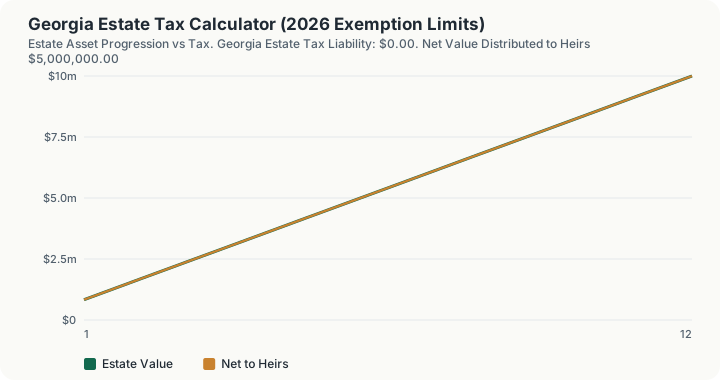
The tier schedule above returns $0.00 at all twelve rungs, from $833,333 of net estate through the $5,000,000 baseline to $10,000,000 at the top. Beyond the sweep the answer is unchanged: the engine returns $0.00 on a $15,000,000 Georgia estate. The stored Georgia record holds no exemption, no brackets and a rate of zero, so there is no bracket edge, no exemption cliff and no phase-out on this page, and the marginal cost of the next million dollars of estate value in Georgia is $0.00.
The deductions input has no effect. Entering marital, charitable or administrative deductions reduces the net estate figure the engine computes before the bracket walk, but the walk runs against an empty schedule, so the liability stays at $0.00 whatever you enter. Anyone using this page to test whether a charitable bequest reduces Georgia estate tax will get a correct answer for the wrong reason.
A $0.00 exemption is not a missing exemption. The Statutory Exemption Threshold output returns $0.00 because Georgia has no estate tax for an exemption to modify. It should not be read as Georgia taxing estates from the first dollar.
What is not modelled. The federal estate tax, the federal exemption amount, portability of a predeceased spouse's unused exclusion, the generation-skipping transfer tax and the step-up in basis at death are all outside this code path. So is Georgia income tax on income in respect of a decedent, and so is any inheritance tax, which is a different levy assessed on the recipient rather than the estate and which Georgia also does not impose.
The situs problem. State estate tax follows real property rather than domicile. A Georgia resident holding real estate in Illinois, which taxes estates above $4,000,000, or Hawaii, which taxes above $5,490,000, can owe those states estate tax on that property while owing Georgia nothing. This calculator takes one value and one state and has no way to apportion an estate between jurisdictions, so the $0.00 above is a statement about Georgia and not about the estate.
What This Does Not Account For
- Federal generation-skipping transfer (GST) tax under IRC Chapter 13.
- Ancillary probate requirements for real property situated in other jurisdictions.
- Complex liquidity discounts for minority non-voting family business entities.
- State-specific inheritance taxes levied directly on beneficiaries (e.g. PA, NJ, MD, KY, NE).
Common Pitfalls
- Assuming State Exemption Matches Federal: Forgetting that states like Oregon ($1.0M) and Massachusetts ($2.0M) tax estates far below the federal threshold.
- The "Cliff" Effect in Specific States: Failing to recognize that states like New York eliminate the exemption entirely if the estate exceeds 105% of the threshold.
- Out-of-State Real Property Exposure: Holding real estate in states with active estate taxes exposes non-resident estates to proportional state estate taxes.
- Failing to Fund Revocable Living Trusts: Assets held outside trust structures are subjected to public probate proceedings and statutory executor fees.
Frequently Asked Questions
Does Georgia have a state estate tax?
Does Georgia have an inheritance tax?
When is state estate tax due?
What assets are included in the taxable estate?
Sources
- Georgia Department of Revenue: General state tax administration; Georgia levies no state-level estate tax, so only the federal estate tax applies. dor.georgia.gov