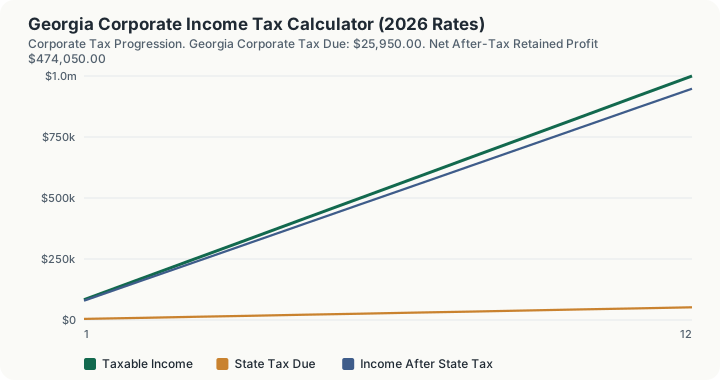
Quick Answer: On $500,000 of pre-apportioned taxable income, Georgia's flat 5.19% corporate income tax rate produces $25,950.00 in state tax due and $474,050.00 in net after-tax profit.
A Rate Still on Its Way Down
Georgia's flat 5.19% corporate income tax rate is one of the more oddly specific figures in this dataset. Most flat-rate states land on a round quarter- or half-percentage-point number, but Georgia's rate carries two decimal places, the mark of periodic statutory rate reductions that have chipped the figure down over time rather than resetting it to a round number.
That precision aside, 5.19% sits just below the midpoint of state corporate rates nationally, lower than neighbors like Alabama (6.50%) and Tennessee (6.50%) but higher than North Carolina's 2.00%. The rate applies uniformly to all apportioned taxable income, with no brackets, making Georgia's tax bill scale in direct proportion to the income a corporation sources to the state.
Georgia's 5.19% rate turns the calculator's $500,000 example into $25,950.00 of state tax, a number that would climb to $32,500.00 if the same income were instead apportioned to neighboring Alabama or Tennessee at their 6.50% rate.
How This Is Calculated
Georgia's corporate rate is on a legislated downward path, and the 2026 figure of 5.19% is a scheduled step in that reduction rather than a settled long-term number. Any multi-year Georgia model built on a fixed rate will drift, because the rate is designed to keep falling if revenue triggers are met.
- The entered income is the base. No apportionment, no Georgia additions or subtractions, and no net operating loss carryforward is computed anywhere in this path. What you type is what is taxed.
- Apply 5.19% flat. Georgia's stored schedule is one open-ended bracket, so every dollar of the base meets the same rate.
- Subtract credits, clamped at zero. The credits field reduces the gross tax directly, and a credit exceeding the liability returns $0.00.
- Effective rate. Net tax divided by entered income.
- Net retained profit. Entered income minus net tax.
- Twelve tiers. The same calculation is repeated at incomes from one sixth of your figure to twice it for the schedule above.
Worked Example
Using this calculator's baseline scenario: a corporation with $500,000 in taxable income apportioned to Georgia.
- Start with apportioned taxable income. The corporation has already apportioned $500,000 of its total taxable income to Georgia using the state's statutory apportionment formula, before any state-level tax is applied.
- Apply Georgia's flat statutory rate. Georgia taxes all C-corporation income at a single flat rate of 5.19%, regardless of income size, so no bracket lookup is required: $500,000 × 5.19% = $25,950.00.
- Georgia corporate tax due: $25,950.00.
- Net retained profit. Subtracting the state tax liability from taxable income leaves $500,000 − $25,950.00 = $474,050.00 in after-tax profit retained by the corporation, before any separate federal tax liability is applied.
Because Georgia uses a single flat rate rather than graduated brackets, the 5.19% effective rate is identical to the marginal rate at every income level: a corporation earning $50,000 and one earning $50 million both face the same 5.19% state rate on their apportioned income.
Georgia's 5.19% Read Off the Tier Table
The tier table applies one rate to twelve income levels. Georgia's stored schedule has a single bracket with no ceiling, so nothing steps and the effective rate reads 5.19% at every rung from $83,333.33 to $1,000,000.00.
Two rungs. Row 3 sets income at $250,000.00 and returns $12,975.00. Row 6, the $500,000 baseline, returns $25,950.00. Row 12 is $1,000,000.00 at $51,900.00.
The marginal figure. Each additional $1,000 of Georgia apportioned income costs $51.90. The engine returns $26,001.90 at $501,000 against $25,950.00 at $500,000. Each additional $10,000 costs $519.00.
The reverse question. A company holding Georgia tax to $25,000 can carry $481,695.57 of apportioned income, where the engine returns exactly $25,000.00 and $456,695.57 of retained profit. That is $18,304.43 below the $500,000 baseline.
Credit against deduction, priced. A $25,000 Georgia credit, such as the job tax credit or the research credit, takes the liability from $25,950.00 to $950.00, a full $25,000.00 saving. Cutting $25,000 out of the base instead returns $24,652.50, saving $1,297.50. The credit is worth $23,702.50 more, a ratio of 19.3 to 1 that is a direct consequence of the low 5.19% rate: the lower the rate, the more a credit outperforms a deduction.
At the small end of the sweep. Row 1 of the tier table sets income at $83,333.33 and returns $4,325.00. At $100,000 the engine returns $5,190.00, at $25,000 it returns $1,297.50, and at zero it returns $0.00 exactly. Nothing changes rate across that range: a $25,000 Georgia corporation and a $1,000,000 one both meet 5.19% on every dollar, so the first dollar of profit is taxed at the same rate as the last. Georgia grants no small-business exemption in this schedule and the engine applies none.
The rate is a moving target, and this page holds it still. Georgia's corporate rate is on a legislated downward path with revenue triggers, and 5.19% is the 2026 step. This calculator reads one stored rate for one tax year; it has no schedule of future rates and cannot project a multi-year liability. The second gap is the net worth tax, which Georgia levies annually on capital rather than income and files on the same return. Nothing on this page computes it, so a Georgia corporation's total state obligation is larger than the figure above by an amount this engine never sees.
What This Does Not Account For
- Federal corporate income tax (21% under IRC § 11).
- Specialized gross receipts taxes (e.g. Ohio CAT, Washington B&O, Texas Franchise Tax) where applicable.
- Minimum entity franchise tax fees or annual report filing charges.
- Base Erosion and Anti-Abuse Tax (BEAT) or Global Intangible Low-Taxed Income (GILTI) provisions.
- Local municipal corporate earnings taxes (e.g. NYC General Corporation Tax).
Common Pitfalls
- Mistaking the Flat Rate for the Final Bill: Assuming Georgia's 5.19% rate applies directly to book income rather than to apportioned taxable income after state additions, subtractions, and NOL adjustments.
- Improper Apportionment Sourcing: Applying market-based sourcing vs cost-of-performance rules incorrectly for service revenue apportioned to Georgia.
- Ignoring Unitary Group Combined Reporting: Failing to account for Georgia's mandatory combined return requirements across related entities.
- Neglecting State NOL Carryforward Caps: Overlooking Georgia's annual percentage limitations on net operating loss deductions, easy to miss given the rate's unusual precision to two decimal places.
Frequently Asked Questions
Does Georgia have a corporate income tax?
When are Georgia corporate tax returns due?
Does Georgia tax S-corporations and LLCs?
How is multi-state corporate income apportioned to Georgia?
Sources
- Georgia Department of Revenue: Corporate Tax Statutes and Guidance (2026). dor.georgia.gov
- Multistate Tax Commission (MTC): Uniform Apportionment and Allocation Guidelines. mtc.gov