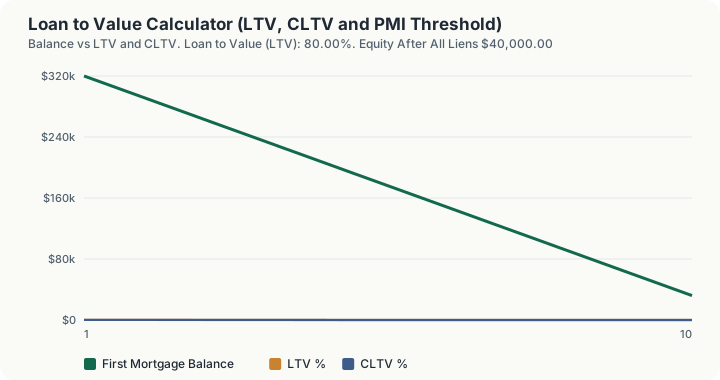
Quick Answer: A $400,000 home with a $320,000 first mortgage has an LTV of 80.00%: comfortably at the PMI threshold. But add a $40,000 HELOC and the CLTV is 90.00%. Lenders underwrite against CLTV, so a borrower who looks fine on LTV can still be declined on the ratio that actually matters.
What does this calculator do?
Two ratios describe how much of a property is financed, and confusing them is the most common mistake in home equity borrowing.
LTV counts the first mortgage only against the property value. CLTV counts every lien secured on the property: the first mortgage, any second, and any drawn HELOC balance.
They coincide only when there is a single loan. As soon as a second lien exists they diverge, and here the gap is 10 percentage points. Most lenders set their approval and pricing limits on CLTV, so that gap is the difference between an approval and a decline.
The 80% threshold matters separately: conventional private mortgage insurance is generally required above it, can be cancelled on request at 80%, and terminates automatically at 78%.
How is this calculated?
LTV = (First mortgage)/(Property value) × 100
CLTV = (First mortgage + Junior liens)/(Property value) × 100
Property value means the appraised value or the purchase price, whichever is lower. Lenders will not lend against a price above appraisal.
The calculator also shows the two routes to 80% LTV: paying down principal, and the property appreciating. Both work, and only one is under your control.
Worked Example
A homeowner with a $400,000 property carries a $320,000 first mortgage and a $40,000 HELOC drawn against the equity.
Step 1: The LTV. $320,000 / $400,000 = 80.00%
Step 2: Total secured debt. $320,000 + $40,000 = $360,000
Step 3: The CLTV. $360,000 / $400,000 = 90.00%
Step 4: The gap between the two. 90.00% - 80.00% = 10.00 pts
Step 5: Equity after every lien. $400,000 - $320,000 - $40,000 = $40,000
Step 6: Equity as a share of value. $40,000 / $400,000 = 10.00%
On step 1 this borrower sits exactly at the PMI threshold and looks well capitalised. On step 3 they have a tenth of the house. A cash-out refinance application is priced against the second number, and the HELOC does not have to be drawn much further before the file stops working.
Step 7: Remove the HELOC. LTV and CLTV both read 80.00%, equity rises to $80,000 and 20.00%, and the gap collapses to 0.00 pts
The two ratios only diverge when a junior lien exists, which is precisely why borrowers who have one tend to quote the ratio that omits it.
Now a thinner deposit on the same house:
Step 8: A $380,000 first mortgage, no junior liens. $380,000 / $400,000 = 95.00%, and the PMI position reads above 80% LTV, conventional PMI is generally required
Step 9: The balance that would reach 80%. $400,000 x 0.80 = $320,000
Step 10: Principal paydown required. $380,000 - $320,000 = $60,000
Step 11: The other route, appreciation. The value at which $380,000 is 80% is $380,000 / 0.80 = $475,000, so the property must gain $475,000 - $400,000 = $75,000
Steps 10 and 11 price the same destination two ways, and only one of them is under the borrower's control. Where the market does the work instead:
Step 12: The original borrower, property revalued to $500,000. LTV falls to 64.00% and CLTV to 72.00% with not one dollar of principal repaid, and equity rises to $140,000, or 28.00% of value
That is why homeowners in rising markets often clear the PMI threshold well before their amortisation schedule says they should. The lender's threshold is a ratio, and there are two ways to move a ratio.
What does this calculator not account for?
- Undrawn HELOC capacity. Some lenders count the full committed line rather than the drawn balance when assessing CLTV, which can raise the ratio substantially.
- Which value the lender uses. A new appraisal may come in below your estimate, and lenders use the lower of appraisal and purchase price.
- HCLTV. A further variant used by the agencies that counts the full HELOC commitment.
- Loan programme limits. FHA, VA and USDA loans have their own maximum LTVs and their own mortgage insurance rules, which differ from conventional PMI.
- PMI cost. This shows where the threshold sits, not what the premium would be.
- Cancellation requirements. Cancelling PMI at 80% typically requires a request in writing, a good payment history, and often a new appraisal at the borrower's expense.
- Lender-paid mortgage insurance, where the cost is built into a higher rate and never cancels.
- Cash-out refinance limits, which are usually stricter than purchase limits.
What mistakes do people make with this?
- Quoting LTV when the lender wants CLTV. With a second lien these are different numbers, and the lender's decision rests on the higher one.
- Assuming PMI drops off at 80% automatically. Automatic termination is at 78% of the original amortisation schedule. Cancelling at 80% requires you to ask, and usually to pay for an appraisal.
- Using your own estimate of value. The lender uses the appraisal, and on a purchase the lower of appraisal and price.
- Forgetting undrawn HELOC capacity. A $100,000 line with $10,000 drawn may be assessed on the full $100,000 by some lenders.
- Expecting appreciation to cancel PMI on its own. It can, but usually requires a new appraisal and a formal request, and some servicers impose a seasoning period.
- Comparing conventional and FHA thresholds. FHA mortgage insurance follows entirely different rules and on many loans never cancels at all.
Frequently Asked Questions
What is the difference between LTV and CLTV?
Which one do lenders use?
When does PMI come off?
Can appreciation get me to 80%?
Does an undrawn HELOC count?
What LTV do I need to avoid PMI?
Sources
- Consumer Financial Protection Bureau, "What is a loan-to-value ratio and how does it relate to my costs?" consumerfinance.gov/ask-cfpb/what-is-a-loan-to-value-ratio-how-does-it-relate-to-my-costs-en-121
Also consulted: Standard mortgage underwriting ratios. LTV and CLTV are arithmetic definitions with no jurisdictional content; The 80% cancellation and 78% automatic termination thresholds reflect the conventional PMI framework under the Homeowners Protection Act; Lender treatment of undrawn HELOC capacity varies, which is noted rather than assumed.