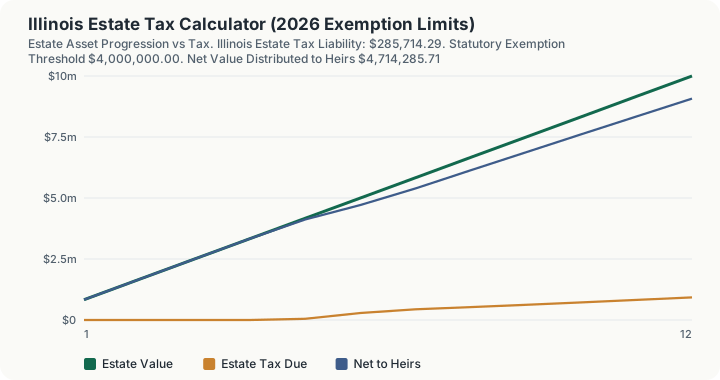
Quick Answer: A $5,000,000 estate in Illinois owes $285,714 in state estate tax. Illinois does not simply tax the $1,000,000 above the $4,000,000 exemption at a flat rate; the actual statutory formula (35 ILCS 405/2, 405/3) is a circular "lesser of" calculation that produces a marginal rate on the first dollars above the exemption that is higher than the 16% top bracket rate.
The Lowest Exemption in the Country
Illinois taxes estates above $4,000,000, and it is the only state whose estate tax is not a rate schedule at all: the statute makes the tax the lesser of a graduated credit-table figure and a flat 40% of the excess, each computed circularly because the tax is deductible against its own base.
That $4,000,000 threshold sits well below the federal exemption, which means a solidly upper-middle-class Illinois estate, one far too small to trigger any federal filing, can still owe the state a meaningful bill once real estate, retirement accounts, and business interests are added together.
Unlike neighboring Kentucky, which taxes inheritances directly based on a beneficiary's relationship to the decedent, Illinois levies no separate inheritance tax: the estate-level calculation described here is the only state death tax an Illinois beneficiary needs to think about.
Because Illinois's brackets are graduated rather than flat, the marginal rate applied to the last dollar of a large estate is higher than the average rate across the whole taxable amount, a distinction that matters when comparing the 16% headline rate to what a given estate will actually pay.
How This Is Calculated
The calculator starts from two numbers you enter: the gross estate at fair market value, and the marital, charitable, and administrative deductions the estate can claim. It subtracts the second from the first to get the net estate, then applies Illinois's own schedule to that figure. Nothing else feeds the result.
Illinois is the one state whose estate tax is not a rate schedule at all. Under 35 ILCS 405/2 and 405/3 the tax is the lesser of two figures, and each of them is circular, because the Illinois tax is deductible against the base it is computed on. The calculator solves the first by iteration and the second in closed form, then takes whichever is smaller.
- Value the gross estate at fair market value on the date of death.
- Subtract allowable deductions to reach the net estate.
- Test the $4,000,000 exclusion. At or below it, the tax is $0 and neither branch runs.
- Solve branch 1. The pre-2001 federal state-death-tax credit table, whose steps run from 0.8% to 16%, is applied to the net estate less the tax itself less $60,000. Because the tax appears on both sides, the calculator iterates until the figure stops moving.
- Solve branch 2. A flat 40% applied to the excess over $4,000,000 net of the tax, which collapses algebraically to $\tfrac{2}{7}$ of the excess, or about 28.57%.
- Take the lesser of the two and subtract it from the net estate.
Which branch binds depends on the estate. A $5,000,000 estate produces $285,714 from branch 2 and more from branch 1, so branch 2 controls; a $10,000,000 estate produces $926,923 from branch 1, which is well under branch 2's $1,714,286, so branch 1 controls. This two-branch algorithm matches the Illinois Attorney General's own published calculator and its Fact Sheet worked examples.
That is the entire computation. The calculator does not carry over a deceased spouse's unused exemption, add back lifetime taxable gifts, apply the generation-skipping transfer tax, discount closely held interests, or figure the separate federal return. Those sit under "What This Does Not Account For" below, not in the math above.
Worked Example
- Start with the gross estate. This example uses a $5,000,000 gross estate: the fair market value of all property, business interests, equities, cash, and life insurance the decedent owned at death, before deductions.
- Illinois does not tax a flat rate on the excess. Illinois's own statute (35 ILCS 405/2, 405/3) computes the tax as the lesser of two circular calculations: (a) the pre-2001 federal state-death-tax-credit table applied to the estate net of the tax itself, and (b) a flat 40% federal-style rate applied circularly to the amount above the $4,000,000 exclusion. Both are "interrelated" (the tax reduces the very base it's computed on), which the Illinois Attorney General's office itself describes as requiring algebra rather than a single lookup.
- Below $4,000,000, both branches are $0. Illinois taxes estates only above $4,000,000; at or below that amount there is no tax under either branch.
- Solve both branches for $5,000,000. The flat-40%-style branch resolves to a closed form of (0.40 ÷ 1.40) × ($5,000,000 − $4,000,000) = $285,714.29; the graduated credit-table branch resolves (after iterating to convergence) to roughly $352,000. The lesser of the two is the flat-style branch: $285,714.29.
- Net estate distributed to heirs. $285,714 in tax leaves $4,714,286 ($5,000,000 minus $285,714) to beneficiaries.
- Why the marginal rate looks "too high." On just the first $1,000,000 above the exemption, $285,714 works out to a 28.6% effective rate on that slice, well above the 16% headline top bracket. This matches the Illinois Attorney General's own published Fact Sheet example for a $5,000,000, all-Illinois-property estate.
- What this leaves out. This is Illinois's state-level computation only; federal estate tax is assessed separately under IRC § 2010.
Crossing $4,000,000, Dollar by Dollar
Illinois has the lowest estate tax exemption in the country at $4,000,000, and the sweep above crosses it between rows 4 and 5. Rows 1 through 4, from $833,333 to $3,333,333, return $0.00. Row 5, at $4,166,667, returns $47,619.05. Row 6, the $5,000,000 baseline, returns $285,714.29.
At $3,999,999 of net estate. One dollar under. The engine returns $0.00, with nothing recorded above the exemption.
At exactly $4,000,000. Still $0.00. Reaching the threshold costs nothing.
At $4,000,100, one hundred dollars later. The engine returns $28.57. That is a marginal rate of 28.57% on the first dollars above the exemption, well above the 16% figure usually quoted as the Illinois top rate. It is not an error: the Illinois computation under 35 ILCS 405/2 and 405/3 is a "lesser of" calculation, and its slope just above the exemption is steeper than any bracket rate in the underlying table.
The marginal cost of the next unit, walked upward. At $4,100,000 the engine returns $28,571.43, so the first $100,000 above the exemption costs $28,571.43, or $285.71 per $1,000. At $4,500,000 the tax is $142,857.14 on $500,000 of excess, the same 28.571% slope. That linear stretch ends: at $6,000,000 the tax is $456,071.43 on $2,000,000 of excess, an average of 22.8% on the excess, and at $15,000,000 it is $1,609,310.34 on $11,000,000 of excess, an average of 14.6%. The marginal rate is at its highest immediately above the exemption and falls as the estate grows, which is the opposite of the usual shape.
The reverse question, and it is worth real money here. An estate can hold $4,000,000 net without owing Illinois anything. The deductions field is the mechanism: a $5,000,000 gross estate with $1,000,000 of marital or charitable deductions produces a $4,000,000 net estate and a $0.00 liability, against $285,714.29 with no deductions. The last $1,000,000 of Illinois net estate above the exemption therefore carries $285,714.29 of tax, and a charitable bequest sized to land the net estate on $4,000,000 exactly recovers all of it.
What the calculation omits. The engine subtracts your deductions from the gross estate and runs the Illinois formula on the remainder. It does not compute federal estate tax, the federal exemption, portability of a deceased spouse's unused exclusion, or the generation-skipping transfer tax. It also has no situs apportionment, which matters in Illinois specifically because non-resident decedents owning Illinois real property are within the Illinois tax and cannot be modelled on this page.
What This Does Not Account For
- Portability of a deceased spouse's unused exemption. Most states with an estate tax, including this one, do not allow it at the state level, and the calculator does not apply it in either direction.
- Lifetime taxable gifts added back into the taxable estate, and any QTIP election, credit shelter trust, or state QTIP decoupling that would change what the taxable estate actually is.
- Valuation discounts for minority or non-marketable interests in closely held entities. Enter the discounted value yourself if the appraisal supports one.
- Federal generation-skipping transfer (GST) tax under IRC Chapter 13.
- Ancillary probate requirements for real property situated in other jurisdictions.
- Complex liquidity discounts for minority non-voting family business entities.
- State-specific inheritance taxes levied directly on beneficiaries (e.g. PA, NJ, MD, KY, NE).
Common Pitfalls
- Assuming State Exemption Matches Federal: Forgetting that states like Oregon ($1.0M) and Massachusetts ($2.0M) tax estates far below the federal threshold.
- The "Cliff" Effect in Specific States: Failing to recognize that states like New York eliminate the exemption entirely if the estate exceeds 105% of the threshold.
- Out-of-State Real Property Exposure: Holding real estate in states with active estate taxes exposes non-resident estates to proportional state estate taxes.
- Failing to Fund Revocable Living Trusts: Assets held outside trust structures are subjected to public probate proceedings and statutory executor fees.
Frequently Asked Questions
Does Illinois have a state estate tax?
Does Illinois have an inheritance tax?
When is state estate tax due?
What assets are included in the taxable estate?
Sources
- Illinois Department of Revenue, the official state tax authority for Illinois rates, rules and forms. tax.illinois.gov
Also consulted: Illinois Attorney General's Office: Estate Tax Guidance (2026).