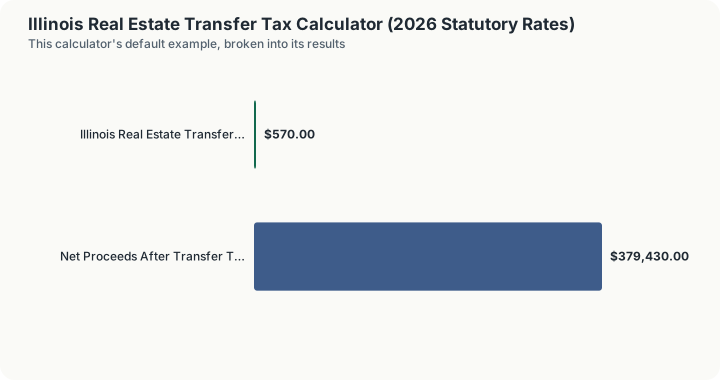
Quick Answer: A $380,000 home sale under Illinois's statewide baseline transfer tax rate of 0.15% generates $570 in tax due, though Chicago transactions face a far higher combined rate.
Overview
Illinois layers up to three tiers of real estate transfer tax onto a single sale. The state charges $0.50 per $500 of value (0.1%) under 35 ILCS 200/31-10, Cook County adds its own $0.25 per $500 (0.05%), and the City of Chicago separately layers on a substantially larger $5.25 per $500, or 1.05%, on top of both. A sale in downstate Illinois outside Cook County typically sees only the state rate plus a modest county add-on; a Chicago sale can see combined rates several times higher.
The state and county portions are generally the seller's responsibility under Illinois practice, though this can be modified by contract, and some municipal ordinances, including certain Chicago provisions, split the tax differently or place portions on the buyer. This calculator models the state rate plus a typical county add-on as its statewide baseline; a transaction specifically inside Chicago city limits should budget for materially more once the city's own transfer tax is added.
How This Is Calculated
Illinois has a modest state rate and a Chicago problem. The state charges $0.50 per $500, or 0.1%, and this calculator adds a 0.05% average county figure for a 0.15% baseline.
Both components are flat, so tax due scales linearly with price and the effective rate reads 0.150% everywhere. Illinois has no mansion tax or high-value surcharge at state level, so that output stays at $0.00.
The baseline does not capture Chicago. Cook County adds $0.25 per $500, or 0.05%, and the City of Chicago adds $5.25 per $500 on its own, which is 1.05%: twenty-one times the statewide average local figure used above. Inside city limits, treat the number this calculator produces as understating the real liability by a wide margin.
Worked Example
Take a $380,000 sale outside Chicago, where the statewide baseline actually applies, and build the transfer tax from its two components.
Step 1 -- The consideration. Contract sale price = $380,000
Step 2 -- The state transfer tax. 35 ILCS 200/31-10, $0.50 per $500 (0.1%): $380,000 x 0.001 = $380.00
Step 3 -- The typical county add-on. Modelled at 0.05%: $380,000 x 0.0005 = $190.00
Step 4 -- Total transfer tax due. $380.00 + $190.00 = $570.00
Step 5 -- Net proceeds after tax. $380,000.00 - $570.00 = $379,430.00
Step 6 -- The effective rate. $570.00 / $380,000 = 0.150%
The calculator's $1,500,000 scenario scales both components proportionally.
Step 7 -- State portion on the luxury sale. $1,500,000 x 0.001 = $1,500.00
Step 8 -- County portion on the luxury sale. $1,500,000 x 0.0005 = $750.00
Step 9 -- Total on the luxury sale. $1,500,000 x 0.0015 = $2,250.00
Everything above is the non-Chicago case, and in Illinois that qualification does more work than the arithmetic does. Cook County's add-on is $0.25 per $500, the 0.05% modelled in Step 3, but the City of Chicago layers a further $5.25 per $500, or 1.05%, on top of state and county. A $380,000 sale inside the city limits therefore faces roughly 1.20% rather than the 0.15% in Step 6, which is about $4,560 rather than $570: eight times the statewide baseline, from a single municipal boundary. The seller pays the state and county portions by custom, while Chicago's city tax is split, with the larger share falling on the buyer.
What This Does Not Account For
- The City of Chicago's municipal transfer tax: At 1.05% (Chicago's own add-on, separate from the 0.10% state and 0.05% Cook County rates), this is the single largest gap between this calculator's baseline output and what a Chicago seller will actually owe.
- Other high-tax municipalities: A number of Illinois home-rule municipalities beyond Chicago impose their own local transfer taxes at rates that differ from the statewide 0.05% average used here.
- Statutory exemptions: Certain transfers, including some between spouses, into a revocable trust, or as part of a foreclosure, are exempt from all or part of the transfer tax and are not modeled by a simple sale-price calculation.
- Real Estate Transfer Declaration filing requirements: Illinois requires a PTAX-203 declaration to be filed with most transfers; this is a compliance step, not itself a tax, and is not modeled here.
- Recording fees: County recorder fees for filing the deed are billed separately from the transfer tax and vary by county and document length.
Common Pitfalls
- Using the statewide baseline for a Chicago transaction. This is the single biggest source of error when estimating Illinois transfer tax; Chicago's combined rate can be roughly eight times the non-Chicago statewide baseline.
- Assuming the tax is paid entirely by one party. Illinois transfer tax allocation between buyer and seller varies by the specific state, county, and municipal ordinance layer, and by local custom in the purchase contract.
- Forgetting Cook County's separate add-on outside Chicago. Suburban Cook County transactions still pay the county's 0.05% add-on even when they are not subject to the City of Chicago's municipal rate.
- Overlooking home-rule municipality rates elsewhere in the state. Illinois has many home-rule municipalities outside Chicago with the authority to levy their own transfer taxes, which this statewide average does not individually capture.
- Treating the PTAX-203 filing as optional. Nearly all Illinois real estate transfers require this declaration to be filed with the county recorder regardless of whether tax is owed.
Frequently Asked Questions
Why is the tax on my $380,000 sale only $570 if I've heard Chicago taxes are much higher?
What is Illinois's state transfer tax rate exactly?
Does Cook County charge its own transfer tax on top of the state rate?
Who typically pays the Illinois transfer tax, the buyer or the seller?
Are any Illinois property transfers exempt from transfer tax?
Sources
- Illinois Department of Revenue, Real Estate Transfer Tax guidance and 35 ILCS 200/31-10. tax.illinois.gov