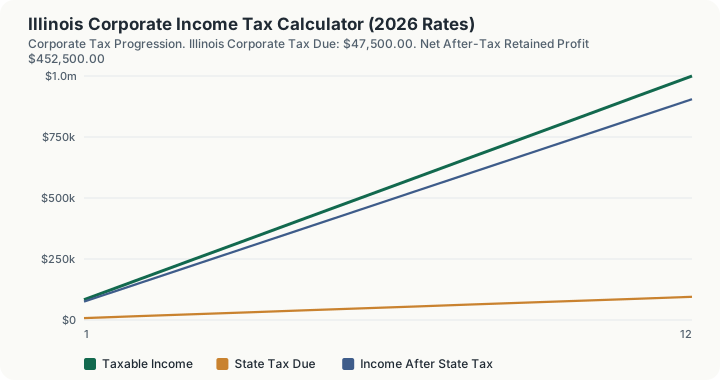
Quick Answer: On $500,000 of pre-apportioned taxable income, Illinois's flat 9.50% corporate income tax rate produces $47,500.00 in state tax due and $452,500.00 in net after-tax profit.
Nine and a Half Percent, Counted as One
Among all 50 states in this dataset, only Minnesota's 9.80% flat rate tops Illinois's 9.50%, making Illinois's corporate income tax rate the second-highest of any state that taxes corporate profit, flat or graduated. It's more than four times North Carolina's 2.00% rate and well above every other state in the Midwest.
Illinois applies the 9.50% rate uniformly to all apportioned C-corporation income, with no bracket thresholds to plan around. For companies weighing an Illinois presence against neighboring Midwestern states like Indiana (4.90%) or Michigan (6.00%), the gap in corporate income tax burden is substantial and represents one of the more significant regional rate differentials in the country.
Illinois's 9.50% rate turns the calculator's $500,000 baseline into $47,500.00 of state tax, nearly five times what the identical income would generate in Missouri at 4.00%. That gap widens in absolute dollar terms as income grows, since both rates are flat.
How This Is Calculated
Illinois quotes 9.50%, and that single number is actually two taxes stacked: a 7.00% corporate income tax plus a 2.50% personal property tax replacement income tax, reported on the same return. The distinction matters because the replacement tax reaches entities the income tax does not, including partnerships and S corporations, which pay it at a lower rate on Illinois income.
- The entered income is the base. No apportionment, no unitary combination, no Illinois additions or subtractions, and no capped net operating loss deduction is performed here.
- Apply 9.50% as a single flat rate. This is important to read literally: the engine holds one bracket at 0.095 and multiplies. It does not compute the 7.00% income tax and the 2.50% replacement tax separately, and it cannot show you the split, even though Illinois assesses them as two taxes on the same base.
- Subtract credits, floored at zero.
- Effective rate. Net tax divided by entered income.
- Net retained profit. Entered income minus net tax.
- Twelve tiers. The same multiplication at incomes from one sixth of your figure to twice it.
Worked Example
Using this calculator's baseline scenario: a corporation with $500,000 in taxable income apportioned to Illinois.
- Start with apportioned taxable income. The corporation has already apportioned $500,000 of its total taxable income to Illinois using the state's statutory apportionment formula, before any state-level tax is applied.
- Apply Illinois's flat statutory rate. Illinois taxes all C-corporation income at a single flat rate of 9.50%, regardless of income size, so no bracket lookup is required: $500,000 × 9.50% = $47,500.00.
- Illinois corporate tax due: $47,500.00.
- Net retained profit. Subtracting the state tax liability from taxable income leaves $500,000 − $47,500.00 = $452,500.00 in after-tax profit retained by the corporation, before any separate federal tax liability is applied.
Because Illinois uses a single flat rate rather than graduated brackets, the 9.50% effective rate is identical to the marginal rate at every income level: a corporation earning $50,000 and one earning $50 million both face the same 9.50% state rate on their apportioned income.
The Highest Combined Rate in This Set, Priced
At 9.50% Illinois charges more per dollar of apportioned income than any other state on this page's family, and the tier table applies that single rate to twelve income levels without a step anywhere.
Two rungs. Row 3 sets income at $250,000.00 and returns $23,750.00. Row 6, the $500,000 baseline, returns $47,500.00. Row 12 doubles to $1,000,000.00 and returns $95,000.00. The effective rate reads 9.50% at every rung, because one open bracket cannot produce anything else.
The marginal figure. Each additional $1,000 of Illinois apportioned income costs $95.00, the highest marginal cost per thousand in this family. The engine returns $47,595.00 at $501,000 against $47,500.00 at $500,000. The same $1,000 costs $55.00 in Florida and $51.90 in Georgia.
The reverse question. An Illinois company capping state tax at $25,000 can carry only $263,157.89 of apportioned income, where the engine returns exactly $25,000.00 and $238,157.89 retained. That ceiling is $24,198.43 lower than Delaware's at 8.70% and less than 55% of Florida's, which is the clearest single expression of what the 9.50% rate costs.
Credit against deduction, priced. A $25,000 Illinois credit takes the liability from $47,500.00 to $22,500.00, saving $25,000.00. Removing $25,000 from the base returns $45,125.00, saving $2,375.00. The credit is worth $22,625.00 more, and the 10.5 to 1 ratio is the narrowest in this family precisely because the rate is the highest.
The split this page cannot show you. The 9.50% is two taxes: a 7.00% corporate income tax and a 2.50% personal property tax replacement income tax, assessed on the same base and reported together. The engine holds a single 0.095 rate and has no way to attribute the $47,500.00 above between them. That matters because the replacement tax reaches partnerships and S corporations at a lower rate while the income tax does not reach them at all, and this calculator has no entity type input to express the difference. Illinois's annual dollar cap on net operating loss deductions is likewise outside the code path, as is unitary combination and single sales factor apportionment.
What This Does Not Account For
- Federal corporate income tax (21% under IRC § 11).
- Specialized gross receipts taxes (e.g. Ohio CAT, Washington B&O, Texas Franchise Tax) where applicable.
- Minimum entity franchise tax fees or annual report filing charges.
- Base Erosion and Anti-Abuse Tax (BEAT) or Global Intangible Low-Taxed Income (GILTI) provisions.
- Local municipal corporate earnings taxes (e.g. NYC General Corporation Tax).
Common Pitfalls
- Underestimating the Rate's Bite: Treating Illinois's 9.50% rate as roughly comparable to a typical state's flat rate, when it's actually more than double the median and second only to Minnesota nationwide.
- Improper Apportionment Sourcing: Applying market-based sourcing vs cost-of-performance rules incorrectly for service revenue apportioned to Illinois.
- Ignoring Unitary Group Combined Reporting: Failing to account for Illinois's mandatory combined return requirements across related entities.
- Neglecting State NOL Carryforward Caps: Overlooking Illinois's annual percentage limitations on net operating loss deductions, which carry outsized weight given the 9.50% rate applied to whatever base survives them.
Frequently Asked Questions
Does Illinois have a corporate income tax?
When are Illinois corporate tax returns due?
Does Illinois tax S-corporations and LLCs?
How is multi-state corporate income apportioned to Illinois?
Sources
- Illinois Department of Revenue: Corporate Tax Statutes and Guidance (2026). tax.illinois.gov
- Multistate Tax Commission (MTC): Uniform Apportionment and Allocation Guidelines. mtc.gov