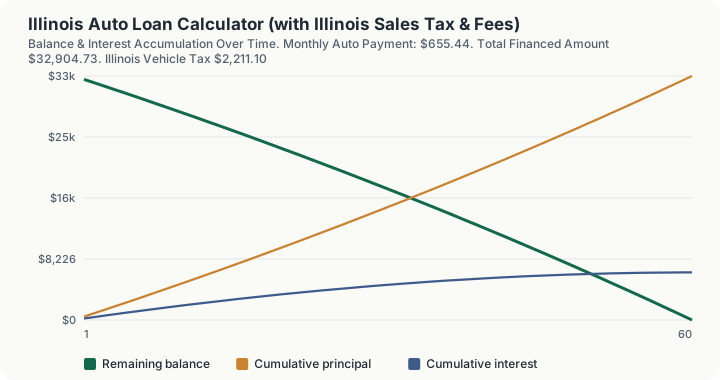
Quick Answer: A $35,000 vehicle in Illinois with $5,000 cash down, the capped $377.63 documentary service fee, a 60-month term, and a 7.25% APR carries a $655.44 monthly payment at the 6.25% state rate. That figure includes $2,211.10 of Illinois vehicle tax and $316.00 in title and registration fees, financing $32,904.73 in total.
Overview
Two things about Illinois car tax are widely misunderstood, and both of them move the number by thousands of dollars.
The first is the local rate. Chicago's general sales tax rate is 10.25%, and that number gets pasted into car payment estimates constantly. It is not the rate on a vehicle. Illinois home rule municipal and county retailers' occupation taxes generally do not apply to property that must be titled or registered with the State, which is exactly what a car is. What does apply is a separate structure: dealer sales are taxed at the state and non-home-rule local rate sourced to the dealer's location, and then home rule USE taxes are triggered by where you register the car. Cook County levies a 1% vehicle use tax on vehicles titled in the county, and the City of Chicago adds a further 1.25% Home Rule Use Tax on top of that for buyers inside city limits. Those two components are real. Using 10.25% instead is not.
The second is the trade-in cap, and here the confusion runs the other way. Illinois briefly capped the trade-in credit on first-division vehicles at $10,000 under Public Act 101-0031. That cap was repealed by Public Act 102-0353 effective 1 January 2022. The credit has been uncapped for years now, but calculators and dealer worksheets written during the cap era are still in circulation. On a $25,000 trade-in the difference between the old rule and the current rule is $937.50 in tax.
This calculator applies the 6.25% state rate to the selling price after an uncapped trade-in credit, includes the statutorily capped documentary service fee in the taxable base, and lets you add a home rule use tax rate if one applies to your registering address.
Auto Loan APR by Credit Score
The APR columns below are national averages, not Illinois figures. No primary source publishes average auto loan APR by state: Experian's report has no geographic cut, the CFPB publishes state origination volume but no rates, and the New York Fed publishes state delinquency only. The payment column is the part that is specific to Illinois, because it runs this calculator's own Illinois tax and fee rules at each tier's rate.
| Credit Tier | VantageScore 4.0 | Avg New APR | Avg Used APR | Est. Payment in Illinois |
|---|---|---|---|---|
| Super prime | 781-850 | 4.55% | 6.30% | $614.19 |
| Prime | 661-780 | 6.23% | 8.77% | $639.67 |
| Nonprime | 601-660 | 9.67% | 14.03% | $693.80 |
| Subprime | 501-600 | 13.44% | 19.42% | $756.12 |
| Deep subprime | 300-500 | 16.01% | 21.77% | $800.35 |
Payment assumptions: $35,000 vehicle price, $0 trade-in, $5,000 cash down, $378 dealer documentation fee, 60-month term, new-vehicle APR applied to the Illinois delivered price including tax and statutory fees. At the 6.39% overall new-car average the same purchase costs $642.12 a month.
The score bands are VantageScore 4.0, not FICO. The same borrower can land in a different tier under each model, so a FICO score pulled from a card issuer will not always match the band here. Source: Experian, State of the Automotive Finance Market, Q1 2026, slide 45.
What Moves Your Payment
Each row changes one input and leaves the rest at the baseline below. The dollar effects are this calculator's own output for Illinois, not a rule of thumb.
| Factor | What Changes | Effect on Monthly Payment | Effect on Total Interest |
|---|---|---|---|
| Vehicle Price | Each extra $1,000 of price raises both the amount financed and the sales tax base, so the tax rises with it. | +$21.17 | +$207.36 |
| Trade-In Allowance | A $1,000 allowance cuts the amount financed by $1,000 and reduces the sales tax base by the same amount, so it saves tax as well as principal. | -$21.16 | -$207.36 |
| Cash Down Payment | A $1,000 larger down payment cuts the amount financed by $1,000. It never reduces the sales tax, which is assessed on the price, not on what you borrow. | -$19.92 | -$195.16 |
| Dealer Doc Fee | A $100 higher documentation fee adds $100 to the amount financed and is inside the sales tax base, so it is taxed on top of itself. Illinois caps the fee at $378. | +$2.12 | +$20.74 |
| Longer Term | Stretching the same balance from 60 months to 72 months spreads the principal over twelve more payments at the same rate. | -$90.49 | +$1,350.03 |
Baseline: $35,000 vehicle price, $0 trade-in, $5,000 cash down, $378 documentation fee, 60 months at 7.25% APR, giving a $655.44 payment and $6,421.80 of total interest.
How This Is Calculated
Illinois pairs a 6.25% state rate with home rule vehicle use taxes that are set separately from the general sales tax rates quoted for Chicago. Four steps.
1. Net taxable selling price. 35 ILCS 120/1 defines "selling price" as the consideration for the sale, which includes the dealer's documentary service fee. The trade-in allowance comes off that total with no dollar limit.
2. Tax. The 6.25% state rate, plus any home rule vehicle use tax you enter:
3. Title and registration. A fixed $316.00, being the $165 certificate of title and the $151 annual standard passenger plate. Illinois has one of the highest title fees in the country. Neither charge is taxable when separately stated.
4. Amortization. The financed balance is the delivered price less the trade-in and the cash down, amortized as a fixed-rate installment loan:
where $P$ is the financed amount, $i$ is the monthly rate (APR ÷ 12), and $n$ is the term in months. Each period's interest is the outstanding balance times $i$, the remainder reduces principal, and the schedule reconciles to zero at maturity.
There is no metro rate table on this page. The general combined rates published for Chicago, Naperville, Rockford, and Springfield are not automotive rates, and no official Illinois Department of Revenue automotive rate table was available to confirm a verified combined figure per metro. Publishing the general rates would overstate every Chicago-area estimate by several points. Ask your dealer or county clerk what home rule use tax applies to your registering address, and enter it directly.
Worked Example
Illinois repealed its $10,000 trade-in credit cap on 1 January 2022, and rate guides still carry the old rule. The baseline runs at the state rate with the statutory documentary fee at its 2026 ceiling.
- Vehicle price: $35,000
- Trade-in allowance: $0
- Cash down: $5,000
- Documentary service fee: $377.63 (the 2026 statutory cap)
- Local home rule use tax: 0%
- Term: 60 months at 7.25% APR
Step 1 -- The taxable selling price. Documentary fee inside the base, trade-in deducted without limit: $35,000 + $377.63 - $0 = $35,377.63
Step 2 -- Illinois vehicle tax at 6.25%. $35,377.63 x 6.25% = $2,211.10
Step 3 -- Title and registration, outside the base. $165.00 title + $151.00 registration = $316.00
Step 4 -- Total delivered price. $35,000 + $377.63 + $2,211.10 + $316.00 = $37,904.73
Step 5 -- Amount financed. $37,904.73 - $0 trade-in - $5,000 cash down = $32,904.73
Step 6 -- The monthly payment. $32,904.73 at 7.25% over 60 months = $655.44
Step 7 -- Month 1. $32,904.73 x (7.25% / 12) = $198.80 interest, $456.64 principal, balance $32,448.09
Step 8 -- Month 2. $32,448.09 x (7.25% / 12) = $196.04 interest, $459.40 principal, balance $31,988.69. Cumulative interest: $394.84
Step 9 -- The accumulation. Interest through month 12 is $2,199.79 and the balance is $27,239.24. Total finance charge over 60 months: $6,421.80
Now the trade-in cap repeal, in numbers. A $10,000 trade-in drops the base to $25,377.63, cuts tax to $1,586.10, saves $625 in tax and brings the payment to $443.80. A $25,000 trade-in drops the base to $10,377.63, cuts tax to $648.60, and saves $1,562.50. Under the repealed $10,000 cap that second buyer would still have been limited to $625 of tax relief. The repeal is worth $937.50 to them.
If you register the vehicle inside Chicago and both the Cook County 1% and the Chicago 1.25% use taxes apply, the combined 8.5% raises tax on the same base to $3,007.10 and the payment to $671.30. That is $796 more tax than the state-only figure, and still far below what the 10.25% general rate would have implied.
What This Does Not Account For
- Private-party purchases. Illinois taxes those under a flat-dollar schedule on Form RUT-50, based on vehicle age and price bands, not a percentage of the price. A percentage model is simply the wrong shape for a private sale. There is also no trade-in deduction on RUT-50 transactions.
- The exact home rule use tax for your address. The calculator accepts a rate; it does not look one up. Cook County's 1% and Chicago's additional 1.25% are the two components documented in the source table, but the full combined automotive rate including any non-home-rule local retailers' occupation tax at the dealer's location is not verified here.
- The Chicago city vehicle sticker and local wheel taxes. These are annual charges levied by municipalities separately from the purchase tax, and they are not part of the amount financed.
- Chicago and Cook County transaction and lease taxes, which are separate levies outside the purchase tax model.
- EV registration surcharge. Illinois adds roughly $100 per year for an electric vehicle on top of the $151 plate, which is not in the fee total here.
- GAP insurance, service contracts, and aftermarket accessories, unless you fold them into the vehicle price yourself.
Common Pitfalls
- Using Chicago's 10.25% general rate on a car. This is the single most expensive mistake in Illinois car math. Home rule retailers' occupation tax does not reach titled property. Applying 10.25% to a $35,377.63 base overstates the tax by more than $1,400 against the state-only figure.
- Believing the $10,000 trade-in cap still exists. It was repealed effective 1 January 2022 by PA 102-0353. Any source that still describes it is describing law from 2019 to 2021.
- Expecting to negotiate the doc fee. In most states this is a live negotiation. In Illinois the fee is capped by statute and virtually every dealer charges the cap exactly, so the realistic outcome is $377.63, not zero. The cap is CPI-indexed and rises most Januaries.
- Forgetting the doc fee is taxable. At the 6.25% state rate the $377.63 fee carries $23.60 of its own tax, making it $401.23 delivered.
- Underestimating title fees. At $165, Illinois charges roughly ten times what several neighbouring states do for a certificate of title. With the $151 plate that is $316 of fees before any tax.
- Rolling negative equity forward. If you owe more than the trade is worth, the shortfall is added to the new loan. It raises the principal and the total interest, and it does not increase your tax credit, which is based on the allowance rather than your equity.
- Judging the loan by payment alone. Stretching this $32,904.73 balance from 60 to 72 months drops the payment to $564.95 but raises total finance charges from $6,421.80 to $7,771.79.
Frequently Asked Questions
What is the sales tax rate on a car in Illinois?
Is the car tax in Chicago really 10.25%?
Is the Illinois trade-in tax credit still capped at $10,000?
How much can an Illinois dealer charge for a doc fee?
What are Illinois title and registration fees?
How is tax calculated on a car bought from a private seller in Illinois?
Sources
- Illinois Department of Revenue, Vehicle Tax Information FAQ. tax.illinois.gov
- 815 ILCS 505/2Z and 625 ILCS 5/5-102 (documentary service fee cap and CPI indexation); 2026 maximum of $377.63 as reported by the Illinois Automobile Dealers Association. bls.gov/cpi
- Consumer Financial Protection Bureau, Truth in Lending Act (Regulation Z, 12 CFR § 1026.22) disclosure requirements for installment credit. ecfr.gov/current/title-12/chapter-X/part-1026
Also consulted: 35 ILCS 120 (Retailers' Occupation Tax Act), including 35 ILCS 120/1 definition of "selling price"; Public Act 102-0353 (repeal of the $10,000 first-division trade-in credit cap, effective 1 January 2022), repealing the cap enacted by Public Act 101-0031; 625 ILCS 5/3-1001 (vehicle use tax) and 35 ILCS 105/3-10 (private-party flat-dollar schedule, Form RUT-50); Illinois Secretary of State, vehicle services basic fee schedule (title and registration); Experian, State of the Automotive Finance Market, Q1 2026, slide 45 (average new and used auto loan APR by VantageScore 4.0 credit tier; national, no state level cut published).