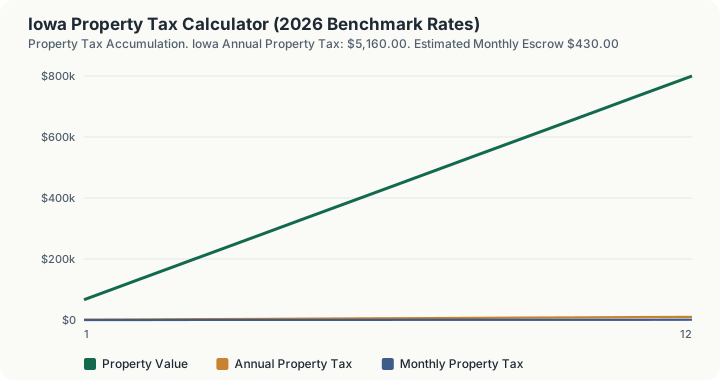
Quick Answer: A $400,000 home in Iowa carries an estimated $5,160.00 in annual property tax at the state's 1.29% effective rate, or about $430.00 a month.
Ninth in the Country, and a Rate That Never Bends
The average effective property tax rate across Iowa is 1.29%, among the ten highest effective property tax rates in the country and good for #9 nationally. That's modestly above the national average of roughly 1.0%. Within the Midwest, where the average effective rate runs near 1.35%, Iowa actually sits just under the regional norm, even with a top-ten national ranking.
Like its neighbors elsewhere in the Midwest, Iowa relies on property tax as the primary funding mechanism for public schools, emergency services, and county infrastructure, with local taxing authorities setting the actual millage each year.
County assessors in Iowa carry out the periodic valuations that feed into the millage calculation, and the exemption and appeal process outlined further down this page is the practical way an individual owner can influence the final number on next year's bill rather than simply accepting the county's first estimate.
How This Is Calculated
Iowa's rollback is the mechanism that matters. A statewide assessment limitation is recalculated every year and reduces the share of residential market value that can be taxed, keeping statewide residential growth within a statutory limit. Your assessment can rise while the taxable portion of it falls.
None of that detail is asked for here. This calculator works one level up, applying Iowa's average effective property tax rate of 1.29% to the value you enter. That rate is the ratio of property taxes actually paid to home value across the state, so the assessment ratios, caps, and exemptions described above are already baked into it.
Steps 1 and 2 are what an Iowa assessor does; the calculator does neither. There is no rollback percentage anywhere in this code path. Steps 3 to 5 describe the computation you are looking at.
- Start from the assessed market value. Assessors revalue in odd-numbered years.
- Apply the rollback and exemptions. The rollback percentage converts assessed value to taxable value, and the homestead credit and military exemption then reduce it further.
- Multiply by the effective rate. At 1.29%, a $400,000 home in Iowa comes to $5,160 a year before any exemption you enter above.
- Divide by twelve for escrow. That same home works out to $430.00 a month set aside in a mortgage escrow account.
- Compare it against your own bill. Because the rollback is set statewide, a fast-appreciating county sees more of its growth taxed than a flat one does. Your county's number is the one that governs; this figure tells you whether it is roughly where an Iowa home of that value ought to land.
Worked Example
Using this calculator's baseline inputs: a $400,000 home in Iowa, taxed at the state's 1.29% average effective rate (rank #9 of 50 states).
- Start with the assessed value. The home is assessed at its full $400,000.00 market value, with no homestead exemption applied in this baseline scenario.
- Apply the effective rate. $400,000.00 × 1.29% = $5,160.00 in annual property tax, Iowa's statewide average effective rate.
- Convert to a monthly escrow. Lenders typically collect property tax in twelve equal installments alongside principal and interest: $5,160.00 ÷ 12 = $430.00 per month.
- Project a five-year hold. At a flat rate, five years of ownership totals $5,160.00 × 5 = $25,800.00, before any reassessment, exemption change, or millage increase.
At 1.29%, Iowa carries one of the heaviest property tax burdens in the country, ranking #9 of 50 states: a real cost to weigh against the purchase price.
What Changes as the Value Column Climbs
The reverse question first, because Iowa's rate makes it bite. At 1.29%, a $250 monthly escrow line supports an Iowa home worth $232,558; the calculator returns $3,000.00 a year and $250.00 a month on that value. The same $250 buys $405,405 of house in Indiana and $566,038 in Louisiana. Iowa's ninth-place rate is a purchase-price constraint before it is a tax bill.
The sweep. Twelve rows run value from $66,666.67 to $800,000.00 and annual tax from $860.00 to $10,320.00, through $5,160.00 at the $400,000 row. The monthly column runs $71.67 to $860.00. There is no bend in it anywhere.
Marginal cost of the next unit. Each additional $10,000 of value costs $129.00 a year, each $100,000 costs $1,290.00, and moving the entry from $400,000 to $410,000 shifts the bill from $5,160.00 to $5,289.00. The increment does not change with value, which is the whole content of "flat effective rate".
What Iowa's rollback does to that, and why it is not here. Iowa recalculates a statewide assessment limitation each year that reduces the taxable share of residential market value, so an Iowa owner's assessment can rise while the taxed portion of it falls. No rollback percentage exists in this code path. calculateStatePropertyTax reads a single 1.29% figure for Iowa and multiplies by the value you enter. The rollback is inside that average historically, in the sense that the 1.29% is a ratio of taxes actually paid to home value, but the calculator cannot apply this year's rollback to your house and does not try.
Headline against table, with a credit entered. Put $50,000 in the exemption field against the $400,000 default and the headline drops to $4,515.00 while the table's $400,000 row stays at $5,160.00. The exemption reaches the headline only. Similarly, the effective-rate output continues to read 1.29% whether or not an exemption is applied, because it reports Iowa's statewide rate rather than your own ratio.
Right rate against wrong rate. Applying a county's consolidated levy rate to full market value overstates an Iowa bill substantially, because the levy is extended against rolled-back taxable value rather than market value. The 1.29% used here is already a paid-tax-to-market-value ratio, so it is the figure that is comparable to your own bill divided by what the house is worth, and it is not comparable to anything printed on a levy sheet.
What This Does Not Account For
- Specific hyper-local county and municipal millage district variations within Iowa.
- Special assessment district charges. Iowa cities can levy special assessments against benefiting parcels for street, sidewalk, sewer, or water improvements on top of the base county and school millage.
- Commercial vs residential assessment classification differentials.
- Property tax appeal reductions or localized board of equalization adjustments.
Common Pitfalls
- Confusing Market Fair Value with Assessed Basis: Some jurisdictions assess property at fractional ratios rather than 100% of market value.
- Failing to File Homestead Paperwork: Homestead exemptions are rarely automatic; homeowners must file timely paperwork with the county appraisal district.
- Underestimating Post-Sale Supplemental Assessments: Purchasing a newly constructed or reassessed property often triggers catch-up supplemental tax bills.
- Ignoring Property Tax Appeal Windows: Missing the annual 30-to-60 day statutory protest window forfeits the right to challenge over-assessed property values for that tax year.
Frequently Asked Questions
How high are property taxes in Iowa?
When are property taxes due in Iowa?
How can I lower my property taxes in Iowa?
Does purchasing a home trigger a property tax reassessment?
Sources
- U.S. Census Bureau: American Community Survey (ACS) Real Estate Assessment Benchmark Data. census.gov/programs-surveys/acs
- Iowa Department of Revenue, Local Government Services Division: Assessment Ratio Manuals. revenue.iowa.gov