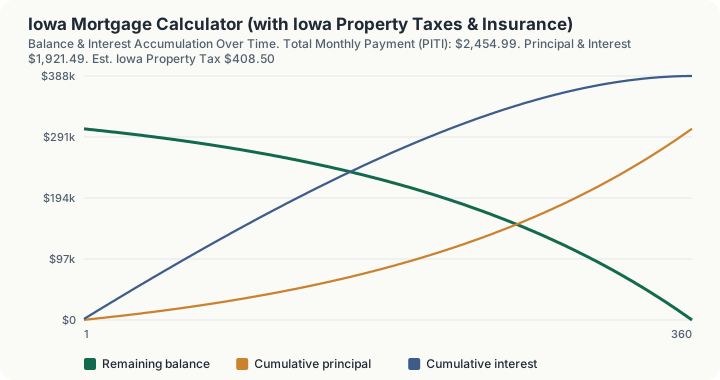
Quick Answer: On a $380,000 Iowa home with 20% down and a 6.5% rate, expect a total monthly payment (PITI) of about $2,454.99, including roughly $408.50 a month in Iowa property tax.
Overview
Iowa carries one of the higher property tax burdens in the country, and this calculator is built around that reality rather than glossing over it. The Iowa Department of Revenue's assessment limitation system (commonly called "rollback") and county-level levy structures produce a statewide effective residential rate that regularly lands near the top of national rankings, close to 1.29% of market value on average, which is the figure this calculator applies to estimate your Iowa property tax line. That is roughly double the effective rate in a low-tax neighbor like Indiana on an identically priced home.
The reason Iowa's rate runs high traces back to its local government funding structure: cities, counties, school districts, and assorted special-purpose districts (drainage, hospital, agricultural extension) all levy against the same assessed value, and Iowa relies more heavily on property tax relative to income or sales tax than many states do. The state's "rollback" mechanism partially offsets rising assessed values statewide, but it does not change the underlying levy math city by city, so actual effective rates still vary by county, with places like Polk County (Des Moines) and Linn County (Cedar Rapids) often running close to or above the statewide average.
This calculator models a standard 30-year fixed mortgage on the loan principal, then layers Iowa's property tax reality and a flat homeowners insurance estimate on top, producing a PITI figure that reflects what actually leaves an Iowa homeowner's account monthly rather than a stripped-down principal-and-interest quote.
How This Is Calculated
- Down payment and loan principal. Down payment cash is the home price times your chosen down payment percentage. Loan principal is home price minus that cash amount.
- Monthly principal and interest (P&I). The loan principal, annual interest rate, and a 360-month (30-year) term feed a standard amortization formula: monthly payment = P × [i(1+i)^n] / [(1+i)^n − 1], where P is the loan principal, i is the monthly interest rate (annual rate ÷ 12), and n is 360 total payments.
- Monthly Iowa property tax. Home price × 1.29% ÷ 12, reflecting Iowa's statewide effective average rate after rollback adjustments.
- Monthly insurance. A flat $125 placeholder for hazard/homeowners insurance, since actual premiums vary by carrier, home age, roof condition, and claims history.
- Total monthly payment (PITI). Monthly P&I plus monthly property tax plus monthly insurance.
- Full amortization schedule. The engine generates all 360 monthly line items, tracking interest and principal at every payment, so total interest paid reconciles exactly against the sum of every period's interest.
Worked Example
Using the calculator's default inputs: - Home Purchase Price: $380,000 - Down Payment: 20% ($76,000 cash) - Interest Rate: 6.5% APR, 30-year fixed
Step by step: 1. Loan principal = $380,000 − $76,000 = $304,000. 2. Monthly interest rate = 6.5% ÷ 12 = 0.5417% per period. 3. Monthly principal and interest on $304,000 over 360 payments at that rate = $1,921.49 (this is the verified test vector the calculator's engine reconciles against). 4. Monthly Iowa property tax = $380,000 × 1.29% ÷ 12 = $4,902 ÷ 12 = $408.50. 5. Monthly insurance placeholder = $125.00. 6. Total monthly payment (PITI) = $1,921.49 + $408.50 + $125.00 = $2,454.99. 7. Over the full 360-month term, cumulative interest paid on the $304,000 loan comes to just over $387,733, the difference between total lifetime payments (360 × $1,921.49) and the original principal.
Compare that $408.50 monthly tax bite to the same home in a lower-tax state and the gap is stark: Iowa's property tax component alone is nearly double what an equivalently priced Indiana or Kentucky home would carry, which materially changes how much house an Iowa buyer can qualify for under standard debt-to-income guidelines.
What This Does Not Account For
- Private mortgage insurance (PMI). Down payments under 20% typically trigger PMI, which is not added to the PITI total here.
- County and school district levy variance. Iowa's 1.29% figure is a statewide effective average; Polk, Linn, Johnson, and Scott counties often diverge from it due to differing city, school, and special-district levies.
- The rollback percentage's year-to-year movement. Iowa's assessment limitation ("rollback") percentage is recalculated annually by the Department of Revenue and can shift the effective rate slightly from year to year.
- Homestead and military exemptions. Iowa offers a homestead tax credit and other exemptions that reduce taxable value for qualifying owner-occupants; this calculator does not model those credits.
- Closing costs and title insurance. Typically 2% to 4% of the loan amount in Iowa, not reflected here.
- Special assessments. Drainage district and other special-purpose levies that appear on some rural Iowa parcels are excluded.
Common Pitfalls
- Underestimating how much Iowa's tax rate changes affordability. A buyer moving from a lower-tax state often qualifies for less home in Iowa than the same income would support elsewhere, purely because of the property tax component of PITI.
- Confusing assessed value with market value. Iowa's rollback percentage means assessed (taxable) value is often meaningfully lower than market value, but the levy rate applied to that reduced base can still produce a similar or higher effective tax than a state with a lower nominal rate.
- Forgetting to apply for the homestead credit. Iowa owner-occupants who fail to file for the homestead tax credit with their county assessor pay more than necessary.
- Assuming county rates are uniform statewide. Effective rates in Iowa vary meaningfully by county and even by school district within a county; the 1.29% figure is a planning average, not a quote.
- Ignoring the semi-annual due dates. Iowa property taxes are typically due in two installments, September 1 and March 1, and are paid in arrears (the bill due in a given fall covers the prior fiscal year), which can confuse first-time Iowa buyers reconciling their escrow account.
Frequently Asked Questions
Why is Iowa's property tax rate higher than most states?
What is Iowa's property tax "rollback" and how does it affect this calculator?
When are Iowa property taxes due?
Does a bigger down payment reduce my Iowa property tax?
How much does the Iowa property tax difference affect my monthly payment compared to a lower-tax state?
Sources
- Iowa Department of Revenue: Property assessment limitation ("rollback") annual determinations. revenue.iowa.gov
- Consumer Financial Protection Bureau (CFPB): Regulation Z (Truth in Lending Act) disclosure requirements for mortgage APR. ecfr.gov/current/title-12/chapter-X/part-1026
- Federal Reserve Economic Data (FRED): 30-year fixed mortgage rate historical benchmarks. federalreserve.gov
Also consulted: Iowa Code Chapter 441 (assessment) and Chapter 445 (property tax collection).