Quick Answer: At the default inputs ($240,000 at 5.75% with 300 months left, refinanced into $306,000 at 6.75% over a fresh 360 months with 2% closing costs rolled in) the $60,000 of released equity must earn 11.84% a year to break even. That is 5.09 percentage points above the new note rate. Deployed at the assumed 8%, the refinance destroys $16,303.43 of value.
What does this calculator do?
The standard way people evaluate a cash-out refinance is to compare the new interest rate against the return they expect from the money. If the note is 6.75% and the money can earn 8%, the reasoning goes, the spread is positive and the deal works.
That comparison is wrong twice over.
The new rate is charged on the whole balance, not on the cash. Refinancing $240,000 at 5.75% into $306,000 at 6.75% does not cost 6.75% on the $60,000 released. It also costs an extra one percentage point on the $240,000 that was already there, and on this loan that repricing costs more than the interest on the cash itself.
Refinancing resets the amortisation clock. A loan five years into a thirty-year term, re-amortised over a fresh thirty, repays principal far more slowly per dollar of payment. At any future date the borrower's balance is higher for that reason alone, entirely separately from the rate.
This calculator prices the released cash as an incremental cash flow stream and takes its internal rate of return. That is the number the decision actually turns on, and it is routinely several points above the note rate.
How is this calculated?
The incremental stream is:
CF₀ = +net cash received, CF_1..n = −Δ payment, CFₙ − = extra balance at the horizon
and the break-even return is that stream's IRR, annualised:
r_annual = (1 + IRR_monthly)¹² − 1
Step 1: Price the existing payment. Solve the level payment that retires the current balance over the months remaining at the current rate.
Step 2: Build the new loan. Add the cash-out to the current balance. Closing costs are quoted as a percentage of that pre-cost figure.
Step 3: Settle the closing costs. Rolled in, they are added to the new balance and the borrower still receives the full cash-out. Paid at the table, the balance stays lower and the cash in hand is reduced instead.
Step 4: Price the new payment over the new term at the new rate.
Step 5: Take the difference. New payment less old payment is the monthly incremental outflow.
Step 6: Amortise both loans and read the remaining balance of each at the analysis horizon. The difference is the extra debt the refinance leaves behind.
Step 7: Assemble the stream: cash received at time zero, the payment increase every month, and the extra balance as a lump at the horizon. Where the old loan would have been paid off before the horizon, the whole new payment becomes incremental from that point.
Step 8: Solve for the IRR and compound it to an annual figure. That is the break-even return.
Step 9: Discount the same stream at the assumed deployment return to get the net present value, and compare the break-even against the assumed return for the verdict.
Worked Example
$240,000 at 5.75%, 300 months left. Take out $60,000 at 6.75% over 360 months, 2% closing costs rolled in, ten-year horizon, cash deployed at 8%.
Step 1: The current monthly payment. PMT($240,000, 5.75% / 12, 300 months) = $1,509.86
Step 2: The pre-cost new loan. $240,000 + $60,000 = $300,000
Step 3: Closing costs at 2%. $300,000 x 2% = $6,000
Step 4: The new loan amount, costs rolled in. $300,000 + $6,000 = $306,000
Step 5: Cash actually received. Because the costs were financed, the borrower still walks away with $60,000
Step 6: The new monthly payment. PMT($306,000, 6.75% / 12, 360 months) = $1,984.71
Step 7: The monthly payment increase. $1,984.71 - $1,509.86 = $474.85
Step 8: Total extra payments over ten years. $474.85 x 120 = $56,982.00
Step 9: Balance at the horizon if you do nothing. The old loan, 120 months further along its 300-month schedule: $181,819.74
Step 10: Balance at the horizon after refinancing. The new loan, 120 months into 360: $261,021.11
Step 11: The extra debt still owed. $261,021.11 - $181,819.74 = $79,201.37
Note that figure. The balance rose by $66,000 at closing, yet the gap at year ten is $79,201.37. The extra $13,200 is the amortisation reset alone.
Step 12: Total nominal cost of the cash. $56,982.00 + $79,201.37 = $136,183.37
Step 13: The break-even return. The IRR of (+$60,000; -$474.85 x 120; -$79,201.37 at month 120), annualised: 11.84%
Step 14: The spread over the note rate. 11.84% - 6.75% = 5.09 percentage points
Step 15: Value at the assumed 8% return. Discounting the same stream at 8%: -$16,303.43
$60,000 of cash, nominally costing $136,183.37 over a decade, needs 11.84% to justify itself. Eight percent is not close.
How the Cost Builds Over the Ten Years
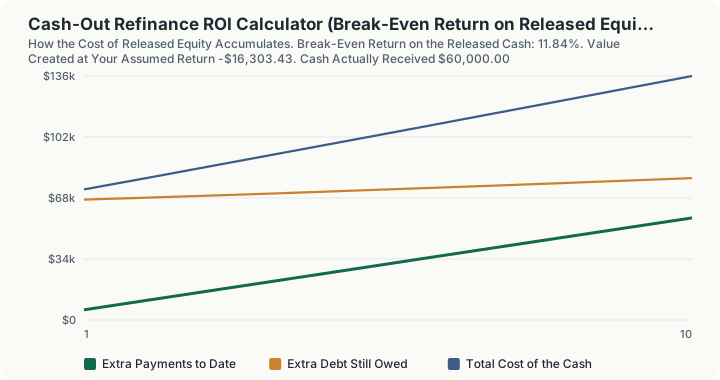
The $136,183.37 in step 12 is a terminal figure, and terminal figures hide their own timing. The schedule breaks it into the two components and shows how each one moves.
Step 16: Year 1. Extra payments to date $5,698.20, extra debt still owed $67,172.79, total cost of the cash $72,870.99
Step 17: Year 2. Extra payments $11,396.40, extra debt $68,380.26, total cost $79,776.66
Step 18: The cost added in year two. $79,776.66 - $72,870.99 = $6,905.62
Step 19: Year 5, the midpoint. Extra payments $28,491.00, extra debt $72,206.48, total cost $100,697.48
Step 20: Year 10. Extra payments $56,982.00, extra debt $79,201.37, total cost $136,183.37
Look at what does and does not grow. Extra payments accumulate in a straight line at $5,698.20 a year, but the extra debt barely moves, from $67,172.79 to $79,201.37 across a decade. The refinance is expensive on day one and then charges roughly $6,900 to $7,150 a year to stay expensive. That front-loading is why a shorter holding period is worse, not better: at year one the borrower has already absorbed $72,870.99 of the eventual $136,183.37, so selling early recovers almost none of it.
What does this calculator not account for?
- Tax is entirely absent. Mortgage interest deductibility, the tracing rules that determine whether interest on cash-out proceeds is deductible at all, and tax on the returns earned by the deployed cash are all outside this model. All figures are pre-tax.
- The deployment return is treated as certain. An 11.84% hurdle met by a risky 12% expected return is not a good trade, because the debt is certain and the return is not. The calculator prices the debt correctly and says nothing about the risk on the other side.
- No mortgage insurance. Cash-out refinances frequently push the loan-to-value ratio past the point where PMI attaches, and that cost is not modelled.
- Rate and payment are assumed fixed. An adjustable-rate new loan, a temporary buydown or a prepayment penalty on the existing note would all change the stream.
- No cash-out limits or seasoning rules. Lenders cap the loan-to-value on cash-out refinances and require ownership seasoning. The calculator will happily compute a loan no lender would write.
- Closing costs are a single percentage. Real closing costs are a stack of fixed and variable line items, and on a small loan the fixed portion dominates.
- The horizon is a settlement point, not a sale. The model assumes the position is squared up at the horizon by paying off the extra balance. Selling earlier or later changes the answer.
What mistakes do people make with this?
Comparing the deployment return to the note rate. This is the error the page exists for. The note rate understates the cost of the released equity by 5.09 percentage points at the defaults, and the gap widens the larger the existing balance is relative to the cash taken.
Thinking a lower payment means a cheaper loan. Stretching a loan back out to thirty years can reduce the payment even while raising the rate. The payment falls; the cost rises.
Ignoring the amortisation reset because it does not show up in the payment. It shows up in the balance. At the defaults it is $13,200 of the $79,201.37 debt gap at year ten, and it costs nothing visible each month.
Rolling in closing costs and calling them free. Financing $6,000 of costs at 6.75% over thirty years means paying interest on them for thirty years. The calculator lets you switch to paying at the table and shows the cash in hand falling instead.
Using a short horizon to flatter the deal. A shorter horizon reduces the total payment increase but concentrates the extra balance, and it usually raises the break-even rather than lowering it. Refinancing at the same rate with no term reset and no closing costs, the break-even collapses to roughly the note rate itself, which is the sanity check that the method is behaving.
Frequently Asked Questions
Why is the break-even so much higher than my new interest rate?
Does keeping my original payoff date fix the problem?
What break-even should I be looking for?
Is it cheaper to pay closing costs at the table?
What if the rate does not go up at all?
Sources
- Consumer Financial Protection Bureau, "What is a loan-to-value ratio and how does it relate to my costs?" consumerfinance.gov/ask-cfpb/what-is-a-loan-to-value-ratio-how-does-it-relate-to-my-costs-en-121
- Consumer Financial Protection Bureau, Buying a house. consumerfinance.gov/owning-a-home
Also consulted: Level-payment solution and present value: the annuity formulation in the engine's time-value-of-money primitive (engine/primitives/tvm.ts); Monthly amortisation with interest accrued on the opening balance: engine/primitives/amortization.ts; Internal rate of return and net present value on the incremental stream: engine/primitives/npv-irr.ts; Incremental cash-flow construction and the break-even derivation: engine/primitives/cash-out-refinance.ts.
This calculator contains no statutory data. The mathematics are standard: The incremental-stream framing is the standard corporate-finance treatment of an incremental financing decision, applied here to a household balance sheet: value the difference between two worlds, not the headline terms of one of them.