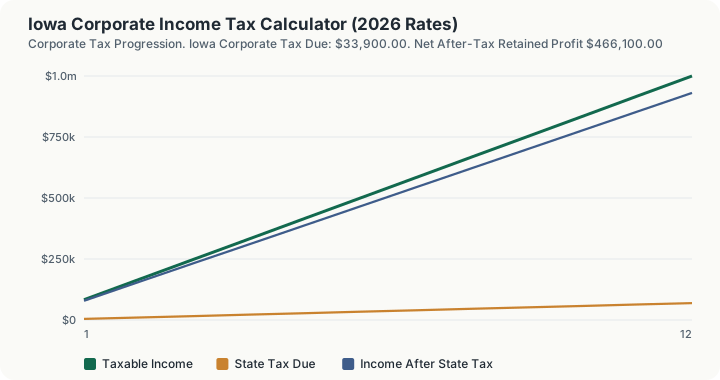
Quick Answer: On $500,000 of pre-apportioned taxable income, Iowa's two-bracket corporate schedule, 5.50% on the first $100,000 and 7.10% on everything above it, produces $33,900.00 in state tax due, a 6.78% effective rate, and $466,100.00 in net after-tax profit.
Overview
Iowa is one of the few remaining states that still runs a graduated corporate income tax, and the reason is worth understanding before you model a number. For tax years beginning in 2026, Iowa taxes the first $100,000 of apportioned corporate taxable income at 5.50% and every dollar above $100,000 at 7.10%. There is no third tier: the schedule tops out at 7.10%, so the marginal rate stops moving once a return clears $100,000.
That two-rate schedule is not a permanent design choice, it is a snapshot of a rate that is still falling. House File 2317, signed March 1, 2022, built an automatic ratchet into Iowa Code: whenever net corporate income tax receipts for a fiscal year exceed $700 million, the Department of Management must calculate the rates that would have raised exactly $700 million that year, and those become the rates for tax years beginning the following January 1. The ratchet fires only downward, and it keeps firing until Iowa lands on a single flat 5.50% for all corporate income. The 9.80% top rate Iowa carried in 2021 has already been walked down to 7.10% through this mechanism. The Department of Revenue's October 2025 rate order held the 2026 rates level with 2024 and 2025, meaning the trigger did not fire for the most recent measurement year.
The practical consequence for planning: unlike a flat-rate state, Iowa's effective rate is a moving target that rises with income and converges on 7.10%. At the calculator's $500,000 baseline the blended effective rate is 6.78%; at $5 million it is 7.07%; at $50 million it is essentially 7.10%. The $100,000 first bracket is real money only for genuinely small filers, it is worth a maximum of $1,600 in tax savings ($100,000 × the 1.60-point spread) no matter how large the corporation gets.
How This Is Calculated
Iowa spent several years cutting a top rate that once approached 12%, and the 2026 schedule is down to two brackets, 5.50% on the first $100,000 and 7.10% above it. Because Iowa is graduated, the calculation is a bracket walk rather than a single multiplication, and the effective rate a filer actually pays sits below 7.10% at every income level.
where $c_i$ are the bracket ceilings ($100{,}000$, then unlimited) and $r_i$ the corresponding rates ($5.50\%$, $7.10\%$).
- Read the income field as the taxable base. The single income input is taken as Iowa taxable corporate income exactly as typed. The code applies no modification, allocation or deduction to it before the rate stage; it is the base.
- Walk the bracket schedule slice by slice. Each band is charged only on the income that falls inside it and the pieces are summed: 5.50% on the slice from $0 to $100,000 ($100,000 of the entered income, $5,500.00); 7.10% on the slice from above $100,000 ($400,000 of the entered income, $28,400.00). On $500,000 that totals $33,900.00.
- Subtract credits and floor the result at zero. The credits field is subtracted from the step-2 figure and the difference is clamped at $0.00, so no credit entry can drive the liability negative. With the field at its $0 default the $33,900.00 stands; enter $14,000 of credits and the page returns $19,900.00, a reduction of exactly the credit entered because the subtraction is a straight one.
- Derive the reported rates from those two numbers. The effective rate is the tax divided by the income entered, 6.78% here, and the top statutory bracket is reported separately as 7.10%. Net after-tax retained profit is the income less the tax, $466,100.00. Those four outputs are the whole of what the engine produces.
Worked Example
Take the calculator's baseline: a corporation with $500,000 of taxable income apportioned to Iowa. Because the schedule is graduated, this is a two-step bracket walk, not one multiplication.
- Start with apportioned taxable income. $500,000 has already been apportioned to Iowa under the single sales factor, before any state-level tax is applied.
- Tax the first bracket. The first $100,000 is taxed at 5.50%: $100,000 × 5.50% = $5,500.00.
- Tax the second bracket. The remaining $400,000 ($500,000 − $100,000) is taxed at 7.10%: $400,000 × 7.10% = $28,400.00.
- Iowa corporate tax due: $5,500.00 + $28,400.00 = $33,900.00.
- Effective vs. marginal rate. $33,900 ÷ $500,000 = 6.78% effective, against a 7.10% marginal rate. The 0.32-point gap is entirely the benefit of that first bracket.
- Net retained profit. $500,000 − $33,900.00 = $466,100.00 retained after Iowa tax, before federal liability.
The single most common modeling error on Iowa returns is multiplying total income by 5.50% because that is the headline number in most "Iowa corporate tax rate" summaries. On this $500,000 base that shortcut understates the bill by $6,400, a 23% miss.
Filing Mechanics: Form, Deadlines & Estimated Payments
- Return: Iowa Form IA 1120, Iowa Corporation Income Tax Return.
- Due date: The last day of the fourth month following the close of the tax year, April 30 for calendar-year filers, not the April 15 date most states and the federal return use. This one-off deadline is a recurring source of missed-filing surprises for multistate filers.
- Extension: Iowa grants an automatic six-month extension with no form to file, conditioned on having paid at least 90% of the tax due by the original due date. Fall below 90% and the extension is void, exposing the return to failure-to-file penalty.
- Estimated payments: Required when Iowa corporate tax liability is expected to reach $1,000 or more, paid in four installments on Form IA 1120ES.
The $100,000 Bracket Edge, Priced
Iowa's schedule has exactly one boundary, and the calculator will walk you across it if you ask it to.
At $99,900 of apportioned income. Every dollar sits in the 5.50% band. The calculator returns $5,494.50, effective rate 5.50%, marginal rate 5.50%.
At $100,100, two hundred dollars later. $100,000 is taxed at 5.50% and $100 at 7.10%. The calculator returns $5,507.10, effective rate still 5.50% to two decimals, marginal rate now 7.10%.
The $200 step costs $12.60 rather than the $11.00 it would have cost inside the first bracket. At exactly $100,000 the tax is $5,500.00. Nothing re-rates: the first $100,000 keeps its 5.50% treatment permanently, which is why the effective rate creeps rather than jumps. That $1,600 first-bracket saving is the same $1,600 at $100,001 of income as at $50,000,000.
Marginal cost of the next unit, above the edge. Each additional $10,000 of Iowa income costs $710.00. Moving the baseline from $500,000 to $501,000 raises the tax from $33,900.00 to $33,971.00, exactly $71.00 for the extra $1,000.
The reverse question. How much can be earned before the 7.10% rate engages? $100,000, at a cost of $5,500.00. That is the only planning threshold on this page, and for a filer with meaningful Iowa nexus it is crossed in the first quarter. The more useful reverse figure is the convergence: at $5,000,000 the calculator returns $353,400.00 for an effective rate of 7.07%, and at $50,000,000 it returns $3,548,400.00 for 7.10%. The graduation is arithmetically real and economically negligible above about $1,000,000.
Reading the twelve-row sweep. The table runs apportioned income from $83,333.33 to $1,000,000.00. Tax runs $4,583.33 to $69,400.00. Row one is the only row that sits entirely inside the 5.50% band; from row two onward every row is a two-bracket walk, which is why the tax column grows faster than the income column. Row two, $166,666.67 of income, produces $10,233.33, which is 6.14% rather than 5.50%.
One thing the sweep does not do. The credits field is subtracted from the headline figure only. Enter $10,000 of Iowa credits against the $500,000 baseline and the headline drops from $33,900.00 to $23,900.00, with the effective rate falling to 4.78%, but every row of the twelve-row table still shows the pre-credit tax. compute builds the schedule from calculateStateCorporateTax directly and never applies the credit to it. Read the table as gross Iowa tax before credits.
What This Does Not Account For
- Federal Taxable Income Starting Point. Net corporate earnings are determined under IRC § 63 before Iowa modifications. This calculator starts one step later: the income box is read as the finished Iowa taxable figure and nothing is derived from a federal return.
- Iowa Additions & Subtractions. Iowa-specific adjustments are applied, including the state's bonus depreciation position and interest add-backs. No addback and no subtraction is computed anywhere in this page's code path, so enter an income figure that already reflects them.
- Apportionment Factor Allocation. Income is apportioned to Iowa using the state's single sales factor with market-based sourcing for receipts other than tangible personal property. The engine performs no apportionment of any kind. The word does not appear in the primitive this page binds to; the figure you type is taken as the Iowa figure and multiplied by the rate as it stands.
- Net Operating Loss (NOL) Deductions. Allowable Iowa NOL carryforwards are deducted before the bracket walk begins, this matters more in Iowa than in a flat state, because reducing income below ## What This Does Not Account For 00,000 changes the marginal rate, not just the base. No loss deduction is applied by this calculator. If a carryforward is available, subtract it yourself before entering the income.
- Federal corporate income tax (21% under IRC § 11).
- The Iowa franchise tax on financial institutions, which replaces the corporate income tax for banks and is levied under a separate schedule on Form IA 1120F.
- Iowa's alternate insurance premium taxes for insurance companies.
- Base Erosion and Anti-Abuse Tax (BEAT) or Global Intangible Low-Taxed Income (GILTI) provisions.
- Iowa property tax and the local option sales taxes that vary by jurisdiction; Iowa cities do not levy a separate municipal corporate income tax.
Common Pitfalls
- Applying 5.50% to the Whole Base: The single largest error on Iowa corporate projections. 5.50% is the first bracket and the eventual flat-rate destination, not the 2026 rate on income above $100,000.
- Assuming the Rate Will Fall Again Next Year: HF 2317's trigger is conditional on corporate receipts exceeding $700 million. It did not fire for TY2026. Modeling a scheduled glide path to 5.50% on fixed dates misreads how the statute works, there is no calendar, only a revenue test.
- Missing the April 30 Deadline: Iowa's due date is the last day of the fourth month, a full two weeks after the federal date. Filers who calendar Iowa off the federal deadline are early; filers who assume Iowa mirrors an April 15 state deadline elsewhere sometimes mis-key the payment date.
- Blowing the 90% Extension Test: Iowa's extension is automatic but conditional. Underpaying by even a small margin at the original due date retroactively removes extension protection.
- NOLs Applied After the Bracket Walk: Iowa NOLs reduce taxable income before the brackets are applied, which can pull a marginal dollar from 7.10% down to 5.50%.
Frequently Asked Questions
What is Iowa's corporate income tax rate in 2026?
Why do some sources say Iowa's corporate rate is 5.50%?
When are Iowa corporate tax returns due?
Does Iowa require estimated corporate tax payments?
How is multi-state corporate income apportioned to Iowa?
Sources
- Iowa Department of Revenue: Iowa Corporate Income Tax Rates; IDR Order on Tax Year 2026 Corporate Income Tax Rates (issued October 21, 2025). revenue.iowa.gov
Also consulted: Iowa General Assembly: House File 2317 (2022) and its fiscal note, establishing the $700 million corporate receipts trigger and the 5.50% flat-rate target; Iowa Administrative Code 701, 404.9: Time and place for filing corporate returns.