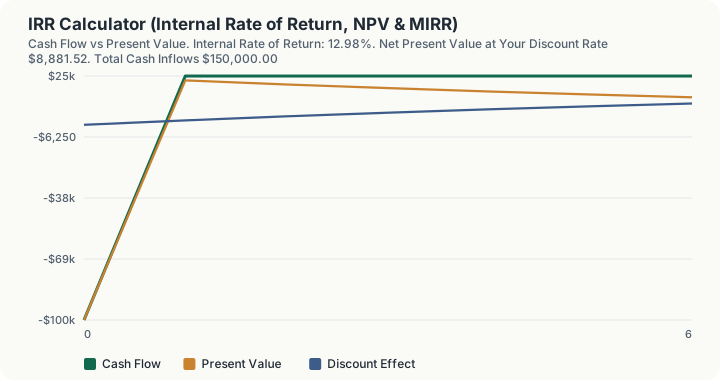
Quick Answer: Investing $100,000 for $25,000 a year over six years gives an IRR of 12.98%. At a 10% discount rate the NPV is $8,881.52, so the project is worth doing. But the MIRR is only 10.64%, because IRR silently assumes you can reinvest every interim payment at 12.98% and you probably cannot.
What does this calculator do?
The internal rate of return is the discount rate at which a project's net present value is exactly zero. It has no closed-form solution and is found numerically.
IRR is the most quoted investment metric and the most misused. Two problems recur.
First, it assumes interim cash flows are reinvested at the IRR itself. A project returning 13% does not mean the cash it throws off also earns 13% while you wait. MIRR fixes this by letting you state the rate at which money is actually reinvested, and it is almost always lower.
Second, a cash flow series that changes sign more than once can have several mathematically valid IRRs. This calculator reports when that happens rather than picking one and presenting it as the answer.
How is this calculated?
NPV discounts every cash flow back to today:
NPV = ∑(t = 0 to n) CFₜ/((1 + r)ᵗ)
IRR is the rate that makes that sum zero:
∑(t = 0 to n) CFₜ/((1 + IRR)ᵗ) = 0
There is no algebraic solution, so it is solved iteratively. The engine scans for sign changes in the NPV curve across a bracket running from -99% to +500%, and refines each crossing by Newton-Raphson with a bisection fallback. The headline IRR is the lowest root found; where more than one exists, the multiple-solutions field says so rather than letting a single number stand in for an ambiguous answer.
Where it finds none it returns no rate at all and the result reads "No solution". That is a deliberate guard, not a failure: a series whose cash flows never change sign has no rate at which its present value is zero, so any number reported for it would be an artefact of where the search stopped rather than a return.
MIRR takes all inflows forward to the final period at your reinvestment rate, takes all outflows back to today at your finance rate, and derives the single rate connecting them:
MIRR = ((FV(inflows at reinvestment rate))/(−PV(outflows at finance rate)))^(1/n) − 1
Worked Example
An operator puts $100,000 into a piece of equipment that throws off $25,000 at the end of each of the next six years.
Step 1: The cash flow series. Year 0 = -$100,000, then +$25,000 in each of years 1 through 6
Step 2: Total inflows. $25,000 x 6 = $150,000.00
Step 3: Undiscounted profit. $150,000.00 - $100,000.00 = $50,000.00
That $50,000 is the number people quote, and it treats a dollar in year six as identical to a dollar today. Discounting fixes that, one year at a time:
Step 4: Present value of the year 1 inflow at 10%. $25,000 / 1.10 = $22,727.27
Step 5: Present value of the year 2 inflow. $25,000 / 1.10^2 = $20,661.16, and the two years together are worth $43,388.43 today
Step 6: The remaining four years, discounted the same way. $18,782.87 + $17,075.34 + $15,523.03 + $14,111.85 = $65,493.09
Step 7: Present value of all six inflows. $43,388.43 + $65,493.09 = $108,881.52
Step 8: Net present value. $108,881.52 - $100,000.00 = $8,881.52, so the decision rule reads accept
Step 9: The IRR. The rate at which Step 8 would come out as exactly zero, solved numerically: 12.98%
Notice the relationship between steps 8 and 9. Positive NPV at 10% and an IRR of 12.98% are the same fact stated twice, and raising the hurdle to the IRR is what closes the gap:
Step 10: The same project discounted at 13%. NPV = -$61.26, and the decision flips to reject
Thirteen percent is a fraction above the 12.98% IRR, which is exactly why NPV lands a fraction below zero.
Now the assumption IRR hides. It only delivers 12.98% if every $25,000 that arrives is reinvested at 12.98% for the rest of the project:
Step 11: Compound the six inflows forward at a realistic 8%. $25,000 x ((1.08^6 - 1) / 0.08) = $183,398.23 at the end of year six
Step 12: The rate that turns $100,000 into that figure over six years. ($183,398.23 / $100,000)^(1/6) - 1 = 10.64%, the MIRR
Step 13: The cost of the assumption. 12.98% - 10.64% = 2.34 percentage points of the headline IRR that exist only on paper
Step 14: Reinvestment at 4% instead. MIRR falls to 8.79%, now 4.19 points below the IRR and below the 10% discount rate the project was approved against
One variation on the inflows, for contrast:
Step 15: Cash flows growing 5% a year. Total inflows rise to $170,047.83, IRR to 16.81%, NPV to $21,775.48, and MIRR to 12.77%
What does this calculator not account for?
- Irregular timing. This models annual cash flows at year end. Genuinely dated, uneven flows need XIRR, which the engine supports but this page does not expose.
- Risk. IRR says nothing about the probability of achieving the cash flows. Two projects with identical IRRs can carry entirely different risk.
- Project scale. A 40% IRR on $1,000 is worth less in absolute terms than a 12% IRR on $1 million. NPV, not IRR, ranks projects by value created.
- Mutually exclusive projects. IRR and NPV can rank two projects differently. Where they disagree, NPV is the correct guide.
- Tax and depreciation, which change the actual after-tax cash flows.
- Inflation. Enter either all nominal figures with a nominal discount rate, or all real figures with a real one; mixing them produces a meaningless answer.
- Financing structure, and the difference between project IRR and equity IRR.
- Terminal or residual value, which for many real projects dominates the result.
What mistakes do people make with this?
- Treating IRR as an achievable return. It is achievable only if every interim cash flow is reinvested at the IRR. When it is not, MIRR is the honest number, and here it is 2.34 percentage points lower.
- Ranking projects by IRR. IRR is a rate and ignores scale. Use NPV to decide which project creates more value.
- Ignoring multiple roots. A series that changes sign more than once, typical where a project needs a large late outlay, can have several valid IRRs. This page tells you when that is possible.
- Comparing IRRs of different lengths. A 15% IRR over two years and a 15% IRR over twenty are not equivalent propositions.
- Mixing real and nominal figures. Cash flows in today's money discounted at a nominal rate will understate NPV substantially.
- Forgetting that NPV crosses zero at the IRR. If your discount rate exceeds the IRR, the NPV must be negative. The 13% scenario above shows exactly that.
Frequently Asked Questions
What is a good IRR?
Why is MIRR lower than IRR?
Can a project have more than one IRR?
Should I use IRR or NPV to choose between projects?
Why is my NPV negative when the IRR looks healthy?
What discount rate should I use?
Sources
- U.S. Securities and Exchange Commission, Investor.gov, the official authority for the investing this calculator relates to. investor.gov
Also consulted: Standard discounted cash flow mathematics. NPV and IRR are defined by the equations shown above and carry no jurisdictional or statutory content; MIRR follows the conventional formulation, taking inflows forward at the reinvestment rate and outflows back at the finance rate; The engine solves IRR numerically and counts sign changes in the series to detect the possibility of multiple roots.