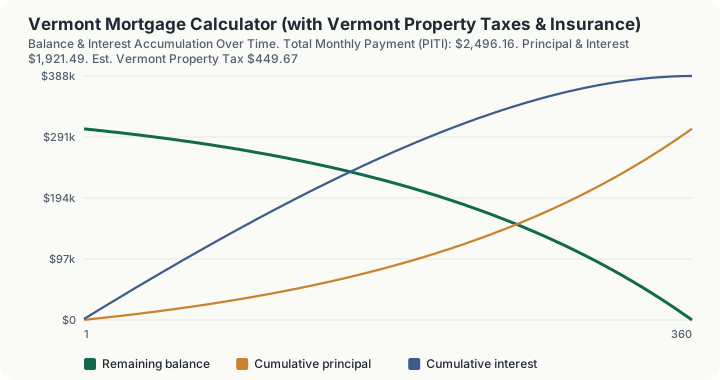
Quick Answer: On a $380,000 home with 20% down and a 6.5% fixed rate, the loan principal is $304,000, the principal and interest payment is about $1,921 a month, and Vermont's 1.42% effective property tax rate, among the highest in the nation, pushes the estimated total PITI payment to roughly $2,496.16.
Overview
Vermont consistently ranks among the top handful of states for effective property tax rates, typically in the 1.4% range, driven largely by the state's education funding model, which relies heavily on statewide property tax rather than local income or sales tax revenue to fund school budgets under Act 68 and its successor statutes. This calculator uses a 1.42% effective rate, and the resulting monthly tax line is the single largest driver separating Vermont's total housing cost from lower-tax states modeled elsewhere on this platform, even when the underlying home price and mortgage rate are identical.
Vermont further complicates the picture by taxing homestead and non-homestead properties at different rates within the same town, since owner-occupied primary residences are typically taxed under a separate education tax rate schedule than second homes, rental properties, and camps. This calculator models a blended effective rate suitable for general estimation, but buyers evaluating a specific parcel should confirm whether it qualifies for homestead classification, since misclassification is a common source of unexpected tax bills for people relocating to Vermont or purchasing a vacation property.
How This Is Calculated
- Down payment and loan principal. Home Price times the down payment percentage gives the cash down; the remainder becomes the loan principal. At $380,000 with 20% down, that is $76,000 down and $304,000 financed.
- Principal and interest. The loan principal amortizes over 360 monthly periods (30 years) using the standard mortgage payment formula, PMT = P x [r(1+r)^n] / [(1+r)^n - 1], where r is the monthly rate (annual APR / 12).
- Property tax. Home Price times 1.42% gives the estimated annual property tax, divided by 12 for the monthly escrow contribution.
- Insurance. A flat $125 monthly estimate represents typical homeowners insurance, added to complete the PITI total.
Worked Example
Using the platform's verified baseline: a $380,000 home, 20% down, and a 6.5% fixed rate.
- Home price: $380,000.00
- Down payment (20%): $76,000.00
- Loan principal: $304,000.00
- Monthly rate: 6.5% / 12 = 0.54167%
- Principal and interest (verified): $1,921.49
- Estimated monthly property tax (1.42% annual / 12): $449.67
- Estimated monthly insurance: $125.00
- Estimated total monthly PITI: approximately $2,496.16
- Total interest paid over 30 years: roughly $387,733
Notice that the property tax line alone, at roughly $449.67 a month, is larger than the entire monthly property tax plus insurance total for several lower-tax states modeled on this platform. That single input is what makes Vermont's total monthly housing cost run well above what the same loan principal and rate would produce elsewhere.
The Rate Step, The Down Payment Step, And The Price Step
The rate step, at one eighth of a point. Holding the $380,000 price and 20% down fixed, the engine returns a principal and interest payment of $1,896.56 at 6.375%, $1,921.49 at 6.500%, $1,946.55 at 6.625% and $2,022.52 at 7.000%. One eighth of a point therefore costs about $25 a month. Over the full 360 payments the same eighth is worth far more: total interest runs $378,763.14 at 6.375%, $387,732.82 at 6.500% and $396,756.31 at 6.625%, so the step from 6.375% to 6.500% costs $8,972.09 and the next one $9,021.08. Going from 6.5% to 7.0% costs $36,371.80 of interest, which is more than the down payment difference between 20% and 25%.
The down payment step, priced against the tax line. At 20% down the Vermont PITI is $2,496.16. At 5% down it is $2,856.44, at 0% down $2,976.53, and at 25% down $2,376.06. The whole of that movement is principal and interest: the property tax line stays at $449.67 in every one of those four scenarios, because the engine applies the 1.42% rate to the purchase price and the purchase price does not change when the down payment does. Total interest moves from $387,732.82 at 20% down to $460,432.24 at 5% and $484,667.97 at 0%, so the fifteen points of equity between 5% and 20% are worth $72,700.34 of interest over the term.
The price step, and the only line that responds to it. Raising the price from $380,000 to $400,000 moves the Vermont PITI from $2,496.16 to $2,620.95 and the tax line from $449.67 to $473.33. Dropping to $300,000 gives $1,996.96 with a tax line of $355.00. At $475,000, which is the calculator's higher-price scenario, PITI is $3,088.94 with $562.08 of monthly tax. Price is the only input that moves the escrow figure at all; rate and down payment leave it untouched.
The reverse question. A buyer with a fixed monthly budget can read those anchors backwards. In Vermont at 6.5% with 20% down, $1,996.96 a month supports a $300,000 purchase, $2,496.16 supports $380,000, $2,620.95 supports $400,000 and $3,088.94 supports $475,000. Each additional $20,000 of purchase price costs roughly $124.79 a month at these inputs, of which $23.66 is the tax line and the rest is principal and interest.
Right method against wrong method, priced. The 5%-down scenario is the trap on this page. Moving from 20% down to 5% raises the reported PITI from $2,496.16 to $2,856.44, a difference of $360.28 a month, and a buyer comparing the two figures will conclude that is the cost of the smaller down payment. It is not. No private mortgage insurance is added anywhere in this code path, at any loan-to-value ratio, so the 5%, 0% and 20% figures are all quoted PMI-free. A real 5%-down loan carries a PMI charge on top of $2,856.44, and the engine has no input that would produce it.
What This Does Not Account For
- No private mortgage insurance is computed at any loan-to-value ratio. The 0%-down scenario returns $2,976.53 and the 20%-down scenario $2,496.16, and neither carries a PMI line. The gap between them is principal and interest only.
- The property tax line is the 1.42% effective rate applied to the purchase price, once. It is not applied to an assessed value, it is never reassessed, and it is held constant for all 360 months. The figure is $449.67 a month in month one and $449.67 a month in month 360.
- The $125 monthly insurance figure is a flat placeholder, not a quote. It does not vary with price, location or coverage, so it is identical at the $300,000 and $475,000 scenarios.
- The term is fixed at 360 months and the rate at a single APR. No 15-year option, no adjustable rate and no extra-payment input exists on this page, so every total-interest figure above assumes the loan runs to term unchanged.
- Homestead versus non-homestead tax rate differences. Vermont taxes owner-occupied primary residences differently than second homes and rentals under its education funding statute; this calculator applies a single blended rate rather than distinguishing between the two.
- Town-level municipal tax variance. The 1.42% figure blends the statewide education tax with typical municipal rates; individual towns set their own municipal portion, so actual bills vary from town to town.
- Current use (Act 250 land use) valuation. Rural Vermont properties enrolled in the state's current use program for forest or agricultural land are assessed very differently than standard residential parcels.
- Private mortgage insurance (PMI). Down payments below 20% typically require PMI, which is not included in this calculator's output.
- Vermont's Homestead Declaration filing requirement. Buyers must file this declaration annually to be taxed at the lower homestead rate; missing the deadline can result in being billed at the higher non-homestead rate for that tax year.
Common Pitfalls
- Forgetting to file the Homestead Declaration. New Vermont homeowners who miss this annual filing can be taxed at the non-homestead rate, which is meaningfully higher than the rate this calculator assumes.
- Underestimating total housing cost when relocating from a low-tax state. Buyers comparing Vermont to states with sub-1% effective property tax rates often budget based on the mortgage payment alone and are surprised by how much the tax line adds.
- Assuming a lower home price offsets the entire tax burden. Because property tax scales with home price at a fixed 1.42% rate, a cheaper home still carries a proportionally large tax bill relative to states with lower rates.
- Overlooking PMI on the 5% down payment scenario. That built-in scenario increases the loan principal substantially; a real transaction at 5% down would also typically add a PMI premium not reflected here.
- Not distinguishing municipal tax rate from the statewide education rate. Vermont property tax bills combine both, and the split varies by town, so two homes of identical value in different towns can have different total bills even at the same assessed value.
Frequently Asked Questions
Why is Vermont's property tax rate so much higher than nearby states?
What is the difference between homestead and non-homestead rates?
Does this calculator include Vermont's Land Gains Tax?
How much does property tax add to my total monthly payment in Vermont?
Should I use this calculator for a second home or camp in Vermont?
Sources
- Vermont Department of Taxes, Division of Property Valuation and Review, education property tax rate guidance. tax.vermont.gov
- Consumer Financial Protection Bureau (CFPB), Regulation Z and mortgage disclosure standards. ecfr.gov/current/title-12/chapter-X/part-1026
Also consulted: Vermont Department of Taxes, Homestead Declaration and Property Tax Credit information.