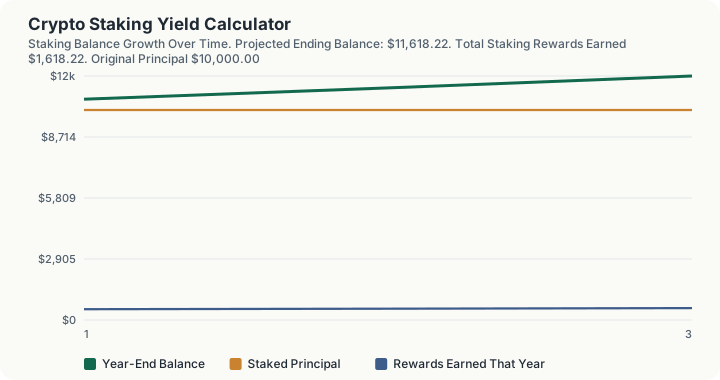
Quick Answer: $10,000 staked at a 5% advertised annual yield, compounding daily for 3 years, grows to $11,618.22, a gain of $1,618.22 (16.18% total return). Daily compounding lifts the true effective annual yield to 5.1267%, slightly above the 5% headline rate.
Overview
Staking is how many proof-of-stake blockchains pay holders for locking up their tokens to help secure the network. In exchange, the protocol pays out staking rewards, usually quoted as an annual percentage rate. Those rewards can either sit uncompounded, get manually claimed and restaked by the holder, or, on many modern protocols, compound automatically and continuously.
That compounding frequency matters more than most people expect. Two protocols advertising the same "5% APR" do not pay out the same effective annual yield if one compounds daily and the other requires a manual monthly claim, because compounding more frequently means each reward starts earning its own rewards sooner. This calculator projects a staked position's growth given a principal amount, an advertised annual yield, a compounding frequency, and a time horizon, and reports both the nominal rate you entered and the true effective annual yield that frequency actually produces.
The underlying math is the same compound-growth calculation used throughout this platform's time-value-of-money primitive, wrapped with staking-specific parameter names. There is nothing exotic about staking growth mathematically; it is ordinary compound interest. What is specific to staking is the tax treatment, the fact that yields are entirely at the protocol's discretion and can change without notice, and the additional layer of protocol and smart-contract risk that a savings account or bond does not carry.
How This Is Calculated
- Convert the advertised annual yield to a periodic rate. Periodic rate = annual yield ÷ compounding periods per year. Daily compounding uses 365 periods; weekly uses 52; monthly uses 12; annual uses 1.
- Project the ending balance using compound growth. Ending balance = principal × (1 + periodic rate)^(periods per year × years). This is standard compound interest, computed here through the platform's shared TVM engine primitive rather than a bespoke formula.
- Derive the effective annual yield. Effective annual yield = (1 + periodic rate)^(periods per year) − 1, expressed as a percentage. This is always at or above the advertised nominal rate whenever compounding happens more than once a year, and exactly equal to it when compounding is annual.
- Total rewards earned is simply the ending balance minus the original principal, and total return over the horizon is that reward amount expressed as a percentage of the principal.
Worked Example
Using the calculator's own defaults: $10,000 staked, a 5% advertised annual yield, daily compounding, over a 3-year horizon.
- Periodic (daily) rate: 5% ÷ 365 = 0.013699% per day.
- Total compounding periods over 3 years: 365 × 3 = 1,095 days.
- Ending balance: $10,000 × (1.00013699)^1095 = $11,618.22.
- Total staking rewards earned: $11,618.22 − $10,000 = $1,618.22.
- Total return over the 3-year horizon: $1,618.22 ÷ $10,000 = 16.18%.
- Effective annual yield implied by daily compounding: (1.00013699)^365 − 1 = 5.1267%, modestly above the 5% headline rate, since daily compounding lets each day's reward begin earning its own (tiny) reward almost immediately.
For comparison, the same $10,000 at the same 5% nominal rate but compounded only annually (a fully manual claim-and-restake, once a year) would grow to $11,576.25 over 3 years, about $42 less, purely because of the lower compounding frequency. Compounding frequency is a real, quantifiable difference in outcome, not just a technical footnote.
Three Years, One Reward at a Time
The compounding effect in point 6 is stated as a rate. The year-end balances make it visible as dollars.
Step 1 -- Year 1. Rewards earned $512.67, year-end balance $10,512.67
Step 2 -- Year 2. Rewards earned $538.96, year-end balance $11,051.63
Step 3 -- The increase in year two rewards. $538.96 - $512.67 = $26.29, earned purely on the prior year's rewards
Step 4 -- Cumulative rewards after two years. $512.67 + $538.96 = $1,051.63
Step 5 -- Year 3. Rewards earned $566.59, cumulative rewards $1,618.22, balance $11,618.22
Each year's reward is about 5.13% larger than the last, because the staked position grows while the rate stays fixed. Over three years that adds $80.21 above three flat years of $512.67. The schedule assumes every reward is restaked immediately and the token price never moves, so the balances are denominated in tokens rather than dollars in any real sense. A 5% yield on an asset that falls 30% is still a loss, and nothing in this projection sees that.
Compounding Frequency: Why Auto-Compounding Protocols Pay More Than the Headline Rate
Many liquid staking protocols and staking-as-a-service platforms automatically reinvest rewards continuously or near-continuously, so the effective yield an investor actually earns runs above the advertised nominal APR. Other protocols, or self-custody staking setups, require the holder to manually claim accumulated rewards and restake them, which means the effective compounding frequency is really however often the holder bothers to do that, not however often the protocol technically distributes rewards. A holder who lets claimed rewards sit unstaked for months before restaking them is, in practice, earning something closer to simple interest during that idle period, not the compounded rate this calculator projects.
This is also why two staking APRs that look identical on paper can produce meaningfully different dollar outcomes: always check both the advertised rate and how often it actually compounds (or how disciplined you are about manually restaking) before comparing two staking opportunities head to head.
What This Does Not Account For
- Staking yields are not fixed and can change. The annual yield you enter is a snapshot assumption. Protocols routinely adjust staking rewards based on network participation, inflation schedules, and validator economics; a 5% yield today is not a promise of 5% next year.
- Income tax on rewards as they are received. Per current IRS guidance (Revenue Ruling 2023-14), staking rewards are ordinary taxable income in the year the holder gains "dominion and control" over them, meaning when they become freely transferable, not deferred until a later sale. This calculator does not compute that tax liability; it only projects the pre-tax growth of the position.
- Protocol, slashing, and smart-contract risk. Staked assets can be subject to slashing penalties for validator misbehavior, lock-up or unbonding periods that delay withdrawal, and smart-contract or protocol failure risk. None of these are modeled here; the calculator assumes the full projected balance is realized and available.
- Price volatility of the underlying asset. This calculator projects the growth in the number of tokens/units, valued in the same currency terms you entered the principal in. It does not model the underlying asset's price changing in dollar terms over the horizon.
- Validator or platform fees. Many staking services and validators take a commission out of gross rewards before crediting the holder; this calculator assumes the entered annual yield is already net of any such fee, since that is what protocols typically advertise as "yield."
Common Pitfalls
- Comparing two staking APRs without checking compounding frequency. A 5% APR compounding daily is not the same effective yield as a 5% APR compounding annually; always compare effective annual yields, not headline nominal rates.
- Forgetting that staking rewards are taxed on receipt, not on sale. Unlike an unrealized capital gain, staking rewards create a tax obligation the moment they become yours to control, even if you never sell them and even if the asset's price later falls.
- Assuming a quoted "APY" already accounts for your actual restaking behavior. An advertised APY assumes a specific compounding frequency; if you manually claim and restake less often than that, your real effective yield is lower than the advertised figure.
- Treating advertised yield as guaranteed. Staking yields fluctuate with network conditions and are set unilaterally by the protocol; they are not contractual guarantees the way a fixed-rate bond coupon is.
- Ignoring unbonding/lock-up periods when planning liquidity needs. Many staking protocols impose a delay, sometimes days or weeks, between requesting to unstake and actually receiving liquid funds; this calculator assumes continuous, unrestricted compounding and does not model withdrawal delays.
Frequently Asked Questions
Is staking income taxed when I receive it or only when I sell?
Why does the "effective annual yield" differ from the rate I entered?
Can staking yields go down after I start staking?
Does auto-compounding always beat manual claim-and-restake?
What is not captured by this calculator that could affect my real return?
Sources
- Internal Revenue Service, Revenue Ruling 2023-14 (staking rewards includible in gross income upon receipt of dominion and control). irs.gov/pub/irs-drop/rr-23-14.pdf
- Internal Revenue Service, Digital Assets guidance hub. irs.gov/filing/digital-assets
- Internal Revenue Service, Notice 2014-21 (virtual currency treated as property for federal tax purposes). irs.gov/pub/irs-drop/n-14-21.pdf