Quick Answer: A $400,000 home in Kansas carries an estimated $5,000.00 in annual property tax at the state's 1.25% effective rate, or about $416.67 a month.
One and a Quarter Percent, Flat
Nationally, Kansas's #10 ranking, tied with Wisconsin, and 1.25% average effective rate put it above the national median. Nationally, the average effective rate runs close to 1.0%, which puts Kansas modestly above the national average of roughly 1.0%. That's above the Midwest regional average of about 1.17%.
That revenue underwrites the basics (public schools, county government, emergency services), the same way it does across most of the Midwest, though the specific mix of school, county, and municipal millage varies by jurisdiction within Kansas.
Because assessment and appeal procedures in Kansas are administered locally rather than by a single statewide office, the exact timeline for a reassessment or an appeal can vary by county. The sections below outline the exemptions and appeal windows generally available to owners who want to contest a valuation.
How This Is Calculated
Kansas assesses residential property at 11.5% of market value, one of the lowest classification ratios in the country, and then exempts the first slice of every home's value from the 20-mill statewide school levy. The low ratio and the high mill rates it invites are two sides of the same design.
None of that detail is asked for here. This calculator works one level up, applying Kansas's average effective property tax rate of 1.25% to the value you enter. That rate is the ratio of property taxes actually paid to home value across the state, so the assessment ratios, caps, and exemptions described above are already baked into it.
Steps 1 and 2 belong to the county appraiser, not to this calculator, which holds no 11.5% ratio and no mill levy. Steps 3 to 5 are the arithmetic actually performed.
- Start from appraised value. County appraisers value property annually as of January 1.
- Apply the ratio and exemptions. The 11.5% residential ratio produces assessed value, and the statewide school levy exemption applies before local levies.
- Multiply by the effective rate. At 1.25%, a $400,000 home in Kansas comes to $5,000 a year before any exemption you enter above.
- Divide by twelve for escrow. That same home works out to $416.67 a month set aside in a mortgage escrow account.
- Compare it against your own bill. Comparing a Kansas mill rate with a full-value state's rate overstates the difference by roughly a factor of nine. Your county's number is the one that governs; this figure tells you whether it is roughly where a Kansas home of that value ought to land.
Worked Example
Using this calculator's baseline inputs: a $400,000 home in Kansas, taxed at the state's 1.25% average effective rate (rank #10 of 50 states, tied with Wisconsin).
- Start with the assessed value. The home is assessed at its full $400,000.00 market value, with no homestead exemption applied in this baseline scenario.
- Apply the effective rate. $400,000.00 × 1.25% = $5,000.00 in annual property tax, Kansas's statewide average effective rate.
- Convert to a monthly escrow. Lenders typically collect property tax in twelve equal installments alongside principal and interest: $5,000.00 ÷ 12 = $416.67 per month.
- Project a five-year hold. At a flat rate, five years of ownership totals $5,000.00 × 5 = $25,000.00, before any reassessment, exemption change, or millage increase.
At 1.25%, Kansas lands solidly in the upper half nationally, ranking #10 of 50 states, tied with Wisconsin. That is a moderate but still material carrying cost for homeowners.
The Value Sweep, and the Exemption It Ignores
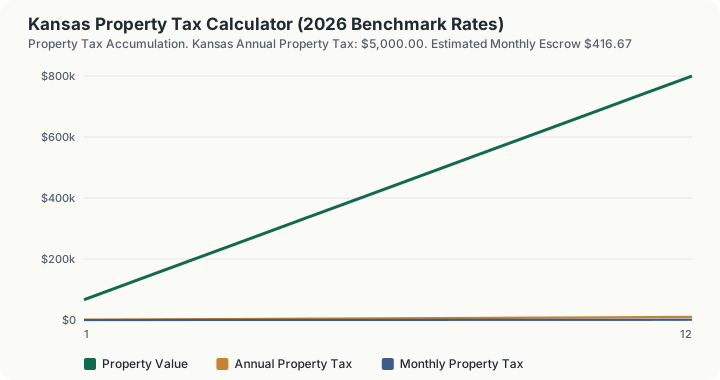
One rate, twelve rows, no step. The table runs the home value from $66,666.67 to $800,000.00 and the annual tax from $833.33 to $10,000.00, with $5,000.00 at the $400,000 row and $416.67 a month beside it. Divide any row by its value and the answer is 1.25%. There is no threshold in this schedule, no cap and no classification test: calculateStatePropertyTax reads one Kansas rate and multiplies.
The 11.5% ratio is the largest thing not in that arithmetic. Kansas assesses residential property at 11.5% of appraised value and then extends mill levies against that small base, which is why Kansas mill rates look enormous next to a full-value state's. None of that mechanism exists in this code. The 1.25% is a statewide ratio of taxes actually paid to home value, which already contains the ratio and the levies. Comparing a Kansas mill rate directly against another state's effective rate overstates the gap by roughly a factor of nine, and this page deliberately sidesteps that by never using a mill rate at all.
Marginal cost of the next unit. Each additional $10,000 of appraised value costs $125.00 a year, and each $100,000 costs $1,250.00. Raising the entry from $400,000 to $410,000 lifts the bill from $5,000.00 to $5,125.00. The round rate makes this the easiest arithmetic in the batch: one eightieth of the house, every year.
The reverse question. A $250 monthly escrow line supports a Kansas home worth $240,000, which the calculator confirms at $3,000.00 a year and $250.00 a month. Against Iowa's 1.29% the same budget carries $232,558, and against Missouri-adjacent low-rate states considerably more; within the Plains, Kansas and Iowa are close enough that the rate is rarely the deciding factor between them.
Where the headline stops matching the table. Enter a $40,000 homestead exemption against the $400,000 default and the headline falls to $4,500.00. The twelve-row table does not respond: its $400,000 row still shows $5,000.00, because the schedule is built from the value you typed rather than from value net of exemption. The effective-rate output behaves the same way, holding at 1.25% regardless of what you enter for the exemption, since it reports the state figure and not your own ratio.
What This Does Not Account For
- Specific hyper-local county and municipal millage district variations within Kansas.
- Special assessment or improvement district charges. Some Kansas municipalities levy additional assessments on benefiting parcels for street, drainage, or sewer improvements on top of the base county and school millage; the specific list of districts varies by municipality.
- Commercial vs residential assessment classification differentials.
- Property tax appeal reductions or localized board of equalization adjustments.
Common Pitfalls
- Confusing Market Fair Value with Assessed Basis: Some jurisdictions assess property at fractional ratios rather than 100% of market value.
- Failing to File Homestead Paperwork: Homestead exemptions are rarely automatic; homeowners must file timely paperwork with the county appraisal district.
- Underestimating Post-Sale Supplemental Assessments: Purchasing a newly constructed or reassessed property often triggers catch-up supplemental tax bills.
- Ignoring Property Tax Appeal Windows: Missing the annual 30-to-60 day statutory protest window forfeits the right to challenge over-assessed property values for that tax year.
Frequently Asked Questions
How high are property taxes in Kansas?
When are property taxes due in Kansas?
How can I lower my property taxes in Kansas?
Does purchasing a home trigger a property tax reassessment?
Sources
- U.S. Census Bureau: American Community Survey (ACS) Real Estate Assessment Benchmark Data. census.gov/programs-surveys/acs
Also consulted: Kansas Department of Revenue, Division of Property Valuation: Assessment Ratio Manuals.