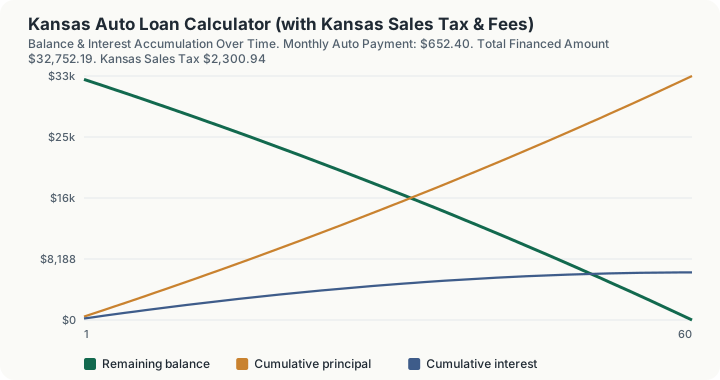
Quick Answer: A $35,000 vehicle in Kansas with $5,000 cash down, a $399 dealer documentation fee, a 60-month term, and a 7.25% APR carries a $652.40 monthly payment at the 6.5% state rate. That figure includes $2,300.94 of Kansas sales tax and $52.25 in title and registration fees, financing $32,752.19 in total. In Wichita, where Sedgwick County adds 1.0%, the payment is $659.45.
Overview
The rate you pay on a car in Kansas is decided by where you park it, not by where you buy it. A Kansas dealer collects the combined rate in effect at its own place of business, but if you live somewhere with a higher rate, you owe the difference as local compensating use tax under K.S.A. 79-3703, paid to your county treasurer when you register. The net result is that your registering address drives the number. Buying in a low-rate county to save tax does not work.
That sourcing rule creates a second problem, which is why this page is careful about local rates. The combined sales tax rates published for Kansas addresses frequently include special district add-ons: community improvement districts, transportation development districts, and STAR bond districts. Those districts attach to a physical storefront. They do not follow a vehicle to a registration address in a different jurisdiction. So the 9.1% or 9.35% you will find quoted for an Overland Park or Topeka address is a general storefront rate, and it is not the right number for a car registered elsewhere in the same county.
Because no official Kansas Department of Revenue automotive rate table was available, this page publishes only the one metro rate that could be corroborated cleanly, and asks you to confirm the rest with your county treasurer rather than showing you a figure that is probably too high.
The purchase side is otherwise straightforward: 6.5% state rate, an uncapped trade-in credit, and a taxable, uncapped doc fee. The part that catches people out arrives the following year, in the form of the county vehicle property tax.
Auto Loan APR by Credit Score
The APR columns below are national averages, not Kansas figures. No primary source publishes average auto loan APR by state: Experian's report has no geographic cut, the CFPB publishes state origination volume but no rates, and the New York Fed publishes state delinquency only. The payment column is the part that is specific to Kansas, because it runs this calculator's own Kansas tax and fee rules at each tier's rate.
| Credit Tier | VantageScore 4.0 | Avg New APR | Avg Used APR | Est. Payment in Kansas |
|---|---|---|---|---|
| Super prime | 781-850 | 4.55% | 6.30% | $611.34 |
| Prime | 661-780 | 6.23% | 8.77% | $636.70 |
| Nonprime | 601-660 | 9.67% | 14.03% | $690.58 |
| Subprime | 501-600 | 13.44% | 19.42% | $752.61 |
| Deep subprime | 300-500 | 16.01% | 21.77% | $796.64 |
Payment assumptions: $35,000 vehicle price, $0 trade-in, $5,000 cash down, $399 dealer documentation fee, 60-month term, new-vehicle APR applied to the Kansas delivered price including tax and statutory fees. At the 6.39% overall new-car average the same purchase costs $639.15 a month.
The score bands are VantageScore 4.0, not FICO. The same borrower can land in a different tier under each model, so a FICO score pulled from a card issuer will not always match the band here. Source: Experian, State of the Automotive Finance Market, Q1 2026, slide 45.
What Moves Your Payment
Each row changes one input and leaves the rest at the baseline below. The dollar effects are this calculator's own output for Kansas, not a rule of thumb.
| Factor | What Changes | Effect on Monthly Payment | Effect on Total Interest |
|---|---|---|---|
| Vehicle Price | Each extra $1,000 of price raises both the amount financed and the sales tax base, so the tax rises with it. | +$21.22 | +$207.85 |
| Trade-In Allowance | A $1,000 allowance cuts the amount financed by $1,000 and reduces the sales tax base by the same amount, so it saves tax as well as principal. | -$21.21 | -$207.84 |
| Cash Down Payment | A $1,000 larger down payment cuts the amount financed by $1,000. It never reduces the sales tax, which is assessed on the price, not on what you borrow. | -$19.92 | -$195.16 |
| Dealer Doc Fee | A $100 higher documentation fee adds $100 to the amount financed and is inside the sales tax base, so it is taxed on top of itself. | +$2.12 | +$20.79 |
| Longer Term | Stretching the same balance from 60 months to 72 months spreads the principal over twelve more payments at the same rate. | -$90.07 | +$1,343.77 |
Baseline: $35,000 vehicle price, $0 trade-in, $5,000 cash down, $399 documentation fee, 60 months at 7.25% APR, giving a $652.40 payment and $6,391.99 of total interest.
How This Is Calculated
Kansas subtracts the trade-in from the selling price but refuses the deduction on a lease turn-in. Four steps.
1. Net selling price. K.S.A. 79-3602(ll) defines "sales or selling price" as the total consideration, which includes the dealer's documentation or administrative fee, and expressly excludes the trade-in allowance.
There is one exclusion worth knowing. Turning in a leased or rented vehicle toward a purchase does not qualify as a trade-in, so no deduction is allowed on a lease turn-in.
2. Sales tax. The 6.5% state rate under K.S.A. 79-3603, plus the combined city and county rate for your registering address:
3. Title and registration. A fixed $52.25, being the $10 certificate of title and $42.25 for typical annual passenger registration. The statutory registration base is $30 for a car at or under 4,500 pounds and $40 above that, with mandatory surcharges bringing the usual out-of-pocket to roughly $42.25. County service fees may add a little more.
4. Amortization. The financed balance is the delivered price less the trade-in and the cash down, amortized as a fixed-rate installment loan:
where $P$ is the financed amount, $i$ is the monthly rate (APR ÷ 12), and $n$ is the term in months. Each period's interest is the outstanding balance times $i$, the remainder reduces principal, and the schedule reconciles to zero at maturity.
Kansas Vehicle Tax Rates
| Metro | County | County Rate | City Rate | State | Combined |
|---|---|---|---|---|---|
| Wichita | Sedgwick | 1.000% | 0.000% | 6.5% | 7.500% |
That is the only Kansas metro rate published here, and the reason it qualifies is that it is clean: Sedgwick County levies 1.0% and the City of Wichita levies no city sales tax at all, so there is nothing for a special district to muddy at the base rate.
Overland Park, Olathe, Kansas City, and Topeka are deliberately absent. The published combined rates for those cities run between roughly 9.1% and 9.35%, and those figures include district components that do not apply to a vehicle registered outside the district. Rather than print a number that would overstate your tax by several hundred dollars, this page asks you to get the rate from your county treasurer and enter it in the local rate field.
Kansas rates also change quarterly, with changes announced for 1 April 2026 among others. Any rate you use, including the Wichita figure above, is worth checking against the current KDOR jurisdiction code booklet before you sign.
Worked Example
Kansas stacks a local rate on top of 6.5% and the combined figure reaches 7.5% in Wichita and higher in some jurisdictions, so the state-floor run below is a comparison baseline rather than a bill anyone receives.
- Vehicle price: $35,000
- Trade-in allowance: $0
- Cash down: $5,000
- Dealer doc fee: $399
- Local rate: 0% (state floor)
- Term: 60 months at 7.25% APR
Step 1 -- The net selling price. Doc fee inside the base, trade-in allowance excluded from selling price: $35,000 + $399 - $0 = $35,399.00
Step 2 -- Kansas sales tax at 6.5%. $35,399.00 x 6.5% = $2,300.94
Step 3 -- Title and registration, outside the base. $10.00 title + $42.25 registration = $52.25
Step 4 -- Total delivered price. $35,000 + $399.00 + $2,300.94 + $52.25 = $37,752.19
Step 5 -- Amount financed. $37,752.19 - $0 trade-in - $5,000 cash down = $32,752.19
Step 6 -- The monthly payment. $32,752.19 at 7.25% over 60 months = $652.40
Step 7 -- Month 1. $32,752.19 x (7.25% / 12) = $197.88 interest, $454.52 principal, balance $32,297.67
Step 8 -- Month 2. $32,297.67 x (7.25% / 12) = $195.13 interest, $457.27 principal, balance $31,840.40. Cumulative interest: $393.01
Step 9 -- The running total. Interest through month 12 is $2,189.59, balance $27,112.98. Over 60 months, $6,391.99
Register the same car in Wichita and the 7.5% combined rate raises the tax to $2,654.93 and the payment to $659.45, a difference of $353.99 in tax.
A $10,000 trade-in drops the base to $25,399, cuts tax to $1,650.94 at the state rate, and lowers the payment to $440.26. The credit is worth $650 at 6.5% and $750 in Wichita at 7.5%. That is the figure a private sale has to beat before selling your old car yourself comes out ahead.
The doc fee cuts the other way, and Kansas caps nothing. A $399 fee costs $424.94 delivered once its own 6.5% tax is counted. It is worth negotiating.
What This Does Not Account For
- The annual county vehicle property tax. Kansas assesses an ad valorem property tax on vehicles every year at registration renewal, based on the vehicle's value and your local mill levy. On a newer vehicle it typically dwarfs the $42.25 registration fee, and it is the dominant recurring cost of car ownership in Kansas. It is not financed and is not modeled here.
- Local rates for most metros. Four of the five Kansas metros researched had no verifiable automotive rate, only general storefront rates inflated by special districts. The calculator accepts a rate; it does not look one up.
- Quarterly rate changes. Kansas revises local rates on a quarterly cycle. A rate that is correct today may not be correct next quarter.
- The doc fee figure itself. $399 is a market estimate, not a sourced statutory or survey number. Kansas has no cap, so use your dealer's actual buyer's order figure.
- Lease turn-ins. No trade-in deduction is allowed when a leased or rented vehicle is surrendered toward another vehicle. The calculator applies whatever allowance you enter without testing that condition.
- County service fees charged by individual treasurers at registration.
- GAP insurance, service contracts, and aftermarket accessories, unless you fold them into the vehicle price yourself.
Common Pitfalls
- Using the published storefront rate for your city. This is the expensive one. A quoted 9.35% rate for a Topeka address probably includes CID or TDD components tied to a specific retail development. Applied to a $35,399 base, the gap between 9.35% and a true 7.5% automotive rate is $655 of imaginary tax.
- Shopping across county lines to save tax. It does not work. The dealer collects at its location, and you settle the difference at your own county treasurer under the compensating use tax. Your registering address decides the rate.
- Ignoring the annual property tax when comparing offers. Two buyers in different Kansas counties can pay very similar purchase tax and then differ by hundreds of dollars a year on the ad valorem bill because of the mill levy. That difference never shows up in a payment quote.
- Expecting a doc fee cap. Kansas has none, and the fee is taxable on top. Neighbouring Iowa caps it at $180 and Illinois at $377.63; Kansas simply does not.
- Assuming a lease turn-in counts as a trade. It does not, and the difference on a $20,000 vehicle at 7.5% is $1,500.
- Rolling negative equity forward. If you owe more than the trade is worth, the shortfall is added to the new loan. It raises the principal and the total interest, and it does not increase your tax credit, which is based on the allowance rather than your equity.
- Judging the loan by payment alone. Stretching this $32,752.19 balance from 60 to 72 months drops the payment to $562.33 but raises total finance charges from $6,391.99 to $7,735.77.
Frequently Asked Questions
What is the sales tax on a car in Kansas?
Why is the rate quoted for my city higher than what I should pay on a car?
Can I save tax by buying a car in a lower-rate Kansas county?
Does a trade-in reduce sales tax in Kansas?
Is the Kansas dealer doc fee capped or taxable?
What is the Kansas annual vehicle property tax?
Sources
- Consumer Financial Protection Bureau, Truth in Lending Act (Regulation Z, 12 CFR § 1026.22) disclosure requirements for installment credit. ecfr.gov/current/title-12/chapter-X/part-1026
Also consulted: K.S.A. 79-3603 (sales tax imposition) and K.S.A. 79-3703 (compensating use tax); K.S.A. 79-3602(ll) (definition of "sales or selling price", trade-in exclusion, inclusion of dealer charges); Kansas Department of Revenue, Publication KS-1526, Business Taxes for Motor Vehicle Transactions; K.S.A. 8-143 (registration fee schedule by weight) and Kansas County Treasurers Association fee schedules; Kansas Department of Revenue quarterly jurisdiction code and local sales tax rate booklet; Experian, State of the Automotive Finance Market, Q1 2026, slide 45 (average new and used auto loan APR by VantageScore 4.0 credit tier; national, no state level cut published).