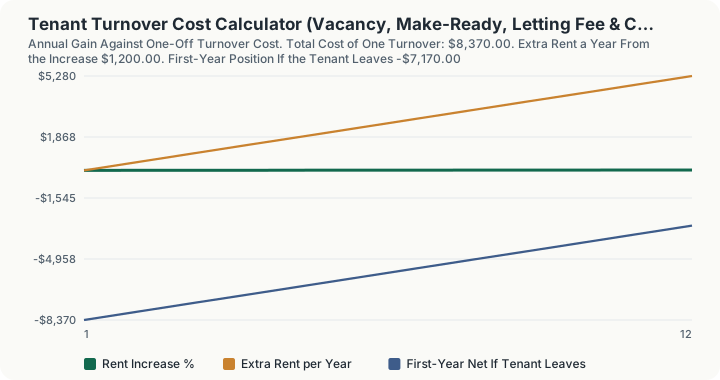
Quick Answer: One turnover on a $2,000 a month rental costs $8,370.00 once 1.5 months of vacancy, $2,200 of make-ready work, an 8% letting fee, $250 of advertising and a half-month concession are counted. That is 4.19 months of rent, or 34.88% of a year's gross rent. Weighed against a 5% rent increase worth $1,200 a year, it takes 6.98 years of undisturbed tenancy to pay for a single turnover the increase provokes.
What does this calculator do?
The cost of losing a tenant is almost never the vacant months alone, and the vacant months are the only part most landlords count. Four items stack, and three of them never appear on a rent roll.
Lost rent for the period the unit sits empty is the visible one. Make-ready is the second: paint, flooring, cleaning, and the deferred items a sitting tenant tolerated and a prospective one will not. The letting or leasing fee is the third, typically quoted as a percentage of the first year's rent or as a flat fee equivalent to somewhere between half a month and a full month. The fourth is the concession, a half or full month free, that is frequently the price of filling the unit at the asking rent rather than dropping the asking rent itself.
The decision this informs is nearly always the same one: whether to push a rent increase that risks the tenant leaving. And the comparison that matters is asymmetric. The increase produces an annual gain, forever. The turnover produces a one-off cost. Intuition says the annual gain should win quickly. The arithmetic says otherwise, usually by years rather than months, because the turnover cost is measured in months of rent while the increase is measured in percentage points of it.
How is this calculated?
Cost = RₘV + RₘC + (12Rₘ × f) + M + A
Years to recover = Cost/(12Rₘ × g)
where Rₘ is monthly rent, $V$ vacant months, $C$ concession months, $f$ the letting fee percentage of annual rent, $M$ make-ready, $A$ advertising and $g$ the proposed rent increase.
Step 1: Compute the current annual rent. $2,000 x 12 = $24,000.00
Step 2: Compute the rent lost while the unit is empty. $2,000 x 1.5 months = $3,000.00
Step 3: Compute the free-rent concession granted to the incoming tenant. $2,000 x 0.5 months = $1,000.00
Step 4: Compute the letting fee as a percentage of one year's rent. $24,000 x 8% = $1,920.00
Step 5: Add the make-ready cost. $2,200.00
Step 6: Add advertising and screening. $250.00
Step 7: Total the five components. $3,000 + $1,000 + $1,920 + $2,200 + $250 = $8,370.00
Step 8: Express the total in months of rent. $8,370.00 / $2,000 = 4.19 months
Step 9: Express the total as a share of a year's gross rent. $8,370.00 / $24,000.00 = 34.88%
Step 10: Compute the annual gain from the rent increase being considered. $24,000 x 5% = $1,200.00
Step 11: Compute the first-year position if the increase drives the tenant out. $1,200.00 - $8,370.00 = negative $7,170.00
Step 12: Compute the years of the increase needed to pay for one turnover. $8,370.00 / $1,200.00 = 6.98 years
Step 13: Compute the increase that would pay for the turnover within a single year. $8,370.00 / $24,000.00 = 34.88%
Step 8 is the line worth reading twice. The unit is empty for 1.5 months, and the turnover costs 4.19 months of rent. The gap between those two numbers is the entire argument, and it is made up of items that a vacancy-rate analysis simply does not see.
Step 13 is the same division as step 9, and it is reported separately because it answers a different question. As a share of annual rent it tells you how expensive the turnover is. As a break-even increase it tells you how large a rent rise would have to be before risking the tenant is an even bet over a single year, and at 34.88%, no realistic increase comes close.
Worked Example
Compare two markets with the identical unit, identical make-ready and identical letting fee. The only difference is how fast it re-lets.
Step 1: Hot market: half a month empty, no concession needed. $2,000 x 0.5 = $1,000.00 of lost rent, concession $0.00
Step 2: Add the costs that do not change with market conditions. $1,000 + $1,920 + $2,200 + $250 = $5,370.00
Step 3: Express that in months of rent. $5,370.00 / $2,000 = 2.69 months
Step 4: Soft market: three months empty, a full month free. $2,000 x 3 = $6,000.00 of lost rent; $2,000 x 1 = $2,000.00 concession
Step 5: Add the fixed components again. $6,000 + $2,000 + $1,920 + $2,200 + $250 = $12,370.00
Step 6: Express that in months of rent. $12,370.00 / $2,000 = 6.19 months
Step 7: Compare the two markets. $12,370.00 - $5,370.00 = $7,000.00, or 3.5 months of rent, purely from re-letting speed
Even in the best case the cost does not fall below 2.69 months of rent, because the letting fee, the make-ready and the advertising do not go away no matter how quickly the unit fills. That floor is the reason retention is worth paying for. A $500 goodwill repair, or forgoing a $600 annual increase, is cheap against a $5,370 floor.
Now push a much larger increase instead. A 12% rise on $24,000 is $2,880 a year, and $8,370 / $2,880 is 2.91 years: still nearly three years of undisturbed tenancy needed to pay for one turnover it might provoke. Raising the increase does not escape the arithmetic; it only softens it.
What does this calculator not account for?
- It does not estimate the probability the tenant actually leaves. Every comparison here is conditional on the turnover happening. A rational decision multiplies the turnover cost by the probability of provoking it, and that probability is yours to judge.
- It does not discount the future increase. The years-to-recover figure compares an undiscounted annual gain against a present cost. At any positive discount rate the true recovery period is slightly longer than shown.
- It does not compound the rent increase. A 5% rise this year raises the base every subsequent year, and a landlord who never raises rent falls further behind market over time. This is a single-period comparison.
- It does not model the counterfactual of a smaller increase. Often the real choice is not 5% or nothing, but 5% or 3%, and the calculator compares one proposed increase against one turnover.
- It does not include lost ancillary income (parking, storage, pet rent, utility recovery) during the vacant period.
- It does not include carrying costs during vacancy, such as the mortgage, insurance, taxes and utilities that continue while nothing is coming in. These are real and are excluded, so the figure here is conservative.
- It does not model the risk of a worse tenant. A turnover replaces a known payment history with an unknown one, and the expected cost of that risk is not quantified.
- It contains no tax treatment. Make-ready that is a repair is deductible; make-ready that is a capital improvement is depreciated. Neither is modelled.
What mistakes do people make with this?
- Counting only the vacant months. At the defaults, 1.5 vacant months produce a 4.19-month cost. Skipping the other three components understates the answer by nearly two thirds.
- Treating the letting fee as unavoidable and therefore ignoring it. It is unavoidable per turnover, which is precisely why it belongs in the cost of a turnover.
- Forgetting the concession. A half month free is a genuine cost, and landlords routinely treat it as costless because it preserves the headline rent. It preserves the headline and it costs a half month.
- Comparing an annual gain with a one-off cost without dividing. The right comparison is years to recover, not "the increase is bigger than nothing".
- Assuming a bigger increase escapes the problem. Doubling the increase roughly halves the recovery period, and at 12% it is still 2.91 years.
- Blaming the market for the whole cost. Even with a half-month vacancy and no concession, $5,370 remains, because the letting fee, make-ready and advertising are structural.
- Ignoring the deferred maintenance the make-ready represents. Some of it would have been due anyway; some of it exists only because a new tenant will not accept what a sitting one did. This calculator takes your figure and does not split them.
Frequently Asked Questions
How much does tenant turnover really cost a landlord?
Should I raise the rent if it might make my tenant leave?
What rent increase would pay for a turnover in a single year?
Is it cheaper to give a sitting tenant a discount than to re-let?
Why does the calculator show more months of cost than months of vacancy?
Sources
This calculator uses no statutory or tabulated data. It is pure property mathematics, implemented in engine/primitives/tenant-turnover.ts: lost rent as monthly rent times vacant months, a concession as monthly rent times concession months, a letting fee as a percentage of annual rent, plus make-ready and advertising as stated amounts, with the total then expressed in months of rent and compared against the annual gain from a proposed increase.
Also consulted: Every input is a figure from your own operation, your rent, your expected days on market, your management agreement's letting fee, your contractor's make-ready quote. There is no national benchmark this tool substitutes for them, and there should not be: turnover cost varies far more by unit, market and lease terms than any published average could capture; Method reference: single-period cost aggregation and payback period, as set out in PRIMITIVES.md. The payback figure is undiscounted by design, which is stated above under what this does not account for.