Quick Answer: A $1,000 taxable purchase in Kansas costs $87.10 in combined state and local sales tax, for a total of $1,087.10 out the door.
Six and a Half Points From the State, Two and a Fifth From Everyone Else
Retailers doing business in Kansas collect sales tax in two pieces at once: the state's 6.50% statutory rate, and whatever the local jurisdiction adds on top. Local jurisdictions (cities, counties, and in some cases special taxing districts) are free to add their own surcharges on top of that, and the statewide average of those add-ons is 2.21%, which brings the typical combined rate to 8.71%.
Getting that combined figure wrong, even by a fraction of a percentage point, creates exposure at audit time, since the state and any local taxing authority both expect their share to be collected and remitted correctly. That puts Kansas a bit above the roughly 7.3% average combined rate seen across the states that levy a general sales tax. New sellers registering to collect tax in Kansas for the first time typically need the state-level number to open an account with the revenue department, and the local add-on on top of it to actually invoice customers correctly from day one.
How This Is Calculated
Kansas charges 6.50% at the state level with an average 2.21% in county and city taxes, giving a combined 8.71% and $87.10 on a $1,000 purchase. Kansas is worth watching on food: the state phased its own rate on groceries down to zero, but city and county taxes were never removed from the food base, so groceries in Kansas are still taxed, just at local rates alone rather than at the full combined rate. Kansas also allows community improvement and transportation development districts that add a further layer on top of the ordinary city and county rates in specific shopping developments.
For general merchandise, the state and local rates share one base:
The calculator runs:
- Read the purchase price. The full pre-tax amount you enter becomes the taxable base.
- No item-level exemption filtering. The zero state rate on groceries is not modeled, so a food total entered here will carry a state portion it should not.
- Multiply by the state rate. This produces the state portion of the bill.
- Apply the local surcharge. The 2.21% average covers county and city taxes; special districts inside individual developments can push a specific address well above it.
- Add the pieces together. State tax plus local tax gives the total tax, and adding that to the purchase price gives the amount you actually pay.
Worked Example
For a $1,000 taxable purchase in Kansas:
- Starting purchase price. The buyer rings up a $1,000.00 taxable retail purchase in Kansas, the baseline amount before any tax is applied.
- State portion. Kansas's statutory state sales tax rate of 6.50% applies to the full purchase amount: $1,000.00 × 6.50% = $65.00 owed to the state.
- Local portion. Local municipal, county, and special-district surcharges add an average of 2.21% on top of that: $1,000.00 × 2.21% = $22.10 more.
- Combined tax due. Summing the two pieces, $65.00 in state tax plus $22.10 in local surcharge comes to $87.10 in total sales tax owed on the transaction.
- Total out-of-pocket cost. Adding that $87.10 in tax to the $1,000.00 purchase price brings the buyer's total out-of-pocket cost to $1,087.10.
This example uses Kansas's statewide average local rate of 2.21%; actual combined rates vary by city and county, so a real receipt could show a combined rate above or below the 8.71% average used here.
Reading the State and Local Columns Separately
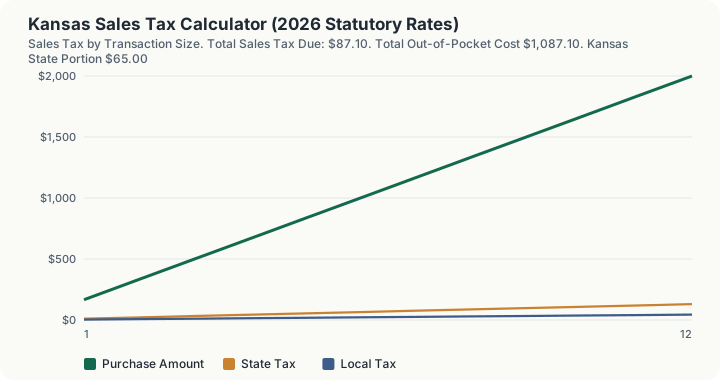
The composition, at the $1,000 default. Kansas tax comes to $87.10: $65.00 state and $22.10 local, so local jurisdictions collect 25.4% of the total. With the local box unticked the calculator returns $65.00, the pure state figure.
At $35,000. A vehicle purchase produces $3,048.50 of tax, $2,275.00 state and $773.50 local, for $38,048.50 out the door. Kansas's state rate alone, 6.50%, is higher than the entire combined rate in Iowa's state-only mode.
Nothing steps, anywhere. The engine holds one state rate and one statewide average local rate for Kansas and multiplies both by the base you enter. There is no jurisdiction, no item class and no threshold in the code, so the combined 8.71% applies to the first dollar and to the ten-thousandth alike. Kansas's food rate history and its local rate variation are outside this model entirely; 2.21% is an average, and specific Kansas cities sit well above it.
Marginal cost of the next unit. Each additional $100 of purchase costs $8.71, split $6.50 state and $2.21 local. Each additional $1,000 costs $87.10.
The sweep. Twelve rows run the purchase from $166.67 to $2,000.00. State tax goes $10.83 to $130.00, local $3.68 to $44.20, combined $14.51 to $174.20. Both columns are straight lines and their ratio never changes, which is the visual signature of two flat rates on a shared base.
Right method against wrong method, priced. Applying the 8.71% combined rate to a receipt total rather than to the pre-tax price is the standard error. Feed the calculator the $1,087.10 total from the default purchase and it returns $94.68 instead of $87.10, an overstatement of $7.58. Working backwards properly, the pre-tax purchase behind a $1,000.00 total is $919.88, which produces $80.12 of tax and exactly $1,000.00 out the door. That is 8.01% of the gross against an 8.71% rate on the net, and confusing the two is worth about seventy basis points on every line.
What This Does Not Account For
- Statutory exemptions on unprepared groceries, prescription medications, or manufacturing equipment.
- Special industry excise taxes (lodging hotel taxes, vehicle rental fees, alcohol/tobacco excise).
- Use tax compliance on out-of-state untaxed online purchases.
- B2B resale certificate exemptions or direct pay permit programs.
Common Pitfalls
- Confusing State and Combined Rates: Quoting the state base rate without factoring in local city and county add-on taxes.
- Overlooking Consumer Use Tax: Failing to self-report and remit use tax on untaxed out-of-state purchases on your state income tax return.
- Missing Annual Sales Tax Holidays: Many states offer annual tax-free weekends for back-to-school items, severe weather supplies, or energy-efficient appliances.
- Failing to Collect Resale Certificates: Selling wholesale without collecting valid exemption certificates exposes sellers to full sales tax liability upon audit.
Frequently Asked Questions
What is the sales tax rate in Kansas?
Are groceries taxed in Kansas?
How does use tax differ from sales tax?
Are digital goods and SaaS taxable in Kansas?
Sources
- Streamlined Sales Tax Governing Board (SSTGB): State Taxability Matrix. streamlinedsalestax.org/for-businesses/taxability-matrix
Also consulted: Kansas Department of Revenue: 2026 Sales and Use Tax Rate Schedules.