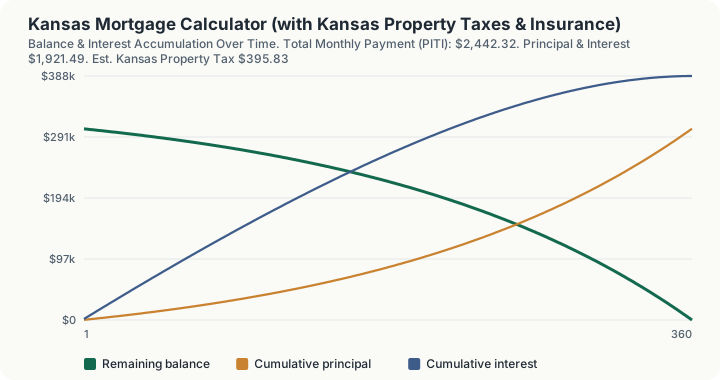
Quick Answer: On a $380,000 Kansas home with 20% down and a 6.5% rate, expect a total monthly payment (PITI) of about $2,442.32, including roughly $395.83 a month in Kansas property tax.
Overview
Kansas taxes real property using a classification system baked into its state constitution: residential property is assessed at 11.5% of its appraised (market) value, and local mill levies (a mill is $1 of tax per $1,000 of assessed value) set by counties, cities, school districts, and other taxing units are applied to that reduced assessed base. The net effect, once you translate mill levies and the 11.5% assessment ratio back into a percentage of full market value, is a statewide effective residential rate close to 1.25%, the figure this calculator applies. That is meaningfully higher than a low-tax neighbor like Indiana on an identically priced home, and roughly comparable to, though somewhat below, Iowa's effective burden.
Because Kansas layers many independent taxing authorities onto the same parcel (county, city, unified school district, community college, library, fire district, and more), the total mill levy, and therefore the effective rate, varies more county to county in Kansas than in states with simpler tax structures. Johnson County and Sedgwick County (Wichita) often carry different effective rates than smaller rural counties due to differing school district levies and municipal service costs. The 1.25% figure used here is a statewide effective average drawn from Kansas Department of Revenue Division of Property Valuation data, appropriate for planning but not a substitute for a specific county's mill levy calculation.
This calculator runs a standard 30-year fixed mortgage on the financed loan balance and layers Kansas's property tax reality and a flat insurance estimate on top, producing a PITI figure that reflects the full monthly obligation rather than a stripped-down principal-and-interest number.
How This Is Calculated
- Down payment and loan principal. Down payment cash is the home price times your chosen down payment percentage. Loan principal is home price minus that cash amount.
- Monthly principal and interest (P&I). The loan principal, annual interest rate, and a 360-month (30-year) term feed a standard amortization formula: monthly payment = P × [i(1+i)^n] / [(1+i)^n − 1], where P is the loan principal, i is the monthly interest rate (annual rate ÷ 12), and n is 360 total payments.
- Monthly Kansas property tax. Home price × 1.25% ÷ 12, reflecting Kansas's statewide effective average rate once the 11.5% residential assessment ratio and typical mill levies are translated to a market-value percentage.
- Monthly insurance. A flat $125 placeholder for hazard/homeowners insurance, since actual premiums vary by carrier, home age, and claims history (Kansas homeowners insurance also tends to reflect hail and severe-weather risk more than many states).
- Total monthly payment (PITI). Monthly P&I plus monthly property tax plus monthly insurance.
- Full amortization schedule. The engine generates all 360 monthly line items, tracking interest and principal at every payment, so total interest paid reconciles exactly against the sum of every period's interest.
Worked Example
Using the calculator's default inputs: - Home Purchase Price: $380,000 - Down Payment: 20% ($76,000 cash) - Interest Rate: 6.5% APR, 30-year fixed
Step by step: 1. Loan principal = $380,000 − $76,000 = $304,000. 2. Monthly interest rate = 6.5% ÷ 12 = 0.5417% per period. 3. Monthly principal and interest on $304,000 over 360 payments at that rate = $1,921.49 (this is the verified test vector the calculator's engine reconciles against). 4. Monthly Kansas property tax = $380,000 × 1.25% ÷ 12 = $4,750 ÷ 12 = $395.83. 5. Monthly insurance placeholder = $125.00. 6. Total monthly payment (PITI) = $1,921.49 + $395.83 + $125.00 = $2,442.32. 7. Over the full 360-month term, cumulative interest paid on the $304,000 loan comes to just over $387,733, the difference between total lifetime payments (360 × $1,921.49) and the original principal.
Note how Kansas's $395.83 monthly property tax component sits between the lower-tax Midwest states (Indiana, Kentucky) and higher-tax Iowa on the same home value, a useful benchmark when comparing relocation costs across the region.
What This Does Not Account For
- Private mortgage insurance (PMI). Down payments under 20% typically trigger PMI, which is not added to the PITI total here.
- County and district mill levy variance. Kansas's 1.25% figure is a statewide effective average; Johnson, Sedgwick, and Shawnee counties, among others, can diverge due to differing school district and municipal mill levies.
- The statewide 20-mill school finance levy interaction with local exemptions. Kansas applies a mandatory statewide 20-mill levy for schools on top of local levies; homestead-related exemptions on that portion are not modeled here.
- Homestead refund and property tax relief programs. Kansas offers a Homestead Refund and a Safe Senior property tax relief program for qualifying low-income, elderly, and disabled homeowners that can meaningfully reduce actual liability; this calculator does not model those credits.
- Closing costs and title insurance. Typically 2% to 4% of the loan amount in Kansas, not reflected here.
- Special assessments. Improvement district assessments for things like street paving or sewer upgrades, common in some newer Kansas subdivisions, are excluded.
Common Pitfalls
- Confusing the 11.5% assessment ratio with the effective tax rate. Kansas assesses residential property at 11.5% of appraised value, then applies mill levies to that reduced base; the resulting effective rate against full market value, around 1.25%, is what actually matters for budgeting, not the 11.5% ratio itself.
- Assuming mill levies are uniform statewide. Because Kansas layers county, city, school, and special-district levies independently, two homes of identical value in different Kansas counties can have noticeably different actual tax bills.
- Skipping the Homestead Refund application. Eligible Kansas homeowners who don't file for available property tax relief programs pay more than the law requires them to.
- Comparing this PITI figure to a P&I-only rate quote. Advertised "starting at" mortgage payments from lenders almost always exclude taxes and insurance, making the true monthly cost of Kansas homeownership look lower than it actually is.
- Overlooking how the statewide 20-mill school levy stacks with local levies. Total mill levy in a given Kansas location is the sum of many independent levies, not a single number set by one authority, which is why effective rates vary so much county to county.
Frequently Asked Questions
How does Kansas calculate property tax differently from other states?
What is a mill levy in Kansas?
Are there property tax relief programs for Kansas homeowners?
Does a bigger down payment reduce my Kansas property tax?
Why do effective property tax rates vary so much between Kansas counties?
Sources
- Consumer Financial Protection Bureau (CFPB): Regulation Z (Truth in Lending Act) disclosure requirements for mortgage APR. ecfr.gov/current/title-12/chapter-X/part-1026
- Federal Reserve Economic Data (FRED): 30-year fixed mortgage rate historical benchmarks. federalreserve.gov
Also consulted: Kansas Department of Revenue, Division of Property Valuation: Statewide assessment ratios and mill levy data; Kansas Constitution, Article 11 (property classification and assessment ratios); Kansas Department of Revenue: Homestead Refund and Safe Senior program guidance.