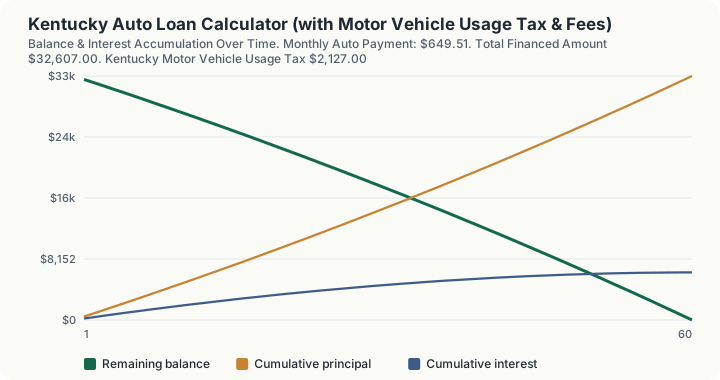
Quick Answer: A $35,000 vehicle in Kentucky with $5,000 cash down, a $450 dealer documentation fee, a 60-month term, and a 7.25% APR carries a $649.51 monthly payment. That figure includes $2,127.00 of Kentucky motor vehicle usage tax at 6% and $30.00 in state title and registration fees, financing $32,607.00 in total.
Overview
Kentucky does not charge sales tax on a car. It charges a motor vehicle usage tax, levied at 6% under KRS 138.460 and collected by your county clerk when the vehicle is titled. The rate matches the 6% general sales tax, which is why the distinction gets flattened in most online estimates, but the two are different taxes with different bases and different rules.
The most important of those rules is the trade-in deduction, and it is the reason a lot of Kentucky payment estimates come out wrong in both directions. Kentucky was for years a genuine no-trade-in-credit state, and older articles still say so. That changed on July 1, 2014. A trade-in allowance now reduces the taxable base, but only under conditions that depend on whether you are buying new or used and on where your trade-in was registered.
On a new vehicle, the trade-in is deducted when the notarized Affidavit of Total Consideration is filed with the clerk. Without that affidavit the clerk defaults the base to 90% of MSRP and no trade deduction applies at all.
On a used vehicle, the trade-in allowance is allowed only if the vehicle you are trading in was previously registered in Kentucky. A trade that has only ever been registered in Ohio, Indiana, or Tennessee produces no tax reduction whatsoever. It still lowers what you borrow. It does not lower what you owe the clerk.
That is the single condition to check before you trust any Kentucky number, including this one. Leave the trade-in field at zero if your trade does not qualify.
Auto Loan APR by Credit Score
The APR columns below are national averages, not Kentucky figures. No primary source publishes average auto loan APR by state: Experian's report has no geographic cut, the CFPB publishes state origination volume but no rates, and the New York Fed publishes state delinquency only. The payment column is the part that is specific to Kentucky, because it runs this calculator's own Kentucky tax and fee rules at each tier's rate.
| Credit Tier | VantageScore 4.0 | Avg New APR | Avg Used APR | Est. Payment in Kentucky |
|---|---|---|---|---|
| Super prime | 781-850 | 4.55% | 6.30% | $608.63 |
| Prime | 661-780 | 6.23% | 8.77% | $633.88 |
| Nonprime | 601-660 | 9.67% | 14.03% | $687.52 |
| Subprime | 501-600 | 13.44% | 19.42% | $749.27 |
| Deep subprime | 300-500 | 16.01% | 21.77% | $793.11 |
Payment assumptions: $35,000 vehicle price, $0 trade-in, $5,000 cash down, $450 dealer documentation fee, 60-month term, new-vehicle APR applied to the Kentucky delivered price including tax and statutory fees. At the 6.39% overall new-car average the same purchase costs $636.31 a month.
The score bands are VantageScore 4.0, not FICO. The same borrower can land in a different tier under each model, so a FICO score pulled from a card issuer will not always match the band here. Source: Experian, State of the Automotive Finance Market, Q1 2026, slide 45.
What Moves Your Payment
Each row changes one input and leaves the rest at the baseline below. The dollar effects are this calculator's own output for Kentucky, not a rule of thumb.
| Factor | What Changes | Effect on Monthly Payment | Effect on Total Interest |
|---|---|---|---|
| Vehicle Price | Each extra $1,000 of price raises both the amount financed and the sales tax base, so the tax rises with it. | +$21.12 | +$206.87 |
| Trade-In Allowance | A $1,000 allowance cuts the amount financed by $1,000 and reduces the sales tax base by the same amount, so it saves tax as well as principal. | -$21.11 | -$206.87 |
| Cash Down Payment | A $1,000 larger down payment cuts the amount financed by $1,000. It never reduces the sales tax, which is assessed on the price, not on what you borrow. | -$19.92 | -$195.16 |
| Dealer Doc Fee | A $100 higher documentation fee adds $100 to the amount financed and is inside the sales tax base, so it is taxed on top of itself. | +$2.11 | +$20.68 |
| Longer Term | Stretching the same balance from 60 months to 72 months spreads the principal over twelve more payments at the same rate. | -$89.67 | +$1,337.81 |
Baseline: $35,000 vehicle price, $0 trade-in, $5,000 cash down, $450 documentation fee, 60 months at 7.25% APR, giving a $649.51 payment and $6,363.66 of total interest.
How This Is Calculated
Kentucky charges a 6% Motor Vehicle Usage Tax on the consideration sworn to on Form 71A100, with no county or city add-on anywhere in the state. Five steps.
1. Total consideration given. KRS 138.450 defines the usage tax base as the total consideration given, reported on the notarized Affidavit of Total Consideration (Form 71A100). In practice that figure includes dealer fees, so the documentation fee sits inside the base while the separately stated title and registration charges sit outside it.
The trade-in term is zero unless your trade meets the conditions above.
2. Usage tax. A single statewide rate with no local component.
3. Title and registration. A fixed $30.00, being the $9 statutory certificate of title fee under KRS 186A.115 and the $21 published all-in county clerk registration charge under KRS 186.050. County clerks add a title clerk fee of their own, commonly $6, which is not included here because it varies by county.
4. Amount financed. A qualifying trade-in works twice: it lowered the tax base in step one, and it also reduces the balance you borrow. A non-qualifying trade-in works once, on the loan only.
5. Amortization. The financed amount amortizes as a fixed-rate installment loan:
where $P$ is the financed amount, $i$ is the monthly rate (APR divided by 12), and $n$ is the term in months. Each period's interest is the outstanding balance times $i$, the remainder reduces principal, and the schedule reconciles to zero at maturity.
Kentucky has no county or city add-on to the usage tax, so there is no local rate control on this calculator. The 6% figure is what every Kentucky buyer pays regardless of county. Local government does tax vehicles in Kentucky, but through a separate annual property tax rather than at the register.
Worked Example
Kentucky is still widely listed as a no-trade-in-credit state. It has not been one since 1 July 2014, and the run below shows what the credit is actually worth, followed by the condition that can take it away.
- Vehicle price: $35,000
- Trade-in allowance: $0
- Cash down: $5,000
- Dealer doc fee: $450
- Term: 60 months at 7.25% APR
Step 1 -- The taxable base. Retail price including the doc fee, less a qualifying trade-in: $35,000 + $450 - $0 = $35,450.00
Step 2 -- Motor vehicle usage tax at 6%. $35,450.00 x 6% = $2,127.00
Step 3 -- Title and registration, outside the base. $9.00 title + $21.00 registration = $30.00
Step 4 -- Total delivered price. $35,000 + $450.00 + $2,127.00 + $30.00 = $37,607.00
Step 5 -- Amount financed. $37,607.00 - $0 trade-in - $5,000 cash down = $32,607.00
Step 6 -- The monthly payment. $32,607.00 at 7.25% over 60 months = $649.51
Step 7 -- Month 1. $32,607.00 x (7.25% / 12) = $197.00 interest, $452.51 principal, balance $32,154.49
Step 8 -- Month 2. $32,154.49 x (7.25% / 12) = $194.27 interest, $455.24 principal, balance $31,699.25. Cumulative interest: $391.27
Step 9 -- The accumulation. By month 12 you have paid $2,179.89 in interest and owe $26,992.77. Across the full term, $6,363.66
Now add a $10,000 trade-in that qualifies. The taxable base drops to $25,450, usage tax falls to $1,527.00, and the payment drops to $438.37. The trade-in saved $600.00 in tax on top of the $10,000 it removed from the loan.
Run the same deal with a $10,000 trade-in that was never registered in Kentucky and you are buying used, and the tax stays at $2,127.00. The $600 is gone. That is a real difference on an otherwise identical transaction, and it is the number to ask your clerk about before you sign.
What This Does Not Account For
- The 90% of MSRP default. If the notarized Affidavit of Total Consideration is not filed on a new vehicle, KRS 138.450 sets the base at 90% of manufacturer's suggested retail price rather than what you paid, and no trade deduction applies. A discounted purchase without the affidavit is taxed as if the discount never happened.
- The used-vehicle 50% floor. For a used vehicle with a qualifying trade, the affidavit price must be at least 50% of the difference between the reference manual trade-in values of the two vehicles. A price below that floor is adjusted upward by the clerk.
- Annual ad valorem property tax. Kentucky bills a vehicle property tax every year at registration renewal, at a $0.45 per $100 state rate on NADA value plus county, city, school, and special district rates. It is a recurring cost the loan does not cover.
- The county clerk title fee. The $9 state title fee is statutory. Clerks add their own charge, commonly $6, and the split varies by county.
- Private-party purchases. Usage tax on a private sale is generally assessed on the greater of the stated price or the reference manual retail value unless a notarized affidavit supports the lower figure.
- GAP insurance, service contracts, and aftermarket add-ons, unless you fold them into the vehicle price yourself.
Common Pitfalls
- Reading an article that says Kentucky gives no trade-in credit. That was true before July 1, 2014 and is repeated widely. It is wrong now, and a buyer who believes it may sell privately and lose the $600 credit the trade would have produced.
- Assuming the trade-in credit is automatic. It is not. On a new vehicle it depends on filing the affidavit. On a used vehicle it depends on the trade having been Kentucky-registered. Two buyers with identical paperwork on the surface can pay $600 apart.
- Trading in an out-of-state vehicle and budgeting for the tax saving anyway. A vehicle moved into Kentucky and traded in before you register it here gives you nothing on a used-vehicle purchase.
- Forgetting the doc fee is taxed. Kentucky caps nothing here and the usage tax base is total consideration, so a $450 fee adds $27.00 of tax on top of itself.
- Confusing usage tax with the annual property tax. Paying one does not offset the other. The usage tax is once, at titling. The property tax comes every year.
- Judging a loan by the monthly payment alone. Stretching this $32,607.00 balance from 60 to 72 months drops the payment to $559.84 and raises total finance charges from $6,363.66 to $7,701.46.
Frequently Asked Questions
What is Kentucky's sales tax on a car?
Does a trade-in reduce tax in Kentucky?
Is there a local car tax in Kentucky?
How much are Kentucky title and registration fees?
Are dealer doc fees capped in Kentucky?
What happens if I do not file the Affidavit of Total Consideration?
Sources
- Kentucky Department of Revenue, Motor Vehicle Usage Tax guidance. revenue.ky.gov
- Consumer Financial Protection Bureau, Truth in Lending Act (Regulation Z, 12 CFR 1026.22) disclosure requirements for installment credit. ecfr.gov/current/title-12/chapter-X/part-1026
Also consulted: KRS 138.460 (motor vehicle usage tax, 6% rate); KRS 138.450 (definitions of retail price and total consideration, Affidavit of Total Consideration, 90% of MSRP default, used-vehicle trade-in conditions as amended effective July 1, 2014); KRS 186A.115 (certificate of title fee); KRS 186.050 (vehicle registration and license fees); Kentucky Department of Revenue, motor vehicle property tax guidance (annual ad valorem assessment at renewal); Experian, State of the Automotive Finance Market, Q1 2026, slide 45 (average new and used auto loan APR by VantageScore 4.0 credit tier; national, no state level cut published).