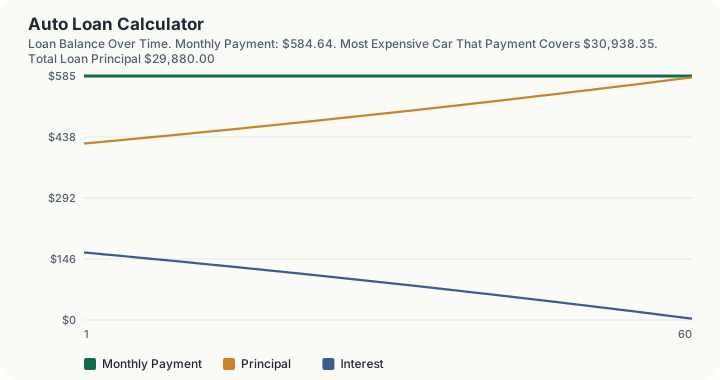
Quick Answer: A $35,000 vehicle with $5,000 cash down, a $3,000 trade-in, 6.5% APR, a 60-month term, 6.5% sales tax, and $800 in dealer fees produces a $584.64 monthly payment on a $29,880 loan.
Overview
This is the national, lender-agnostic version of the platform's auto loan tools. Unlike the state-specific calculators, which bake in a fixed statutory sales tax rate for a particular state, this calculator treats sales tax rate, dealer fees, trade-in value, and any debt still owed on that trade-in as independent inputs. That makes it the right tool for a buyer comparing offers across state lines, working with a private-party sale, or simply wanting full control over every line item that feeds into the final loan principal.
The most important thing this calculator does that a simple payment estimator does not is separate a trade-in's two components: its appraised value and any loan balance still owed against it. Most car buyers think of a trade-in as a single number, but a trade-in with equity (worth more than what is owed) reduces the amount financed, while a trade-in with negative equity (owed more than it is worth, sometimes called being "underwater" or "upside down") actually increases the amount financed, because the lender is effectively rolling the old loan's shortfall into the new one. This calculator models both directions correctly.
It also models the tax treatment used in most, though not all, states: sales tax is generally charged on the vehicle price minus the trade-in's appraised value, not the trade-in's net equity and not the out-of-pocket cash difference. That distinction matters because it means a trade-in reduces your tax bill even when it has no equity at all, since the taxable base only looks at the trade-in's value, not what is still owed on it.
How This Is Calculated
- Net trade equity. Net Trade = Trade-In Value - Trade-In Debt Owed. This can be negative if more is owed than the trade-in is worth.
- Taxable base. Taxable Base = max(0, Vehicle Price - Trade-In Value). Sales tax is calculated on price minus the trade-in's value, not its equity.
- Sales tax. Sales Tax = Taxable Base x Sales Tax Rate.
- Out-the-door price. Out-the-Door Price = Vehicle Price + Sales Tax + Dealer Fees.
- Loan principal. Loan Principal = max(0, Out-the-Door Price - Cash Down Payment - Net Trade Equity). Subtracting a negative net trade equity (negative equity) increases the loan principal.
- Amortization. If the APR is above 0%, the loan is amortized with the standard annuity payment formula:
If the APR is exactly 0%, the payment is simply Loan Principal / Term, with zero finance charge, since promotional 0% APR offers from manufacturers charge no interest at all.
- Working back from a payment. To find the most expensive car a monthly payment covers, the calculator first finds the loan that payment supports, the present value $P = PMT \times \frac{1 - (1+i)^{-n}}{i}$, then solves steps 2 to 5 backwards for the price that produces exactly that loan. Because sales tax is charged on price minus the trade-in's value, the price is solved with tax included. At 6.5% over 60 months, with 6.5% tax, a $3,000 trade-in, $5,000 down and $800 in fees, a $500 monthly payment covers a car priced at about $30,938.35.
Worked Example
Scenario 1: Standard purchase with a positive-equity trade-in. - Vehicle Price: $35,000; Cash Down: $5,000; Trade-In Value: $3,000; Trade-In Debt: $0; APR: 6.5%; Term: 60 months; Sales Tax Rate: 6.5%; Dealer Fees: $800. - Taxable base: $35,000 - $3,000 = $32,000. Sales tax: $32,000 x 6.5% = $2,080.00. - Out-the-door price: $35,000 + $2,080 + $800 = $37,880.00. - Net trade equity: $3,000 - $0 = $3,000. - Loan principal: $37,880 - $5,000 - $3,000 = $29,880.00. - Monthly payment: $584.64. Total interest over 60 months: approximately $5,198.
Scenario 2: 0% APR promotional financing, no trade-in. - Vehicle Price: $30,000; Cash Down: $0; Trade-In: $0; APR: 0%; Term: 48 months; Sales Tax Rate: 6%; Dealer Fees: $600. - Sales tax: $30,000 x 6% = $1,800. Out-the-door price: $30,000 + $1,800 + $600 = $32,400.00. - Loan principal: $32,400.00 (no down payment or trade to subtract). - Monthly payment: $32,400 / 48 = $675.00. Total interest: $0.00, since a true 0% APR offer charges no finance charge at all.
Scenario 3: Negative equity trade-in ($2,000 underwater). - Vehicle Price: $25,000; Cash Down: $2,000; Trade-In Value: $8,000; Trade-In Debt Owed: $10,000; APR: 7%; Term: 60 months; Sales Tax Rate: 5%; Dealer Fees: $500. - Taxable base: $25,000 - $8,000 = $17,000. Sales tax: $17,000 x 5% = $850. - Out-the-door price: $25,000 + $850 + $500 = $26,350. - Net trade equity: $8,000 - $10,000 = -$2,000 (negative). - Loan principal: $26,350 - $2,000 - (-$2,000) = $26,350.00. Notice the negative equity fully offsets the $2,000 cash down payment, so the loan principal ends up equal to the out-the-door price even though real cash changed hands at signing.
Where the First Year of Payments Goes
Scenario 1 above stops at the payment. The more useful question for anyone deciding on a term is how much of the loan is actually gone after a year of paying it.
Step 1 -- Month 1. Interest $161.85, principal $422.79, balance $29,457.21
Step 2 -- Month 2. Interest $159.56, principal $425.08, balance $29,032.14
Step 3 -- After twelve payments. Interest paid to date $1,788.29, principal repaid $5,227.35, balance $24,652.65
Step 4 -- Month 30, the halfway point of the term. Interest paid to date $3,807.05, balance $16,147.96
Step 5 -- Month 60, payoff. Total interest $5,198.19, balance $0.00
Twelve payments of $584.64 total $7,015.64, and only $5,227.35 of that reduced the debt. More telling is month 30: half the payments are made, but $3,807.05 of the $5,198.19 in total interest has already been charged, because interest is front-loaded onto the largest balances. A car that depreciates faster than $5,227 in its first year leaves the borrower underwater despite paying on time, which is the mechanism behind the negative-equity trade-in in scenario 3.
What This Does Not Account For
- State-specific trade-in tax rules. Not every state subtracts trade-in value from the taxable base; several states tax the full vehicle price regardless of trade-in. This calculator assumes the trade-in-reduces-taxable-base model, which is common but not universal, so verify your state's rule before trusting the tax figure exactly.
- Dealer reserve and rate markup. The APR entered here is treated as the final rate; it does not model the spread a dealer may add on top of the rate a lending partner actually approves.
- GAP insurance for negative equity trades. Rolling negative equity into a new loan increases the risk of being underwater again quickly; this calculator does not add or recommend Guaranteed Asset Protection coverage, though lenders often push it in exactly this scenario.
- Extended warranties and aftermarket add-ons sold at signing, which are not included in dealer fees or the financed amount.
- Manufacturer incentives and rebates beyond what is manually entered as part of the down payment or trade value.
Common Pitfalls
- Rolling negative equity into a new loan without recognizing the compounding risk. As Scenario 3 shows, negative equity effectively cancels out a cash down payment, leaving the buyer financing the full out-the-door price while still owing money on a car they no longer have.
- Assuming sales tax is charged on net trade equity. In most states that offer a trade-in tax credit, the credit is based on the trade-in's appraised value, not on what is actually owed against it, a distinction this calculator's taxable base formula reflects correctly.
- Confusing a 0% APR offer with a discounted price. A manufacturer's 0% financing promotion often requires giving up a cash rebate that would otherwise be available; comparing the true total cost requires running both scenarios.
- Forgetting that dealer fees are taxed differently by state. Some states include documentation fees in the taxable base and some do not; this calculator adds fees after tax is calculated, matching states where fees are not separately taxed.
- Not shopping the APR separately from the vehicle price. Dealer-arranged financing and a buyer's own bank or credit union pre-approval can differ by several percentage points on an identical loan principal.
Frequently Asked Questions
Does a trade-in reduce the sales tax I owe?
What happens if I owe more on my trade-in than it is worth?
Is a 0% APR loan really interest-free?
How do dealer fees affect my loan?
Should I use this calculator or a state-specific one?
Sources
- Consumer Financial Protection Bureau (CFPB): Truth in Lending Act (Regulation Z) disclosure requirements for vehicle financing. ecfr.gov/current/title-12/chapter-X/part-1026
- Federal Trade Commission (FTC): guidance on trade-in valuation and negative equity risk in auto financing. consumer.ftc.gov
Also consulted: National Automobile Dealers Association (NADA): trade-in appraisal and tax-credit practices by state.