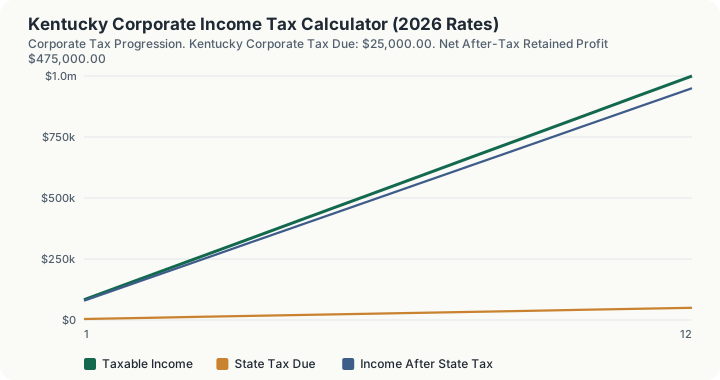
Quick Answer: On $500,000 of pre-apportioned taxable income, Kentucky's flat 5.00% corporate income tax rate produces $25,000.00 in state tax due and $475,000.00 in net after-tax profit.
A Round Number, and Why That Helps
Kentucky's flat 5.00% corporate income tax rate ties South Carolina and Mississippi exactly, and sits in the lower half of state corporate rates nationally, below neighboring West Virginia's 6.5% and Virginia's 6.00%.
Kentucky applies the 5.00% rate uniformly to all apportioned C-corporation income, without brackets, so the marginal and effective rates match at every income level. For a multistate company comparing Ohio Valley states, Kentucky's flat 5.00% is a straightforward number to model against Ohio's gross-receipts-based Commercial Activity Tax, which works on an entirely different base than net income.
Kentucky's 5.00% rate turns the calculator's $500,000 example into $25,000.00 of state tax, the same figure Mississippi and South Carolina would produce on identical income, and notably less than the $32,500.00 a company would owe on the same base in neighboring West Virginia.
How This Is Calculated
Kentucky charges a flat 5.00% on corporate income and then adds something most states do not: the limited liability entity tax, a separate levy computed on Kentucky gross receipts or gross profits that applies to corporations and LLCs alike, with a minimum payable even by loss-making entities. A Kentucky model that stops at 5.00% is missing a real recurring cost.
- Read the income field as the taxable base. The single income input is taken as Kentucky taxable corporate income exactly as typed. The code applies no modification, allocation or deduction to it before the rate stage; it is the base.
- Apply the single statutory rate. Kentucky's 5.00% rate is multiplied against that figure with no bracket lookup, because the schedule has one band running from the first dollar: $500,000 x 5.00% = $25,000.00.
- Subtract credits and floor the result at zero. The credits field is subtracted from the step-2 figure and the difference is clamped at $0.00, so no credit entry can drive the liability negative. With the field at its $0 default the $25,000.00 stands; enter $10,000 of credits and the page returns $15,000.00, a reduction of exactly the credit entered because the subtraction is a straight one.
- Derive the reported rates from those two numbers. The effective rate is the tax divided by the income entered, 5.00% here, and the top statutory bracket is reported separately as 5.00%. Net after-tax retained profit is the income less the tax, $475,000.00. Those four outputs are the whole of what the engine produces.
Worked Example
Using this calculator's baseline scenario: a corporation with $500,000 in taxable income apportioned to Kentucky.
- Start with apportioned taxable income. The corporation has already apportioned $500,000 of its total taxable income to Kentucky using the state's statutory apportionment formula, before any state-level tax is applied.
- Apply Kentucky's flat statutory rate. Kentucky taxes all C-corporation income at a single flat rate of 5.00%, regardless of income size, so no bracket lookup is required: $500,000 × 5.00% = $25,000.00.
- Kentucky corporate tax due: $25,000.00.
- Net retained profit. Subtracting the state tax liability from taxable income leaves $500,000 − $25,000.00 = $475,000.00 in after-tax profit retained by the corporation, before any separate federal tax liability is applied.
Because Kentucky uses a single flat rate rather than graduated brackets, the 5.00% effective rate is identical to the marginal rate at every income level: a corporation earning $50,000 and one earning $50 million both face the same 5.00% state rate on their apportioned income.
What the Sweep Proves About a Flat Rate
The twelve-row table moves apportioned income from $83,333.33 to $1,000,000.00. Kentucky tax runs from $4,166.67 to $50,000.00, with $25,000.00 at the $500,000 baseline. Every row divides to exactly 5.00%, and the chart is a line through the origin.
No boundary exists here. Kentucky has one corporate rate applied from the first dollar, so there is no bracket edge, no small-company band and no phase-in for the sweep to cross. Deferring income across the year end changes the Kentucky liability by zero. That is a genuinely different answer from the one a Maine or Iowa filer gets, and it is the most useful thing this page can say about timing.
Marginal cost of the next unit. Each additional $1,000 of apportioned income costs $50.00: the calculator moves from $25,000.00 to $25,050.00. Because 5.00% is a round number, the shortcut is exact rather than approximate. Twenty dollars of Kentucky income costs one dollar of Kentucky corporate tax, at every level.
The reverse question. A $25,000 Kentucky tax budget corresponds to exactly $500,000 of apportioned income, and a $50,000 budget to $1,000,000, which the table's last row confirms at $50,000.00. The division is exact only because the rate never steps.
Where the number gets built wrong, priced. The dominant error is entering worldwide or federal taxable income rather than the Kentucky-apportioned figure. This calculator does not apportion. Take a company with $2,000,000 of federal taxable income and a Kentucky sales factor that assigns $500,000 to the state: the correct entry produces $25,000.00, and entering the federal figure produces $100,000.00, an overstatement of $75,000.00. The engine multiplies whatever it is given by 0.05 and has no way to detect which number it received.
A second error is subtracting Kentucky tax from a federal calculator's after-tax figure. The $475,000.00 shown as retained here is income after Kentucky corporate tax only, before federal corporate tax, before the Kentucky limited liability entity tax, and before any local occupational license fee, none of which this page computes.
What This Does Not Account For
- Federal Taxable Income Starting Point. Net corporate earnings are determined under IRC § 63 before Kentucky modifications. This calculator starts one step later: the income box is read as the finished Kentucky taxable figure and nothing is derived from a federal return.
- Kentucky Additions & Subtractions. The Kentucky tax deducted federally is added back, and Kentucky applies its own depreciation position and related-party expense addbacks. No addback and no subtraction is computed anywhere in this page's code path, so enter an income figure that already reflects them.
- Apportionment Factor Allocation. Kentucky apportions on a single sales factor with market-based sourcing, and requires unitary combined reporting for affiliated groups absent a consolidated election. The engine performs no apportionment of any kind. The word does not appear in the primitive this page binds to; the figure you type is taken as the Kentucky figure and multiplied by the rate as it stands.
- Net Operating Loss (NOL) Deductions. Allowable Kentucky NOL carryforwards reduce the base before the rate is applied. No loss deduction is applied by this calculator. If a carryforward is available, subtract it yourself before entering the income.
- Limited Liability Entity Tax Check. The separate LLET, computed on Kentucky gross receipts or gross profits and subject to a statutory minimum, is assessed alongside the income tax and is not included in this figure. It is not computed by this page.
- Federal corporate income tax (21% under IRC § 11).
- Specialized gross receipts taxes (e.g. Ohio CAT, Washington B&O, Texas Franchise Tax) where applicable.
- Minimum entity franchise tax fees or annual report filing charges.
- Base Erosion and Anti-Abuse Tax (BEAT) or Global Intangible Low-Taxed Income (GILTI) provisions.
- Local municipal corporate earnings taxes (e.g. NYC General Corporation Tax).
Common Pitfalls
- Mistaking the Flat Rate for the Final Bill: Assuming Kentucky's 5.00% rate applies directly to book income rather than to apportioned taxable income after state additions, subtractions, and NOL adjustments.
- Improper Apportionment Sourcing: Applying market-based sourcing vs cost-of-performance rules incorrectly for service revenue apportioned to Kentucky.
- Ignoring Unitary Group Combined Reporting: Failing to account for Kentucky's mandatory combined return requirements across related entities.
- Neglecting State NOL Carryforward Caps: Overlooking Kentucky's annual percentage limitations on net operating loss deductions, which matter more once the 5.00% rate is applied to a larger taxable base.
Frequently Asked Questions
Does Kentucky have a corporate income tax?
When are Kentucky corporate tax returns due?
Does Kentucky tax S-corporations and LLCs?
How is multi-state corporate income apportioned to Kentucky?
Sources
- Kentucky Department of Revenue: Corporate Tax Statutes and Guidance (2026). revenue.ky.gov
- Multistate Tax Commission (MTC): Uniform Apportionment and Allocation Guidelines. mtc.gov