Quick Answer: Maine's cost of living is 14.5% above the U.S. national average (composite index 114.5), so a $75,000.00 national-average household budget costs about $85,875.00 a year in Maine.
One Fourteen Point Five, and the Only State Here Above the Line
Maine is a rural New England state. On MERIC's composite cost-of-living index it registers 114.5, or 14.5% above the 100.0 national baseline.
Within the Northeast, Maine is among the more affordable Northeastern states. The composite figure is driven mainly by housing (index 124.6), with utilities (index 115.4) and groceries (index 106.2) playing smaller roles.
That combination puts Maine among the fifteen most expensive states nationally, a useful anchor point for anyone weighing a cross-state move, a remote-work relocation, or a corporate cost-of-labor adjustment against the national average. It is also worth remembering that a single statewide figure can't capture the spread between Maine's own metro and rural markets.
That translates to roughly $10,875 of annual budget movement on a $75,000 reference figure, driven largely by housing running 24.6 points above the 100.0 mark. Transportation, healthcare, and general goods and services are folded into the composite calculation too, even though MERIC does not publish them as standalone state indices.
Key Index Components for Maine:
- Composite Benchmark Index: 114.5 (Rank #13)
- Housing Cost Index: 124.6
- Utilities Cost Index: 115.4
- Grocery Cost Index: 106.2
How This Is Calculated
Maine is expensive across the board rather than in one category. Housing reads 124.6, utilities 115.4 and groceries 106.2, so all three sit clearly above the national line and produce a composite of 114.5, rank 13 of 50. The calculator applies that composite to whatever budget you enter.
- Baseline budget. You enter annual household spending priced at the national benchmark, index 100.0.
- Composite lookup. Maine's composite index of 114.5 is read from the 2026 MERIC state table, along with its rank of #13 among the 50 states.
- Single-factor scaling. The baseline is multiplied by 114.5 and divided by 100. Housing 124.6, groceries 106.2 and utilities 115.4 are shown for context and are not weighted individually here, because MERIC's composite already carries its own weights. With every category above parity, there is no cheap line to shelter behind in Maine, which is why the composite tracks lived cost more closely here than in states with one dominant outlier.
- Differential. The dollar and percentage difference against the baseline is taken from the scaled result, which is what the headline output and the monthly view report.
Worked Example
Using this calculator's baseline scenario: a household needing $75,000.00 a year to sustain a standard basket of goods (housing, groceries, utilities, transportation, and healthcare), priced at the U.S. national average (composite index 100.0).
- National baseline. $75,000.00 is the reference spending level at the national-average price level (index 100.0).
- Apply Maine's composite index. Maine's composite index of 114.5 (rank #13 nationally) means local prices run 14.5% above the national basket. Scaling: $75,000.00 × (114.5 ÷ 100) = $85,875.00.
- Dollar differential. $85,875.00 − $75,000.00 = +$10,875.00, so a household living in Maine needs its budget to grow by that amount to match the same standard of living.
- Percentage and monthly view. That is +14.5% of the baseline, or $7,156.25/mo in Maine versus $6,250.00/mo nationally.
Maine runs meaningfully pricier than the national baseline, with housing costs (index 124.6, 24.6 points above average) the largest single driver of the gap.
Reading a Sweep That Runs the Other Way
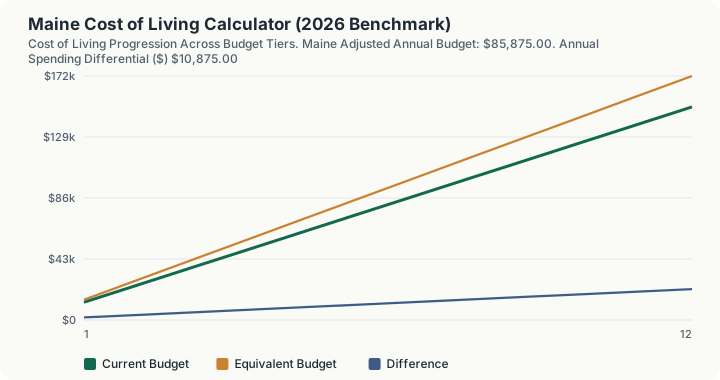
Maine is the one state in this batch that costs more, and every row of the table is above its baseline. The twelve rows scale the budget and hold the index at the composite 114.5 throughout. Row i prices budget × i ÷ 6, so from the $75,000 default the tiers step $12,500.00: row one returns $14,312.50 on $12,500.00, row two returns $28,625.00 on $25,000.00, row four returns $57,250.00 on $50,000.00, row six returns $85,875.00 on the $75,000.00 you entered, which is the headline exactly, and row twelve returns $171,750.00 on $150,000.00.
Every row carries the same premium proportionally. The difference column is 14.5% of that row's own tier all the way down: +$1,812.50 at row one, +$7,250.00 at row four, +$10,875.00 at row six, +$21,750.00 at row twelve. There is no zigzag and no crossover. The column rises on every step, which means the table can be read as a straight ladder: find the tier nearest your own household budget and the row beside it is your answer, without re-entering anything.
The headline is a single multiplication. Maine's composite of 114.5 is read from the MERIC table and applied to the whole budget, so the $75,000 default becomes $85,875.00, a differential of +$10,875.00 and +14.5%. The three sub-indices are printed for context and no code path weights them into that figure; the composite already carries MERIC's weights and the engine does not recompute them.
Housing is the whole story. At 124.6 it is nearly ten points above the composite and eighteen above groceries. Nothing on this page prices a budget at 124.6, though: the engine multiplies by the composite alone, and the housing, grocery and utility indices are published here purely so you can see which categories pull the 114.5 up and which hold it down. A household relocating to Maine with a paid-off house faces a materially smaller premium than the 14.5% headline; a renter faces a larger one.
Marginal cost of the next unit. Each additional $1,000 of national-baseline budget costs $1,145.00 in Maine, and each $10,000 costs $11,450.00. A $100,000 baseline returns $114,500.00, a $14,500.00 premium.
The reverse question, which for Maine runs downhill. A $75,000 Maine cost of living corresponds to a national baseline of only $65,502, which the calculator confirms at $74,999.79. Moving out of Maine to an average-priced state, that household needs $9,498 less to live identically.
Right method against wrong method, priced. Inbound, multiply by 1.145: $75,000 of national spending costs $85,875.00 in Maine. Outbound, divide: $75,000 of Maine spending needs $65,502 elsewhere. Using multiplication in the outbound direction produces $85,875.00 and overstates the requirement by $20,373, which is the same reversal error the low-index states make in the opposite direction and is largest here because Maine's index is furthest from 100.
What the composite cannot show. No metro or coastal dispersion, no tax, no seasonality. Maine's heating load is a real cost driver behind that 115.4 utility index, and the model has no month, no climate zone and no fuel type.
What This Does Not Account For
- Intra-state variance between major metropolitan urban centers and rural counties within Maine.
- Discretionary lifestyle choices, private schooling, and luxury expenditures.
- State income and property tax impacts on disposable take-home salary.
- Dynamic seasonal utility price surges during peak winter heating or summer cooling months.
Common Pitfalls
- Comparing State Averages Instead of Metro Areas: Living in a major metro area is often 20%-40% more expensive than the statewide average.
- Focusing Solely on Housing: Overlooking higher utility, transportation, or food costs in colder or remote regions.
- Ignoring Net Take-Home Pay: Comparing gross salary without factoring in state income and sales tax differentials.
- Failing to Adjust for Family Size: Larger households experience disproportionately higher grocery and healthcare expenditures.
Frequently Asked Questions
Is Maine expensive to live in?
What is the biggest cost factor in Maine?
How much salary do I need to maintain my lifestyle in Maine?
How often are cost of living indices updated?
Sources
- U.S. Bureau of Economic Analysis (BEA): Regional Price Parities. bea.gov/data/prices-inflation/regional-price-parities-state-and-metro-area
- U.S. Bureau of Labor Statistics (BLS): Consumer Expenditure Survey. bls.gov/cex
- Maine Revenue Services, the official state tax authority for Maine rates, rules and forms. maine.gov/revenue
Also consulted: MERIC: Cost of Living Data Series (2025/2026).