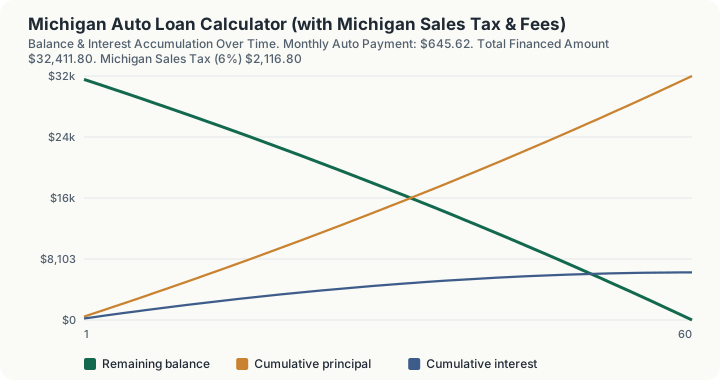
Quick Answer: A $35,000 vehicle in Michigan with $5,000 cash down, a $280 dealer documentation fee, a 60-month term, and a 7.25% APR carries a $645.62 monthly payment. That figure includes $2,116.80 of Michigan sales tax at the flat 6% rate and the $15 certificate of title fee, financing $32,411.80 in total.
Overview
Michigan gives you a trade-in tax credit, but only part of one. For 2026, the maximum trade-in value that can be deducted from your taxable price is $12,000. Trade in a car worth $20,000 and the state still taxes you on $8,000 of it. That single rule is the difference between a Michigan payment estimate that is right and one that is off by hundreds of dollars, and almost every generic auto loan calculator gets it wrong because it assumes the full-credit rule that most states use.
The cap is not permanent. Public Acts 159 and 160 of 2018 phase the credit in: it started at $5,000 in 2019 and rises $1,000 every January 1. It reaches $12,000 in 2026, $13,000 in 2027, $14,000 in 2028, and once it passes $14,000 in 2029 the statute lets it go uncapped, matching how the rest of the country treats trade-ins. Until then, a Michigan buyer with a valuable trade-in is paying tax that a buyer in neighboring Ohio or Indiana would not.
The rest of Michigan's math is simple by comparison. The rate is a flat 6% under MCL 205.52, and Michigan has no county or city sales taxes at all, so a buyer in Detroit, Grand Rapids, Traverse City, and Marquette all pay exactly the same rate on exactly the same base. There is no local rate input on this calculator because there is no local rate to enter.
Auto Loan APR by Credit Score
The APR columns below are national averages, not Michigan figures. No primary source publishes average auto loan APR by state: Experian's report has no geographic cut, the CFPB publishes state origination volume but no rates, and the New York Fed publishes state delinquency only. The payment column is the part that is specific to Michigan, because it runs this calculator's own Michigan tax and fee rules at each tier's rate.
| Credit Tier | VantageScore 4.0 | Avg New APR | Avg Used APR | Est. Payment in Michigan |
|---|---|---|---|---|
| Super prime | 781-850 | 4.55% | 6.30% | $604.99 |
| Prime | 661-780 | 6.23% | 8.77% | $630.08 |
| Nonprime | 601-660 | 9.67% | 14.03% | $683.40 |
| Subprime | 501-600 | 13.44% | 19.42% | $744.79 |
| Deep subprime | 300-500 | 16.01% | 21.77% | $788.36 |
Payment assumptions: $35,000 vehicle price, $0 trade-in, $5,000 cash down, $280 dealer documentation fee, 60-month term, new-vehicle APR applied to the Michigan delivered price including tax and statutory fees. At the 6.39% overall new-car average the same purchase costs $632.51 a month.
The score bands are VantageScore 4.0, not FICO. The same borrower can land in a different tier under each model, so a FICO score pulled from a card issuer will not always match the band here. Source: Experian, State of the Automotive Finance Market, Q1 2026, slide 45.
What Moves Your Payment
Each row changes one input and leaves the rest at the baseline below. The dollar effects are this calculator's own output for Michigan, not a rule of thumb.
| Factor | What Changes | Effect on Monthly Payment | Effect on Total Interest |
|---|---|---|---|
| Vehicle Price | Each extra $1,000 of price raises both the amount financed and the sales tax base, so the tax rises with it. | +$21.12 | +$206.87 |
| Trade-In Allowance | A $1,000 allowance cuts the amount financed and reduces the sales tax base, but the credit is capped at $12,000. Allowance above that cap still cuts the loan and no longer cuts the tax. | -$21.11 | -$206.87 |
| Cash Down Payment | A $1,000 larger down payment cuts the amount financed by $1,000. It never reduces the sales tax, which is assessed on the price, not on what you borrow. | -$19.92 | -$195.16 |
| Dealer Doc Fee | A $100 higher documentation fee adds $100 to the amount financed and is inside the sales tax base, so it is taxed on top of itself. Michigan caps the fee at $280. | +$2.11 | +$20.69 |
| Longer Term | Stretching the same balance from 60 months to 72 months spreads the principal over twelve more payments at the same rate. | -$89.13 | +$1,329.80 |
Baseline: $35,000 vehicle price, $0 trade-in, $5,000 cash down, $280 documentation fee, 60 months at 7.25% APR, giving a $645.62 payment and $6,325.58 of total interest.
How This Is Calculated
Michigan credits a trade-in but caps the credit at $12,000 for 2026, a ceiling that rises each year until it disappears in 2029. Four steps.
1. Trade-in credit after the cap. The credited amount is whichever is smallest: what the dealer allowed you, the price of the car you are buying, or the 2026 statutory ceiling.
2. Net taxable base. Michigan includes dealer preparation, delivery, and documentation charges in the taxable price, so the doc fee sits inside the base. The separately stated title fee does not.
3. Sales tax. One rate, statewide, with nothing stacked on top.
4. Amount financed and amortization. Here the full trade-in counts, not the capped portion. The tax cap limits the credit, not your equity, so every dollar the dealer allows you still reduces the balance you borrow.
That balance amortizes as a fixed-rate installment loan:
where $P$ is the financed amount, $i$ is the monthly rate (APR divided by 12), and $n$ is the term in months. Each period's interest is the outstanding balance times $i$, the remainder reduces principal, and the schedule reconciles to zero at maturity.
Worked Example
Michigan is the only state that caps the trade-in credit in dollars. For 2026 the ceiling is $12,000, rising a thousand a year until it disappears in 2029, and the effect is easiest to see by holding the car constant and varying the trade.
- Vehicle price: $35,000
- Trade-in allowance: $0
- Cash down: $5,000
- Dealer doc fee: $280
- Term: 60 months at 7.25% APR
Step 1 -- The credit allowed. With no trade-in there is nothing to cap: $0.00
Step 2 -- The taxable base. $35,000 + $280 doc fee - $0 credit = $35,280.00
Step 3 -- Michigan sales tax at 6%. $35,280.00 x 6% = $2,116.80
Step 4 -- The certificate of title, outside the base. $15.00
Step 5 -- Total delivered price. $35,000 + $280.00 + $2,116.80 + $15.00 = $37,411.80
Step 6 -- Amount financed. $37,411.80 - $0 trade-in - $5,000 cash down = $32,411.80
Step 7 -- The monthly payment. $32,411.80 at 7.25% over 60 months = $645.62
Step 8 -- Month 1. $32,411.80 x (7.25% / 12) = $195.82 interest, $449.80 principal, balance $31,962.00
Step 9 -- Month 2. $31,962.00 x (7.25% / 12) = $193.10 interest, $452.52 principal, balance $31,509.48. Cumulative interest: $388.92
Step 10 -- The accumulation. By month 12, $2,166.84 of interest paid and $26,831.20 outstanding. Over 60 months, $6,325.58
Now watch what the cap does. Three different trade-ins against the same $35,000 car:
| Trade-In Allowance | Credit Allowed | Taxable Base | Sales Tax | Tax Saved | Monthly Payment |
|---|---|---|---|---|---|
| $0 | $0 | $35,280.00 | $2,116.80 | $0.00 | $645.62 |
| $10,000 | $10,000 | $25,280.00 | $1,516.80 | $600.00 | $434.48 |
| $12,000 | $12,000 | $23,280.00 | $1,396.80 | $720.00 | $392.25 |
| $20,000 | $12,000 | $23,280.00 | $1,396.80 | $720.00 | $232.89 |
The last two rows carry identical tax. The $20,000 trade-in is worth $8,000 more to you than the $12,000 one, and every cent of that extra value goes to reducing the loan rather than the tax bill. Compare it to a state with an uncapped credit, where a $20,000 trade would tax you on $15,280 and produce $916.80 of tax. Michigan's cap costs that buyer $480.
Practical consequence: $720 is the most any trade-in can save you in Michigan sales tax in 2026, no matter how valuable the car. Once your trade clears $12,000, the tax argument for trading in at the dealership rather than selling privately stops growing. Above that point, compare the dealer's offer against a private sale price on the merits alone.
What This Does Not Account For
- Annual registration. Michigan's plate fee is ad valorem under MCL 257.801: it is a percentage of the vehicle's original manufacturer base list price, stepping down 10% per year in years two through four and then holding flat. There is no single flat figure that is honest across vehicles, so this calculator excludes it rather than inventing one. Expect it to be materially higher in the first year than later. A plate transfer is $5.
- Electric vehicle surcharge. Michigan adds an annual registration surcharge for EVs and plug-in hybrids. The 2026 amount was not confirmed against the statute, so it is not modeled.
- The 6% use tax on private-party purchases. Buying from a private seller does not avoid the tax. It moves it: MCL 205.93 imposes a 6% use tax collected by the Secretary of State when you title the vehicle, and there is no trade-in in a private sale to reduce it.
- Michigan's no-fault insurance premium, which is not part of the loan but is a large recurring cost in Michigan specifically.
- Negative equity, GAP insurance, extended warranties, and aftermarket add-ons, unless you fold them into the vehicle price yourself.
- The 2026 doc fee cap revision. The Department of Insurance and Financial Services adjusts the cap for inflation every two years by bulletin. $280 is the figure reported for the current cycle. Confirm it on your buyer's order.
Common Pitfalls
- Assuming your whole trade-in is deductible. This is the expensive one. If your trade is worth more than $12,000, the excess is taxed at 6% like any other part of the purchase price.
- Using last year's cap. The number moved to $12,000 on 1 January 2026 from $11,000 in 2025. Rate guides and dealer worksheets that were not refreshed will understate your credit by $1,000, which is $60 of tax.
- Looking for a local rate. Michigan has none. If a calculator or a quote shows you a combined rate above 6% on a vehicle, something else is being folded in.
- Forgetting the doc fee is taxed. At $280, that is $16.80 of extra tax. Small, but it belongs in the base, and it is why the baseline above shows $35,280 rather than $35,000.
- Treating the doc fee cap as a flat $280. It is the lesser of $280 or 5% of the cash price under MCL 492.113(2)(a). On a $4,000 used car the legal maximum is $200.
- Judging a loan by the monthly payment. Stretching this $32,411.80 balance from 60 to 72 months drops the payment to $556.49 and raises total finance charges from $6,325.58 to $7,655.34.
Frequently Asked Questions
What is Michigan's sales tax rate on cars?
How much of my trade-in is tax deductible in Michigan?
Why does Michigan cap the trade-in credit when other states do not?
Is the dealer documentation fee capped in Michigan?
How much is title and registration in Michigan?
Does Michigan charge an annual property tax on vehicles?
Sources
- Consumer Financial Protection Bureau, Truth in Lending Act (Regulation Z, 12 CFR § 1026.22) disclosure requirements for installment credit. ecfr.gov/current/title-12/chapter-X/part-1026
Also consulted: MCL 205.52 (Michigan General Sales Tax Act, 6% rate) and MCL 205.93 (use tax on vehicles titled in Michigan); MCL 205.51(1)(c) and MCL 205.92(1)(xii), as amended by Public Acts 159 and 160 of 2018 (phased trade-in credit and its annual dollar ceiling); MCL 492.113(2)(a), Motor Vehicle Sales Finance Act (documentary fee cap at the lesser of $280 or 5% of cash price), as adjusted by Department of Insurance and Financial Services bulletin; MCL 257.801 (annual registration fee computed from original manufacturer base list price with age step-down); Michigan Secretary of State, certificate of title and plate fee schedules; Experian, State of the Automotive Finance Market, Q1 2026, slide 45 (average new and used auto loan APR by VantageScore 4.0 credit tier; national, no state level cut published).
Michigan Secretary of State and Treasury PDFs, including the PA 159/160 trade-in guidance and Form 485, refuse automated retrieval. The $12,000 figure is corroborated by the Michigan Legislature's published MCL text and dealer association bulletins. Confirm the current year's cap on your buyer's order before signing.