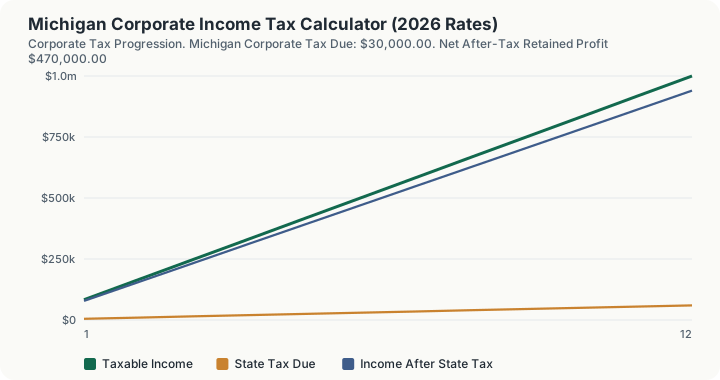
Quick Answer: On $500,000 of pre-apportioned taxable income, Michigan's flat 6.00% Corporate Income Tax produces $30,000.00 in state tax due and $470,000.00 in net after-tax profit, assuming the filer clears Michigan's $350,000 gross receipts filing threshold.
Michigan CIT: A Flat Rate With Two Structural Catches
Michigan's Corporate Income Tax is a flat 6.00% on apportioned C-corporation income, and it is worth being precise about which Michigan rate that is. Michigan's individual income tax is 4.25%, and the two are routinely confused because Michigan's pass-through owners pay the individual rate while C corporations pay the CIT. A corporation modeling Michigan exposure at 4.25% will understate its liability by roughly 41%.
Two structural features define Michigan far more than the rate does.
First: Michigan is a genuine mandatory unitary combined reporting state, and its version is more aggressive than most. A unitary business group is a single taxpayer under the CIT and must file one combined return on Form 4891. Membership turns on two tests applied together, a control test (one person owns or controls, directly or indirectly, more than 50% of the voting ownership interest of the others) and a relationship test (the members' activities produce a flow of value between them, or are integrated with, dependent upon, or contribute to one another). Meeting both is not optional and not elective. Intercompany transactions between members are eliminated, and the group apportions as a whole. This is a real dividing line: Alabama and Missouri, by contrast, are separate-entity states where consolidated filing is an election. A holding structure that files separate returns in those states may have no choice but to combine in Michigan.
Second: Michigan has a hard filing floor that most states lack. A taxpayer whose allocated or apportioned Michigan gross receipts are under $350,000 is not required to file a CIT return and owes no CIT at all. Separately, if computed CIT liability is $100 or less, it need not be paid. For a unitary business group, the $350,000 test is applied to the combined gross receipts of every member after eliminating intercompany transactions, so grouping can push a set of individually sub-threshold entities over the line. Short tax periods must annualize the figure. These two rules together mean a genuinely small Michigan presence can carry a zero filing obligation, which is unusual and materially relevant to small out-of-state sellers with modest Michigan sales.
At the calculator's $500,000 baseline, the flat 6.00% produces $30,000.00 and scales linearly. Michigan has no brackets, so $1,000,000 of Michigan income yields exactly $60,000.00.
How This Is Calculated
The Michigan CIT computation has a gate in front of it: the taxpayer (or the whole unitary group) must first clear the gross receipts filing threshold before the 6.00% rate is applied to anything.
- Read the income field as the taxable base. The single income input is taken as Michigan taxable corporate income exactly as typed. The code applies no modification, allocation or deduction to it before the rate stage; it is the base.
- Apply the single statutory rate. Michigan's 6.00% rate is multiplied against that figure with no bracket lookup, because the schedule has one band running from the first dollar: $500,000 x 6.00% = $30,000.00.
- Subtract credits and floor the result at zero. The credits field is subtracted from the step-2 figure and the difference is clamped at $0.00, so no credit entry can drive the liability negative. With the field at its $0 default the $30,000.00 stands; enter $12,000 of credits and the page returns $18,000.00, a reduction of exactly the credit entered because the subtraction is a straight one.
- Derive the reported rates from those two numbers. The effective rate is the tax divided by the income entered, 6.00% here, and the top statutory bracket is reported separately as 6.00%. Net after-tax retained profit is the income less the tax, $470,000.00. Those four outputs are the whole of what the engine produces.
Worked Example
Take the calculator's baseline: a corporation with $500,000 of taxable income apportioned to Michigan, filing either as a standalone taxpayer or as a unitary business group.
- Confirm the filing threshold is cleared. With $500,000 of apportioned Michigan income, gross receipts necessarily exceed $350,000, so a CIT return is required. A filer below that gross receipts line would stop here and owe nothing.
- Apply Michigan's flat statutory rate. Michigan taxes all C-corporation income at 6.00% with no bracket lookup: $500,000 × 6.00% = $30,000.00.
- Check the de minimis rule. $30,000.00 far exceeds the $100 threshold below which CIT need not be paid, so the full amount is due.
- Michigan CIT due: $30,000.00.
- Net retained profit. $500,000 − $30,000.00 = $470,000.00 retained after Michigan CIT, before federal liability and before any Detroit city tax.
Filing Mechanics: Form, Deadlines & Estimated Payments
- Return: Michigan Form 4891, Corporate Income Tax Annual Return. Unitary business groups file a single Form 4891 for the group, supported by Form 4897 (member data) and Form 4896 (UBG affiliates excluded).
- Due date: The last day of the fourth month after the close of the tax year, April 30 for calendar-year filers, not April 15.
- Extension: Form 4, Application for Extension of Time to File Michigan Tax Returns. An extension of time to file does not extend time to pay.
- Estimated payments: Required when annual CIT liability is reasonably expected to exceed $800. Quarterly returns and payments for calendar-year filers are due April 15, July 15, October 15, and January 15, note that the quarterly dates follow the 15th while the annual return follows the last day of the month, an inconsistency that generates avoidable late-payment interest.
Unitary Combination and the $350,000 Floor in Practice
Michigan's combination of mandatory combination and a hard filing floor produces planning considerations no flat-rate description captures: - Unitary Grouping Cuts Both Ways. Combination eliminates intercompany transactions and lets group losses offset group income, which often helps. But it also aggregates gross receipts for the $350,000 test, a set of small affiliates each below the floor individually can be pulled into a filing obligation together. The control test's "directly or indirectly" language means intermediate ownership chains count. - The $350,000 Floor as a Real Small-Business Shelter. For an out-of-state seller with modest Michigan sales, this threshold is more valuable than any credit. It is measured on gross receipts, not income, so a high-volume low-margin business can owe CIT while a low-volume high-margin one owes nothing. - Single Sales Factor Means Michigan Property Is Not Penalized. Because Michigan apportions on sales alone, locating plant, equipment, or headcount in Michigan does not by itself increase the Michigan tax base, an important point for automotive and supplier operations weighing Great Lakes footprint decisions. - Elective Flow-Through Entity Tax: Michigan offers an entity-level tax election for flow-through entities, letting the entity pay Michigan tax deductibly at the federal level and pass a credit to owners, a separate track from the 6.00% CIT modeled here.
Local Corporate Tax: Detroit and Michigan's City Income Taxes
Michigan is one of the few states where cities levy their own income taxes on corporations, and the relevant example is Detroit, not New York. Detroit imposes a city corporate income tax at 2% on corporate net profits apportioned to the city, the highest municipal corporate rate in Michigan. It is administered by the Michigan Department of Treasury on Detroit's behalf and filed separately from the state CIT, on its own city return.
A corporation operating within Detroit city limits therefore faces a combined state-plus-city rate of roughly 8% on Detroit-apportioned profits, a third above the 6.00% state figure. More than twenty other Michigan cities levy income taxes as well, though most at lower corporate rates than Detroit's. City-level apportionment uses its own formula and is computed independently of the state factor, so state and city taxable income can differ substantially for the same corporation.
The Statutes and Guidance Behind These Figures
- Michigan Income Tax Act, Part 2 (MCL 206.601 et seq.): The Corporate Income Tax, the 6.00% rate, the unitary business group definition, and the $350,000 filing threshold.
- Michigan RAB 2018-12: The Department of Treasury's guidance on applying the CIT control test, including indirect and constructive ownership.
- Public Law 86-272: Shields out-of-state corporations from Michigan's CIT where in-state activity is limited to soliciting orders for tangible personal property. Michigan's separate $350,000 gross receipts floor means many small sellers fall outside the tax on threshold grounds even where P.L. 86-272 protection would not apply.
- City Income Tax Act (MCL 141.501 et seq.): The enabling statute for Detroit's and other Michigan cities' income taxes on corporations.
The Filing Floor Is a Real Threshold, and the Engine Does Not Apply It
Michigan's rate schedule is flat, so the income sweep is a straight line. The threshold that actually matters in Michigan is not in the rate table at all, and that gap is the most important thing to say about the figures on this page.
The marginal cost of the next unit. Each additional $1,000 of apportioned Michigan income costs $60.00. The engine returns $30,000.00 at $500,000 and $30,060.00 at $501,000, and $29,400.00 at $490,000. At scale: $6,000.00 at $100,000, $60,000.00 at $1,000,000, $300,000.00 at the $5,000,000 enterprise row. Effective and marginal rate both read 6.00% at every point.
The threshold the engine skips. A taxpayer whose Michigan gross receipts fall below $350,000 has no CIT filing obligation at all, and the same taxpayer's calculated liability below $100 need not be paid. Neither test exists in this code path: the engine multiplies whatever income figure is entered by 0.06 from the first dollar. Enter $9,900 of income and it returns $594.00; enter $10,100 and it returns $606.00. A real filer at that scale, with gross receipts under $350,000, would owe $0.00. The floor is measured on gross receipts rather than income and there is no gross receipts input on this page, so the calculator cannot test it even in principle.
Right method against wrong method, priced. Entering $10,000 of credits against $500,000 of income takes the computed tax from $30,000.00 to $20,000.00, an exact $10,000.00 saving and an effective rate of 4.00%. Pursuing the same relief as a deduction, by reducing income to $490,000, saves only $600.00. At Michigan's 6.00% rate a credit is worth 16.7 times an equal deduction. Credits above the liability are discarded rather than carried forward: $40,000 of credits against $500,000 of income returns $0.00 and an effective rate of 0.00%, losing $10,000 of value that Michigan's own credit provisions might preserve.
The reverse question. A $30,000.00 Michigan CIT bill corresponds to exactly $500,000 of apportioned income, and each further $10,000 of tax to $166,667 of income. Against Minnesota's $102,041 for the same $10,000 step, Michigan's flatter rate means a marginal dollar of Great Lakes profit carries substantially less state tax.
And the Detroit layer is absent too. The 2% Detroit city corporate income tax described above is filed separately and appears in no output on this page. A corporation with all $500,000 of its profit apportioned into Detroit faces roughly $10,000 of city tax on top of the $30,000.00 computed here, raising the combined burden by a third, and there is no city field in which to record it.
What This Does Not Account For
- Federal Taxable Income Starting Point. Business income is determined under IRC § 63 before Michigan modifications. This calculator starts one step later: the income box is read as the finished Michigan taxable figure and nothing is derived from a federal return.
- Michigan Additions & Subtractions. Michigan-specific adjustments are applied, including the state's treatment of federal bonus depreciation and its statutory decoupling provisions. No addback and no subtraction is computed anywhere in this page's code path, so enter an income figure that already reflects them.
- Unitary Group Determination. Before apportionment, the control and relationship tests are applied to identify every member of the unitary business group; intercompany transactions among members are eliminated. No group, election or filing-method test is applied here. The code reads one income figure and one credit figure and nothing else.
- Gross Receipts Threshold Test. Allocated or apportioned Michigan gross receipts are measured against $350,000, combined across all group members for a UBG, annualized for short periods. Below the threshold, no return is required. No threshold test is applied here. The code reads one income figure and one credit figure and nothing else.
- Apportionment Factor Allocation. Income is apportioned to Michigan using a single sales factor, with market-based sourcing for receipts other than tangible personal property. The engine performs no apportionment of any kind. The word does not appear in the primitive this page binds to; the figure you type is taken as the Michigan figure and multiplied by the rate as it stands.
- Federal corporate income tax (21% under IRC § 11).
- Detroit's 2% city corporate income tax, or the corporate income taxes levied by Michigan's other city-tax jurisdictions.
- Michigan's separate insurance company and financial institution franchise regimes, which replace the CIT for those industries.
- Base Erosion and Anti-Abuse Tax (BEAT) or Global Intangible Low-Taxed Income (GILTI) provisions.
- Michigan does not impose a corporate franchise or net-worth tax on standard CIT taxpayers.
Common Pitfalls
- Using 4.25% Instead of 6.00%. Michigan's individual income tax is 4.25%; the Corporate Income Tax is 6.00%. This is the single most common Michigan modeling error, and it understates corporate liability by about 41%.
- Treating Unitary Combination as Optional. It is not. If the control and relationship tests are both met, the group is one taxpayer and must file combined on Form 4891. Filing separate Michigan returns for members of a unitary group is a filing-position error, not a planning choice.
- Ignoring the $350,000 Gross Receipts Floor. Small Michigan filers frequently pay and file when they had no obligation to do either. Conversely, UBG members test the threshold on combined receipts and can be caught by it unexpectedly.
- Mixing Up the Deadlines. The annual return is due the last day of the fourth month (April 30), while quarterly estimates are due on the 15th. Filers who apply one convention to both generate interest.
- Citing NYC-Style Local Tax Instead of Detroit's. Michigan's municipal corporate tax exposure is real and specific: Detroit at 2%, plus more than twenty other city-tax jurisdictions with their own apportionment rules.
Frequently Asked Questions
What is Michigan's corporate income tax rate?
Does Michigan require combined reporting?
Do all Michigan corporations have to file a CIT return?
When are Michigan CIT returns due?
How is multi-state corporate income apportioned to Michigan?
Sources
- Michigan Department of Treasury: Form 4891 and Form 4890 instructions (TY2025); CIT Filing Requirements and Unitary Business Group guidance. michigan.gov/treasury
Also consulted: Michigan Revenue Administrative Bulletin 2018-12: CIT Unitary Business Group Control Test; City of Detroit, Office of the Chief Financial Officer: Business Income Tax; Michigan Treasury, City of Detroit Corporate Income Tax.