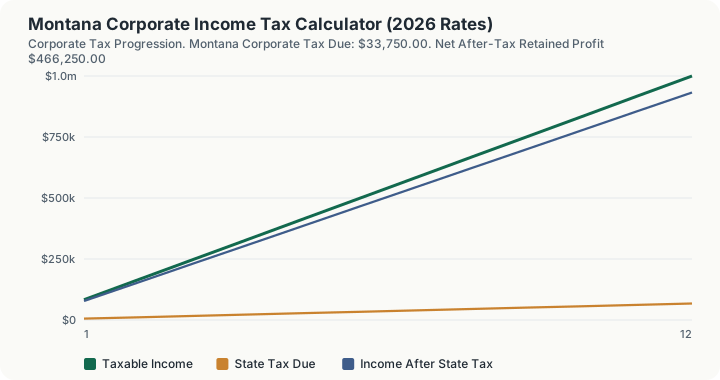
Quick Answer: On $500,000 of pre-apportioned taxable income, Montana's flat 6.75% corporate income tax rate produces $33,750.00 in state tax due and $466,250.00 in net after-tax profit.
A Flat Rate With No Bracket To Cross
Montana levies a flat 6.75% corporate income tax. Because there is one rate and no bracket array, the calculator's marginal rate output and its effective rate output print the same figure at every income level: 6.75% at $100,000 of apportioned income, where the tax is $6,750.00, and 6.75% at $5,000,000, where it is $337,500.00.
That is worth stating precisely because it is the one structural fact that changes how you read every other number on this page. In a graduated state, the answer to "what does the next dollar cost" depends on where you already are. In Montana it does not. The tier schedule below runs from $83,333.33 of apportioned income to $1,000,000, and the ratio of tax to income is identical in all twelve rows.
The calculator's $500,000 baseline produces $33,750.00. The same income at Virginia's or Michigan's 6.00% would produce $30,000.00, so the Montana rate costs $3,750.00 more on an identical apportioned base.
How This Is Calculated
The calculator takes the apportioned taxable income you enter, multiplies it by the flat 6.75% rate, subtracts the credits you enter, and floors the result at zero. It does not build the base for you.
- Read the apportioned taxable income you entered. The figure in the input box is treated as already apportioned to Montana and already net of state additions, subtractions and net operating loss carryforwards. The calculator performs none of those adjustments.
- Apply the flat 6.75% rate to that figure. There is no bracket lookup, because the Montana entry in the corporate rate table holds a single band running from $0 with no upper bound.
- Subtract the credits you entered. Credits come straight off the computed tax, dollar for dollar.
- Floor the result at zero. The subtraction is wrapped in a maximum against zero, so the tax due can never print as a negative number.
- Divide the net tax by the income to get the effective rate. With no credits this always returns 6.75%; with credits it returns something lower.
- Build the twelve-row tier schedule. Each row re-runs step 2 on your entered income multiplied by the row number and divided by six, so row 6 is your own figure and row 12 is double it.
Worked Example
Using this calculator's baseline scenario: a corporation with $500,000 in taxable income apportioned to Montana.
- Start with apportioned taxable income. The corporation has already apportioned $500,000 of its total taxable income to Montana, before any state-level tax is applied.
- Apply Montana's flat statutory rate. $500,000 x 6.75% = $33,750.00. No bracket lookup is required.
- Montana corporate tax due: $33,750.00.
- Net retained profit. $500,000 - $33,750.00 = $466,250.00 in after-tax profit retained by the corporation, before any separate federal liability.
The Only Step This Calculator Contains
Montana's rate schedule has no threshold in it, so the single discontinuity anywhere in this model comes from the credit field, and it is worth walking because it is easy to lose money to.
At $33,749 of entered credits. The computed tax of $33,750.00 less $33,749 leaves $1.00 of Montana tax due, and the effective rate rounds to 0.00%.
At $33,750 of entered credits. Liability reaches exactly $0.00.
At $33,751 of entered credits. Liability is still $0.00. The extra dollar of credit bought nothing.
That is the floor doing its work. Every credit dollar up to $33,750 is worth a full dollar; every credit dollar past it is worth zero in this calculation. The calculator does not carry the excess forward to a later year, does not refund it, and does not report how much of the credit went unused, so a corporation modelling a large credit here should read the $0.00 headline as "fully offset" and not as "credits exactly matched".
Each additional $1,000 of apportioned income costs $67.50. Raising the baseline from $500,000 to $501,000 moves the tax from $33,750.00 to $33,817.50, and the same $67.50 step applies at every point in the sweep, because the rate never changes.
The reverse question: how much income can be apportioned to Montana before the state tax reaches $10,000? At $148,148 of apportioned income the tax is $9,999.99. At $148,149 it is $10,000.06. So the answer is $148,148, and the line is entirely a function of arithmetic rather than of any statutory tier.
Reading the tier schedule the same way, row 1 sits at $83,333.33 of income and $5,625.00 of tax, and row 12 sits at $1,000,000 and $67,500.00. Twelve times the tax for twelve times the income, exactly.
What This Does Not Account For
- The $50 minimum tax is not applied. Montana floors corporate liability at $50 for filers that owe less. This calculator floors at $0.00, so a corporation with a small loss or a large credit will see $0.00 here where the state expects $50.
- The water's-edge election is not modelled. Montana applies a different rate to filers making that election, and the calculator only ever reads the general 6.75% rate.
- No apportionment is performed. Property, payroll and sales factors, single-sales-factor elections and market-based versus cost-of-performance sourcing all happen before the number you type in. Enter unapportioned income and the result will be overstated in proportion.
- No state modifications or NOL carryforwards are computed. The add-back of federally deducted Montana tax, state depreciation differences and NOL limits change the base and are your responsibility to apply first.
- Credits are taken at face value. The calculator does not test eligibility, apply per-credit caps, order credits against one another, or carry unused amounts forward.
- Federal corporate income tax (21% under IRC § 11) is a separate computation and is not included in any figure here.
- Specialized gross receipts taxes, entity franchise fees and annual report charges are outside the model.
- BEAT and GILTI provisions under the federal international regime are not reflected.
Common Pitfalls
- Mistaking the flat rate for the final bill. The 6.75% here applies to the apportioned, adjusted figure you supply, not to book income. On $500,000 the gap between those two bases is worth $67.50 for every $1,000 of difference.
- Reading a $0.00 result as "no return due". The calculator returns $0.00 once credits reach $33,750 on the baseline, but a Montana corporate return and the $50 minimum are unaffected by that display.
- Entering total company income rather than the Montana share. A multistate corporation with 10% of its sales in Montana that types its full $5,000,000 of income sees $337,500.00 instead of the $33,750.00 the 10% share would produce.
- Assuming the effective rate output tells you something new. With no credits entered it is always 6.75%, identical to the marginal rate output, because Montana has one band.
Frequently Asked Questions
Does Montana have a corporate income tax?
What does each extra $1,000 of Montana income cost a corporation?
When are Montana corporate tax returns due?
Does Montana tax S-corporations and LLCs?
Why does the calculator show $0.00 when I enter large credits?
Sources
- Montana Department of Revenue: Corporate Tax Statutes and Guidance (2026). mtrevenue.gov
- Multistate Tax Commission (MTC): Uniform Apportionment and Allocation Guidelines. mtc.gov