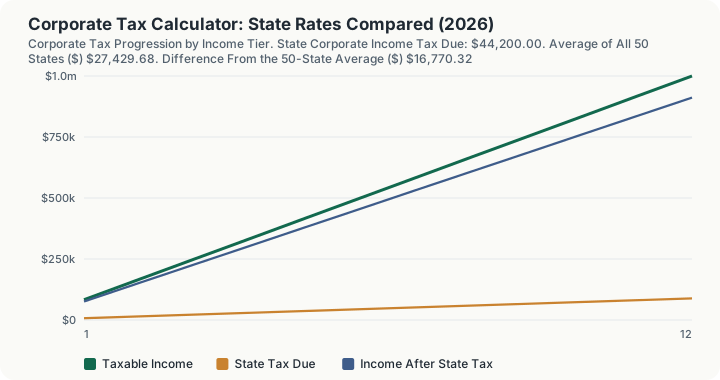
Quick Answer: At $500,000 of state taxable income, California's corporate income tax is $44,200.00, an effective rate of 8.84% and the 4th highest bill of the 50 states, against a 50-state average of $27,429.68.
What does this calculator do?
There is no single United States corporate tax rate at the state level. There are 32 states with a flat corporate income tax, 10 with graduated brackets, two (New Jersey and New York) that apply one rate to all of the income with the rate set by the income's size, four that levy a gross receipts tax instead of an income tax, and two with no entity level business tax at all. A calculator that answers "what is corporate tax" honestly has to let you pick the state and then tell you where that state sits against the rest.
That is what this page does. Select a state, enter the income apportioned to it, and the calculator returns the tax due, the effective and top marginal rates, the statutory structure, and the state's rank among all 50 at that income level, alongside the national average and median bills computed by running the same function for every state.
The federal corporate income tax, a flat 21% under Internal Revenue Code section 11, is a separate layer and is not part of this calculation.
The 2026 spread at $500,000 of taxable income
- Highest: Minnesota $49,000, Illinois $47,500, New Jersey $45,000, California $44,200, Delaware $43,500
- Lowest that still levies the tax: North Carolina $10,000, Missouri and Oklahoma $20,000, North Dakota $20,635
- Zero: Nevada, Ohio, Texas and Washington (gross receipts states), plus South Dakota and Wyoming
- 50-state average: $27,429.68. Median: $29,750.00
How is this calculated?
Flat state tax = Taxable Income × Statutory Rate
Graduated state tax = ∑_b (Income falling within bracket b) × Rate_b
Size-set state tax = Taxable Income × Rate of the band the whole income falls in
Tax Due = max(0, State Tax − Credits)
- State lookup. The selected state's entry is read from the 2026 state corporate tax table, which records its structure (flat, graduated, one rate set by income size, gross receipts, or none), its rate, and its bracket schedule.
- Flat states. Income is multiplied by the single statutory rate. The effective rate and the marginal rate are the same number.
- Graduated states. Each bracket is applied to the portion of income that falls inside it, and the results are summed. The marginal rate reported is the highest bracket the income actually reaches, so the effective rate comes out below it.
- New Jersey and New York. The size of the income picks one rate, and that rate applies to every dollar. New Jersey charges 6.50% up to $50,000, 7.50% up to $100,000, 9.00% above that, and 11.50% (including the 2.5% Corporate Transit Fee) once taxable income is over $10,000,000. New York charges 6.50%, or 7.25% when the business income base is over $5,000,000. Crossing a threshold reprices all of the income, so the bill jumps there.
- Gross receipts and no-tax states. Nevada, Ohio, Texas, Washington, South Dakota and Wyoming return zero, because none of them levies a corporate income tax on net income. See the section below on what that zero does and does not mean.
- Credits. Any credits you enter are subtracted from the computed tax, floored at zero. The marginal rate output is a statutory fact and is not adjusted by credits.
- National ranking. The same calculation is run for all 50 states at the income you entered, and the results are sorted. Rank 1 is the largest bill. States that owe nothing all share the same rank rather than being ordered arbitrarily. The average, median and highest-state figures come from that same 50-state run, not from a stored list.
Worked Example
A corporation with $500,000 of income apportioned to California, and no credits.
- Structure. California levies a flat corporate income tax, so there is no bracket walk.
- Rate applied. The 2026 statutory rate is 8.84%. $500,000 times 0.0884 is $44,200.00.
- Effective rate. $44,200.00 over $500,000 is 8.84%, identical to the marginal rate, as it always is in a flat state.
- Retained income. $500,000 minus $44,200.00 leaves $455,800.00 after state tax and before federal tax.
- National position. Running the same income through all 50 states, California ranks 4th highest, behind Minnesota ($49,000), Illinois ($47,500) and New Jersey ($45,000). The 50-state average is $27,429.68, so California is $16,770.32 above average.
Now the graduated case. Alaska at $500,000 owes $36,962.00, a 7.39% effective rate against a 9.40% top bracket, because its first $25,000 of income is rated at zero and the next $197,000 passes through eight lower brackets. This gap between marginal and effective is the entire practical difference between a graduated state and a flat one.
New Jersey is neither. With $5,000,000 of apportioned income it owes $450,000.00, exactly 9.00% of the whole amount, so its effective rate equals the rate applied. The structure shows at the thresholds instead: $10,000,000 owes $900,000.00, and $10,000,001 owes $1,150,000.12, because the Corporate Transit Fee lands on every dollar once income is over $10,000,000.
What does this calculator not account for?
- Gross receipts taxes are not computed. Ohio's Commercial Activity Tax, Washington's Business and Occupation tax, the Texas franchise (margin) tax and Nevada's Commerce Tax are all levied on receipts or margin, not on net income, and each has its own base, thresholds and industry rate schedules. This calculator returns zero corporate income tax for those four states and labels them as gross receipts states. A business in Ohio, Washington, Texas or Nevada will owe state business tax; it will simply not be the tax this calculator computes.
- Apportionment. You enter income already apportioned to the state. Working out that figure from a multistate sales, payroll and property formula, or from a single sales factor, is a separate exercise and often the largest number in the whole calculation.
- Minimum taxes and franchise fees. Many states impose a minimum tax or a capital-based franchise tax that applies regardless of income, including California's $800 minimum franchise tax and Delaware's separate franchise tax. None of those floors are applied here.
- Local corporate taxes. New York City, Philadelphia, and several other jurisdictions levy their own entity level taxes on top of the state.
- Surtaxes and temporary rate additions. New Jersey's Corporate Transit Fee and New York's 7.25% rate are applied. Other surcharges, such as Connecticut's 10% surtax on larger filers, are not.
- Federal tax, S corporation and partnership treatment. Pass-through entities are taxed on their owners' returns, not through this schedule, and pass-through entity tax elections are not modeled.
- Net operating losses, credits carried forward, and combined reporting. The income figure you enter is treated as the final taxable base.
What mistakes do people make with this?
- Reading a zero as "no business tax." Six states return zero here, but only South Dakota and Wyoming genuinely levy no entity level business tax. The other four moved the tax to a different base. This is the most expensive misreading available on this page.
- Using the top bracket rate as the effective rate in a graduated state. Alaska's 9.40% top bracket produces a 7.39% effective rate at $500,000. The two numbers are not interchangeable in the 10 graduated states.
- Slicing New Jersey or New York into marginal bands. Their rates apply to the whole base. Slicing New Jersey's $500,000 into 6.50%, 7.50% and 9.00% bands gives $43,000.00 against the correct $45,000.00.
- Comparing states on rate rather than on base. A low rate on a broad base can cost more than a high rate on a narrow one. Apportionment rules, throwback rules and the treatment of federal deductions all vary, and none of that shows up in a rate comparison.
- Forgetting the minimum tax when income is low or negative. At zero income this calculator returns zero, but most states still want their minimum tax or franchise fee.
- Assuming nexus follows incorporation. A state can tax income apportioned to it based on economic presence alone. Where you are incorporated and where you owe are different questions.
Frequently Asked Questions
Which state has the highest corporate income tax?
Which states have no corporate income tax?
Is the federal 21% rate included?
Why is my effective rate lower than the rate my state advertises?
Does this handle multistate businesses?
What income figure should I enter?
Sources
- Internal Revenue Code Section 11, federal corporate income tax rate. law.cornell.edu/uscode/text/26/11
- Internal Revenue Service, the official authority for the tax rules this calculator relates to. irs.gov
Also consulted: State Departments of Revenue and legislative sources for 2026 rate changes, including Georgia DOR, Idaho HB 40, Iowa DOR corporate rate order for TY2026, Maine Title 36 Section 5200, Mississippi DOR, Nebraska LB corporate rate reduction, and Utah SB 60.