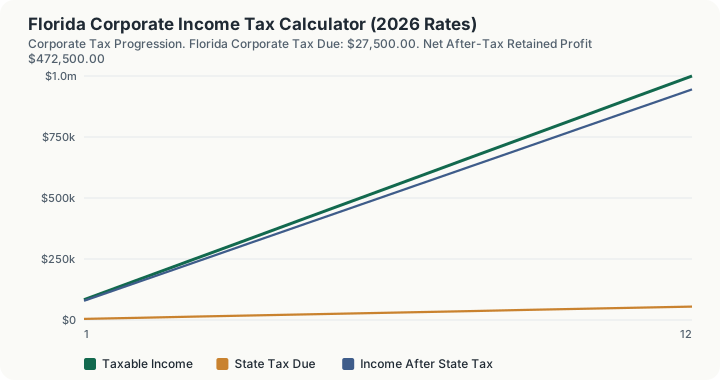
Quick Answer: On $500,000 of pre-apportioned taxable income, Florida's flat 5.50% corporate income tax rate produces $27,500.00 in state tax due and $472,500.00 in net after-tax profit.
Florida's Flat 5.50% in Context
Florida's corporate income tax rate is a flat 5.50%, a figure it shares exactly with Iowa and Louisiana despite the three states having little else in common geographically or economically. That puts Florida modestly below the middle of the pack among states that tax corporate income at all.
Because Florida has no state personal income tax, its corporate income tax carries more of the state's business-tax narrative than in states that also tax individual wages heavily. The 5.50% rate applies flatly to all apportioned C-corporation income with no brackets, so a small in-state retailer and a large multistate distributor both face the identical marginal rate once their income is sourced to Florida.
On the calculator's $500,000 baseline, Florida's flat rate produces $27,500.00 in state tax, identical to what Iowa and Louisiana would generate on the same income, since all three share the 5.50% figure exactly. A company splitting operations across all three states would face an equal per-dollar burden in each.
How This Is Calculated
Florida taxes C-corporation income at a flat 5.50%, and this calculator implements exactly that one multiplication. Florida statute also grants a standard exemption against net income before the rate applies, and that exemption is not implemented here, which is the main reason a small Florida filer's real bill can be zero where this page shows a figure. Florida imposes no personal income tax, so S corporations and LLCs generally face no Florida entity-level income tax at all; the entity choice, not the rate, drives most Florida outcomes, and this page has no entity type input.
- Take the entered income as final. The engine does not apportion. The number you type is treated as the Florida base already, with no additions, subtractions, or net operating loss adjustment applied to it.
- Multiply by 5.50%. Florida's stored schedule holds one bracket with no ceiling, so there is no bracket walk and no exemption subtracted before the rate.
- Deduct credits and floor at zero. The credits field comes off the gross tax dollar for dollar; the result cannot go negative.
- Divide for the effective rate. Net tax over entered income, which reads 5.50% whenever the credits field is empty.
- Subtract for net retained profit. Income less net tax.
- Run the same calculation at twelve income tiers, from one sixth of your figure to twice it, to populate the table above.
Worked Example
Using this calculator's baseline scenario: a corporation with $500,000 in taxable income apportioned to Florida.
- Start with apportioned taxable income. The corporation has already apportioned $500,000 of its total taxable income to Florida using the state's statutory apportionment formula, before any state-level tax is applied.
- Apply Florida's flat statutory rate. Florida taxes all C-corporation income at a single flat rate of 5.50%, regardless of income size, so no bracket lookup is required: $500,000 × 5.50% = $27,500.00.
- Florida corporate tax due: $27,500.00.
- Net retained profit. Subtracting the state tax liability from taxable income leaves $500,000 − $27,500.00 = $472,500.00 in after-tax profit retained by the corporation, before any separate federal tax liability is applied.
Because Florida uses a single flat rate rather than graduated brackets, the 5.50% effective rate is identical to the marginal rate at every income level: a corporation earning $50,000 and one earning $50 million both face the same 5.50% state rate on their apportioned income.
What the Twelve Income Tiers Cost in Florida
Florida's schedule is one open bracket at 5.50%, so the tier table is a straight line and there is no threshold anywhere in this code path to walk across. The devices that work here are the marginal figure, the reverse calculation, and the credit comparison.
Two rungs. Row 3 sets income at $250,000.00 and returns $13,750.00. Row 6, the $500,000 baseline, returns $27,500.00. Doubling income doubles the tax exactly, and the effective rate reads 5.50% at every one of the twelve rungs including the $1,000,000 top, where the engine returns $55,000.00.
The marginal figure. Each additional $1,000 of income apportioned to Florida costs $55.00. The engine returns $27,555.00 at $501,000 against $27,500.00 at $500,000. That $55.00 is also the cost of getting the apportionment wrong by $1,000 in the state's favour.
The reverse question. A company holding its Florida tax to $25,000 can carry $454,545.45 of apportioned income: the engine returns exactly $25,000.00 there, with $429,545.45 retained.
Credit against deduction, priced. A $25,000 Florida credit takes the liability from $27,500.00 to $2,500.00, saving the full $25,000.00. Removing $25,000 from the base instead, by entering $475,000, returns $26,125.00 and saves only $1,375.00. At a 5.50% rate the credit is worth 18.2 times the deduction, the widest ratio of any state in this family, precisely because the rate is low.
The exemption this page does not apply. Florida grants a standard exemption against net corporate income, which is why a large share of small Florida C corporations file and owe nothing. No exemption is subtracted anywhere in this code path: enter $10,000 of income and the engine returns $550.00, where Florida would likely return zero. The engine also performs no apportionment, no bonus depreciation decoupling and no net operating loss deduction, so the figure you enter has to already be the Florida base for the answer to be right.
What This Does Not Account For
- Federal corporate income tax (21% under IRC § 11).
- Specialized gross receipts taxes (e.g. Ohio CAT, Washington B&O, Texas Franchise Tax) where applicable.
- Minimum entity franchise tax fees or annual report filing charges.
- Base Erosion and Anti-Abuse Tax (BEAT) or Global Intangible Low-Taxed Income (GILTI) provisions.
- Local municipal corporate earnings taxes (e.g. NYC General Corporation Tax).
Common Pitfalls
- Mistaking the Flat Rate for the Final Bill: Assuming Florida's 5.50% rate applies directly to book income rather than to apportioned taxable income after state additions, subtractions, and NOL adjustments.
- Improper Apportionment Sourcing: Applying market-based sourcing vs cost-of-performance rules incorrectly for service revenue apportioned to Florida.
- Ignoring Unitary Group Combined Reporting: Failing to account for Florida's mandatory combined return requirements across related entities.
- Neglecting State NOL Carryforward Caps: Overlooking Florida's annual percentage limitations on net operating loss deductions.
Frequently Asked Questions
Does Florida have a corporate income tax?
When are Florida corporate tax returns due?
Does Florida tax S-corporations and LLCs?
How is multi-state corporate income apportioned to Florida?
Sources
- Florida Department of Revenue: Corporate Tax Statutes and Guidance (2026). floridarevenue.com
- Multistate Tax Commission (MTC): Uniform Apportionment and Allocation Guidelines. mtc.gov