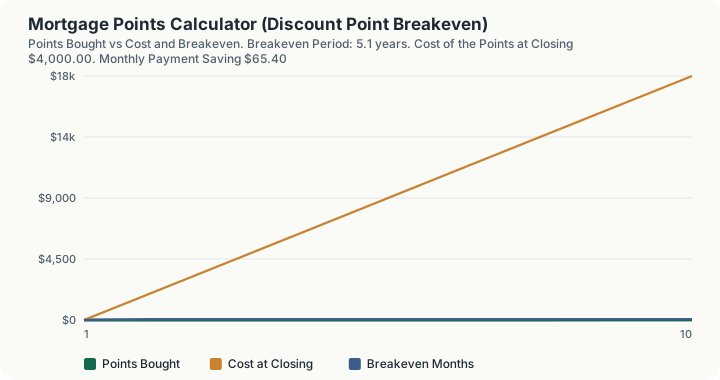
Quick Answer: Paying one point ($4,000) on a $400,000 loan to cut the rate from 6.5% to 6.25% saves $65.40 a month and breaks even after 5.1 years. Keep the loan longer and you are ahead by up to $19,544 over the full term. Move or refinance sooner and you have simply paid $4,000 for nothing.
What does this calculator do?
A discount point is 1% of the loan amount paid at closing to buy a lower interest rate. Whether that is worthwhile is a single question: how long will you keep this loan?
The breakeven is the point cost divided by the monthly saving. Before it, you are behind. After it, you are ahead. The arithmetic is simple; the judgement is not, because most borrowers substantially overestimate how long they will hold a mortgage. Median tenure is well under the breakeven periods that points commonly imply.
One useful property: buying more points does not usually change the breakeven. Two points for twice the rate reduction gives the same 5.1 years here, because both cost and saving double. What changes the breakeven is the rate reduction per point, which is what you should actually shop between lenders.
How is this calculated?
Cost of points:
Cost = Loan × Points/100
Monthly payments at each rate come from the standard annuity formula:
PMT = (P × i)/(1 − (1 + i)⁻ⁿ)
Breakeven is then simply:
Months = Cost/(PMT_without − PMT_with)
The page also shows the net saving over the full term: total interest avoided, less the cost of the points.
Worked Example
A borrower is offered 6.5% on a $400,000 thirty-year loan, or 6.25% for one point paid at closing.
Step 1: The cost of the point. $400,000 x (1 / 100) = $4,000.00
Step 2: The payment at the undiscounted rate. $400,000 at 6.5% over 360 months = $2,528.27 a month
Step 3: The payment at the discounted rate. $400,000 at 6.25% over 360 months = $2,462.87 a month
Step 4: The monthly saving. $2,528.27 - $2,462.87 = $65.40
Step 5: The breakeven. $4,000.00 / $65.40 = 61 months, or 5.1 years
Step 6: The verdict that produces. A moderate breakeven: worth it only if the loan survives past that point
Step 7: Held to term. Interest avoided over thirty years, net of the $4,000 paid, is $19,544.00
Steps 5 and 7 answer different questions and both matter. The point is a bet on how long the loan lives, and the median American mortgage does not reach year six.
Now scale both sides of the trade at once:
Step 8: Two points buying a half-point cut, 6.5% to 6.00%. Cost $8,000.00, payment $2,398.20, monthly saving $130.07
Step 9: The breakeven on that deal. $8,000.00 / $130.07 = 62 months, still 5.1 years, with a lifetime saving of $38,825.20
Doubling the cost and doubling the rate cut leaves the breakeven where it was. The number of points is not the variable that matters. The rate reduction per point is.
Step 10: One point for half the rate cut, 6.5% to 6.375%. Cost is unchanged at $4,000.00, but the payment only falls to $2,495.48, a saving of $32.79
Step 11: The breakeven that produces. $4,000.00 / $32.79 = 122 months, or 10.2 years, and the verdict changes to a long breakeven that most borrowers never reach
Same money, half the benefit, double the wait. Steps 8 through 11 are the comparison to make across lender sheets, and it is not the one most rate sheets invite.
Term changes the answer too, in the direction people usually guess wrong:
Step 12: The original point on a 15-year loan. Payments of $3,484.43 and $3,429.69, a monthly saving of only $54.74
Step 13: Breakeven on the shorter term. $4,000.00 / $54.74 = 73 months, or 6.1 years, with a lifetime saving of just $5,853.20
A shorter loan carries less interest for a lower rate to remove, so the same point buys less. Paying for rate is worth most on the longest loans, which is exactly where borrowers are least likely to still be holding it.
What does this calculator not account for?
- The opportunity cost of the cash. $4,000 at closing could have been invested, or used to reduce the loan balance directly. The simple breakeven ignores this, which flatters points.
- Tax deductibility. Points on a primary residence purchase may be deductible in the year paid in the US, and on a refinance are usually amortised over the loan term. That materially changes the after-tax breakeven.
- The refinance you have not planned yet. Rates fall, people refinance, and the points paid on the old loan are gone. This is the single largest risk to the calculation.
- Selling the home, which ends the benefit at the same moment.
- Lender credits, the reverse trade: taking a higher rate for cash at closing.
- Whether the quoted reduction is real. Some lenders quote points against an inflated base rate, so the reduction is less than it appears.
- Loan level price adjustments, which vary the rate by credit score and LTV independently of points.
- Making extra principal payments, which shortens the effective loan life and therefore the window in which points pay off.
What mistakes do people make with this?
- Overestimating how long you will keep the loan. This is the central error. A 5.1-year breakeven sounds comfortable against a 30-year term, but median mortgage tenure is far shorter than borrowers expect, because both moving and refinancing end it.
- Comparing points instead of rate reduction per point. Two points at 0.25% each is the same trade as one point at 0.25%, just larger. One point for 0.125% is a different and worse trade.
- Ignoring the opportunity cost. The breakeven here is nominal. Discounting the monthly savings at any positive rate pushes it further out.
- Forgetting the tax treatment. In the US, points on a purchase may be deductible immediately while points on a refinance are amortised, which can change the answer entirely.
- Buying points when planning extra payments. Paying down principal faster shortens the loan and can leave you short of the breakeven.
- Treating a long breakeven as merely suboptimal. If it exceeds your realistic holding period, buying points is not a marginal call. It is a straight loss.
Frequently Asked Questions
What is a mortgage point?
How much does a point lower the rate?
What is a good breakeven period?
Does buying more points improve the deal?
Are points tax deductible?
What if I refinance before breakeven?
Sources
- Consumer Financial Protection Bureau, "How should I use lender credits and points?" consumerfinance.gov/ask-cfpb/what-are-discount-points-and-lender-credits-and-how-do-they-work-en-136
- Regulation Z (Truth in Lending), 12 CFR Part 1026, including the Appendix J annual percentage rate computation. ecfr.gov/current/title-12/chapter-X/part-1026
Also consulted: Standard loan amortisation mathematics. The payment formula and the breakeven calculation carry no jurisdictional content; US tax treatment of points, deductible in the year paid on a purchase and amortised on a refinance, is noted as a factor the calculation excludes rather than applied.