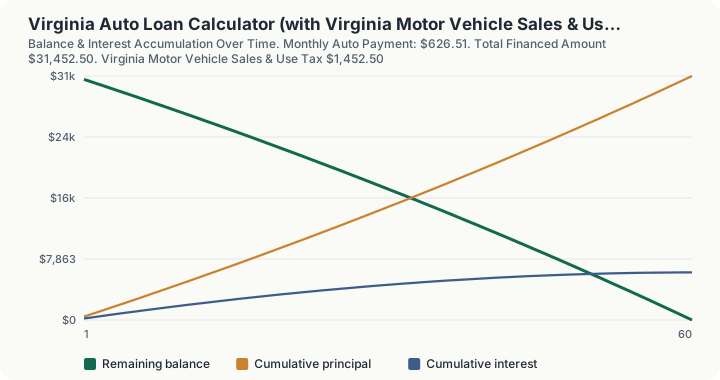
Quick Answer: A $35,000 car in Virginia with $5,000 cash down, a 60-month term, and a 7.25% APR carries a $626.51 monthly payment, including $1,452.50 of Motor Vehicle Sales and Use Tax at 4.15% and financing $31,452.50. Virginia allows no trade-in credit, so a $10,000 trade cuts your loan by $10,000 and your tax by nothing.
Overview
Virginia does not let a trade-in reduce your car tax. That is the fact this page is built around, because almost every online payment estimate gets it wrong, and getting it wrong costs a real buyer real money at the DMV counter.
The statute is explicit and it covers both halves of the market. Va. Code § 58.1-2405 says of a new motor vehicle that the sale price "in no case shall such lesser price include credits for trade-in or any other transaction of such nature." For a vehicle that is not new it says "in no case shall any credit be allowed for trade-in, prior rental or any other transaction of like nature." New or used, the tax base is the full sale price.
The practical consequence: in a state like Maryland's neighbours to the south, or in Texas, a $10,000 trade-in saves you several hundred dollars of tax. In Virginia it saves $0. A private sale of your old car therefore costs you nothing in forgone tax credit, which flips the usual advice. If a private buyer will pay $800 more than the dealer's trade offer, that $800 is yours in full.
The second Virginia-specific rule is a floor rather than a ceiling. Va. Code § 58.1-2402 imposes the tax at 4.15% but never less than $75. On any car below roughly $1,807 the floor replaces the percentage, so a $1,000 beater owes $75, not $41.50.
Third, ignore your local rate. The general retail sales tax runs 6.0% to 7.0% in Northern Virginia, Hampton Roads, and Central Virginia. None of that reaches a car. A vehicle titled under Title 58.1, Chapter 24 is exempt from the general sales and use tax, and the DMV collects a flat 4.15% statewide instead. Virginia takes its local vehicle revenue annually, through the personal property "car tax," which is a separate and substantial bill this calculator does not model.
Auto Loan APR by Credit Score
The APR columns below are national averages, not Virginia figures. No primary source publishes average auto loan APR by state: Experian's report has no geographic cut, the CFPB publishes state origination volume but no rates, and the New York Fed publishes state delinquency only. The payment column is the part that is specific to Virginia, because it runs this calculator's own Virginia tax and fee rules at each tier's rate.
| Credit Tier | VantageScore 4.0 | Avg New APR | Avg Used APR | Est. Payment in Virginia |
|---|---|---|---|---|
| Super prime | 781-850 | 4.55% | 6.30% | $587.08 |
| Prime | 661-780 | 6.23% | 8.77% | $611.43 |
| Nonprime | 601-660 | 9.67% | 14.03% | $663.18 |
| Subprime | 501-600 | 13.44% | 19.42% | $722.75 |
| Deep subprime | 300-500 | 16.01% | 21.77% | $765.03 |
Payment assumptions: $35,000 vehicle price, $0 trade-in, $5,000 cash down, $0 dealer documentation fee, 60-month term, new-vehicle APR applied to the Virginia delivered price including tax and statutory fees. At the 6.39% overall new-car average the same purchase costs $613.79 a month.
The score bands are VantageScore 4.0, not FICO. The same borrower can land in a different tier under each model, so a FICO score pulled from a card issuer will not always match the band here. Source: Experian, State of the Automotive Finance Market, Q1 2026, slide 45.
What Moves Your Payment
Each row changes one input and leaves the rest at the baseline below. The dollar effects are this calculator's own output for Virginia, not a rule of thumb.
| Factor | What Changes | Effect on Monthly Payment | Effect on Total Interest |
|---|---|---|---|
| Vehicle Price | Each extra $1,000 of price raises both the amount financed and the Motor Vehicle Sales and Use Tax base, so the tax rises with it. The Motor Vehicle Sales and Use Tax has a $75 floor, so a cheap vehicle pays the floor rather than the percentage. | +$20.75 | +$203.26 |
| Trade-In Allowance | A $1,000 allowance cuts the amount financed by $1,000, but it does not reduce the Motor Vehicle Sales and Use Tax base. Virginia gives no trade-in tax credit, so you are taxed on the full price. | -$19.92 | -$195.16 |
| Cash Down Payment | A $1,000 larger down payment cuts the amount financed by $1,000. It never reduces the Motor Vehicle Sales and Use Tax, which is assessed on the price, not on what you borrow. | -$19.92 | -$195.16 |
| Dealer Doc Fee | A $100 higher documentation fee adds $100 to the amount financed and is inside the Motor Vehicle Sales and Use Tax base, so it is taxed on top of itself. | +$2.08 | +$20.33 |
| Longer Term | Stretching the same balance from 60 months to 72 months spreads the principal over twelve more payments at the same rate. | -$86.49 | +$1,290.45 |
Baseline: $35,000 vehicle price, $0 trade-in, $5,000 cash down, $0 documentation fee, 60 months at 7.25% APR, giving a $626.51 payment and $6,138.43 of total interest.
How This Is Calculated
Virginia allows no trade-in credit and floors its 4.15% Motor Vehicle Sales and Use Tax at $75. Four steps.
1. Taxable sale price. No trade-in is subtracted. The dealer processing fee is added, because since 1 January 1997 any amount designated a processing fee and disclosed under Va. Code § 46.2-1530(A)(10) is subject to the motor vehicle sales and use tax.
2. Tax, with a floor. A flat rate statewide, then the statutory minimum.
3. Delivered price. Price plus processing fee plus tax. DMV title and registration are excluded here, for the reason given in the next section.
4. Amount financed and amortization. The trade-in appears for the first time at this step. It reduces the balance you borrow and nothing else.
The balance amortizes as a fixed-rate installment loan:
where $P$ is the financed amount, $i$ is the monthly rate (APR ÷ 12), and $n$ is the term in months. Each period's interest is the outstanding balance times $i$, the remainder reduces principal, and the schedule reconciles to zero at maturity.
Worked Example
Virginia does not credit trade-ins. Va. Code 58.1-2405 says the sale price shall in no case include credits for trade-ins, and the run below is worth reading for the step that stays flat when the trade appears. No title or registration fee is financed here, because the DMV chart could not be verified.
- Vehicle price: $35,000
- Trade-in allowance: $0
- Cash down: $5,000
- Processing fee: $0
- Term: 60 months at 7.25% APR
Step 1 -- The taxable sale price. Sale price with no deduction for a trade-in permitted: $35,000.00
Step 2 -- Motor Vehicle Sales and Use Tax at 4.15%. $35,000.00 x 4.15% = $1,452.50
Step 3 -- Test the statutory floor. $1,452.50 is above the $75 minimum, so the percentage governs: $1,452.50
Step 4 -- Total delivered price. $35,000 + $1,452.50 = $36,452.50
Step 5 -- Amount financed. $36,452.50 - $0 trade-in - $5,000 cash down = $31,452.50
Step 6 -- The monthly payment. $31,452.50 at 7.25% over 60 months = $626.51
Step 7 -- Month 1. $31,452.50 x (7.25% / 12) = $190.03 interest, $436.48 principal, balance $31,016.02
Step 8 -- Month 2. $31,016.02 x (7.25% / 12) = $187.39 interest, $439.12 principal, balance $30,576.90. Cumulative interest: $377.42
Step 9 -- The accumulation. Interest through month 12 is $2,102.73 with $26,037.11 outstanding. Over 60 months, $6,138.43
Now add a $10,000 trade-in. The taxable sale price stays at $35,000. The tax stays at $1,452.50. Only the loan moves, to $21,452.50, and the payment to $427.32. Had Virginia allowed the credit, the same trade would have cut the tax by $415. It does not, and that $415 is the number to carry into your decision about whether to trade in or sell privately.
Add a $899 processing fee instead and the taxable price becomes $35,899, the tax $1,489.81, and the delivered price $37,388.81. The fee costs $936.31 once its own tax is counted.
On a cheap car the floor takes over. A $1,500 vehicle would owe $62.25 at 4.15%, so it owes the $75 minimum instead and the delivered price is $1,575. The crossover sits between $1,807, where 4.15% comes to $74.99 and the floor still applies, and $1,808, where it comes to $75.03 and the percentage takes over.
What This Does Not Account For
- The annual car tax, which is the largest omission here. Virginia localities levy an annual ad valorem personal property tax on vehicles normally garaged in the locality, under Va. Code §§ 58.1-3503(A) and 58.1-3506, assessed on J.D. Power clean trade-in value as of 1 January. Rates are set per $100 of assessed value and vary widely by locality. Va. Code § 58.1-3524 provides partial state-funded relief on the first $20,000 of assessed value of a qualifying personal-use vehicle, at a percentage each locality sets annually. Over a five-year loan this recurring bill can rival the purchase tax several times over. Locality rates change every year, so ask your commissioner of the revenue rather than trusting a figure you found online.
- DMV title and registration fees. Titling is widely reported at $15 and passenger registration at $30.75 per year under 4,000 lbs or $35.75 at and above, but the official DMV201 fee chart would not text extract for verification, so those amounts are left out of the delivered price rather than presented as confirmed. Add them yourself once you have the current chart. Many localities also add a local registration or transit-district fee.
- The used-vehicle book value floor. For a used vehicle no more than five years old and listed in a recognized pricing guide, § 58.1-2405 sets the taxable price at no less than the guide value minus $1,500, unless the purchaser files an affidavit under penalty of perjury stating the actual lesser price. A price-only model understates tax on a below-book used purchase.
- The Highway Use Fee charged at registration on electric and fuel-efficient vehicles.
- The online systems filing fee and manual transaction fee under §§ 46.2-1530.1 and 46.2-1530.2, which are distinct from the processing fee.
- GAP insurance, extended service contracts, and aftermarket accessories, unless you fold them into the vehicle price yourself.
Common Pitfalls
- Deducting your trade-in from the tax base. The single most expensive Virginia mistake. On a $35,000 car with a $10,000 trade you will be $415 short of the tax actually due.
- Using your regional sales tax rate. Someone in Fairfax reads 6.0% and applies it to a car. On a $35,000 price that overstates the tax by $647.50. The general rate does not touch a Chapter 24 vehicle.
- Forgetting the $75 minimum on an inexpensive car. Below about $1,807 the floor governs, and a percentage-only estimate is low.
- Assuming the processing fee is capped. Va. Code § 46.2-1530(A)(10) is a disclosure and filing rule, not a cap. Virginia processing fees run high by national standards, and every dollar of the fee carries 4.15% tax on top.
- Budgeting only for the purchase. The annual car tax is a recurring locality bill assessed on the vehicle's value each January. Buying a more expensive car raises it every year you own the car, not just at the counter.
- Assuming a private sale of your old car costs you a tax credit. In most states it does. In Virginia there is no credit to lose, so compare the private offer against the trade offer on price alone.
- Judging the loan by the payment alone. Stretching this $31,452.50 balance from 60 to 72 months lowers the payment to $540.02 and raises total finance charges to $7,428.69.
Frequently Asked Questions
Does a trade-in reduce sales tax in Virginia?
What is the sales tax on a car in Virginia?
Why is the car rate 4.15% when my local sales tax is 6%?
What is the minimum car tax in Virginia?
Is the Virginia dealer processing fee taxable?
What is the Virginia car tax I keep hearing about?
Sources
- Consumer Financial Protection Bureau, Truth in Lending Act (Regulation Z, 12 CFR § 1026.22) disclosure requirements for installment credit. ecfr.gov/current/title-12/chapter-X/part-1026
- Virginia Department of Taxation, the official state tax authority for Virginia rates, rules and forms. tax.virginia.gov
Also consulted: Va. Code § 58.1-2402 (Motor Vehicle Sales and Use Tax imposed at 4.15%, $75 minimum); Va. Code § 58.1-2405 (basis of tax; no credit for trade-in on new or used vehicles; the guide-value-minus-$1,500 floor for used vehicles up to five years old); Va. Code § 46.2-1530(A)(10) (dealer processing fee disclosure and filing; taxability effective 1 January 1997), and §§ 46.2-1530.1 and 46.2-1530.2 (distinct filing and manual transaction fees); Va. Code §§ 58.1-3503(A) and 58.1-3506 (annual local personal property tax on motor vehicles) and § 58.1-3524 (Personal Property Tax Relief Act); Virginia Legislative Information System, published statute text at law.lis.virginia.gov; Virginia Department of Motor Vehicles, titling and registration guidance; Experian, State of the Automotive Finance Market, Q1 2026, slide 45 (average new and used auto loan APR by VantageScore 4.0 credit tier; national, no state level cut published).