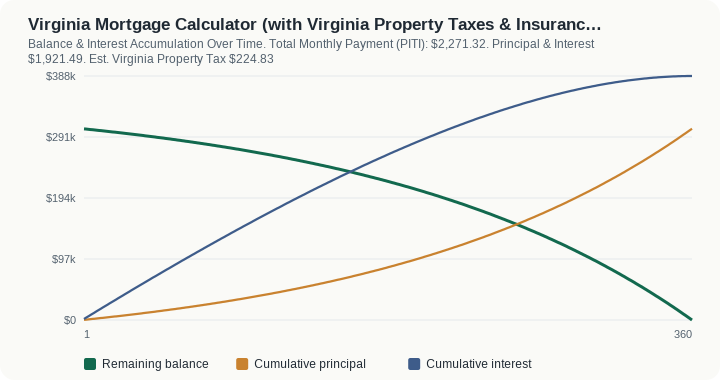
Quick Answer: With $380,000 as the price, 20% down and a 6.5% 30-year fixed rate, this Virginia mortgage calculator returns $2,274.40 a month: $1,921.49 principal and interest, $224.83 of property tax at Virginia's 0.71% effective rate, and $128.08 for insurance, the Virginia average premium.
Virginia in Two Lines of the Config
Virginia's version of this tool differs from the others in two constants. The first is a 0.71% tax rate applied to the purchase price, the Census Bureau's Virginia figure for median taxes paid divided by median home value. The second is a $128.08 monthly insurance line.
Together they put the Commonwealth near the middle. Using a $380,000 house, 20% down and 6.5%, its $2,274.40 monthly figure ranks 32nd of 50 (1st is the costliest). California and Kentucky carry the same 0.71% rate, so the $10.84 spread across the three comes entirely from their insurance averages. The tax line is $56.31 a month lighter than it would be at 0.89%, which is the unweighted mean of the 50 state ratios rather than a true national average.
Real Virginia bills come from each county and independent city, each with its own rate. A single Commonwealth ratio cannot tell Fairfax County from Richmond or Roanoke, so treat the $224.83 as a benchmark and swap in your locality's rate before you commit.
How is this calculated?
The $304,000 loan (price less the $76,000 down) is paid off in 360 level installments of $1,921.49 at 6.5%, with each month's interest rounded to the cent. The tax line is $380,000 x 0.71% = $2,698 a year, shown as $224.83 a month, and it stays pinned to the purchase price for the whole term. Insurance comes in at $128.08, a twelfth of $1,537: the average annual HO-3 premium NAIC published for Virginia from 2023 data, 28th of the 50 states and $200 short of the $1,737 countrywide mean. Treat it as the Commonwealth's typical policy across all coverage levels, not a quote for your house; the tool also leaves it unchanged whatever price you type. Add it and you have $2,274.40.
Worked Example
Three purchase prices, each with 20% down at 6.5%. The middle one is Virginia's Census median value for owner-occupied homes, $403,500.
- $250,000: borrowing $200,000 costs $1,264.14 a month before escrow; with $147.92 of tax and the insurance line, the total is $1,540.14.
- $403,500: borrowing $322,800 costs $2,040.32 a month; tax adds $238.74 and the total is $2,407.14. Annual tax is $403,500 x 0.71% = $2,864.85, and interest over the full term comes to $411,709.95.
- $600,000: borrowing $480,000 costs $3,033.93 a month; tax adds $355.00 and the total is $3,517.01.
On the $380,000 default, 84.48% of the payment is loan, 9.89% is tax and 5.63% is insurance. The very first installment is $1,646.67 interest and only $274.82 principal. Across 30 years the unchanging tax line sums to $80,940, a fifth of the $387,732.82 in interest.
Tax overtakes the $128.08 insurance line once a Virginia house costs more than about $216,473. At the median, tax is already more than 1.8 times the insurance figure.
Rate and Down Payment Sensitivity
Holding the $380,000 price, a half point is worth roughly $100 a month either way: 6% gives $2,175.54 and 7% gives $2,375.43. Over 30 years the 7% loan costs $424,106.79 in interest against $352,150.55 at 6%.
Down payment moves the bill more. At 10% down the total is $2,514.58; at 5% it is $2,634.68; at nothing down it is $2,754.77. Pushing the price up 25% to $475,000 with the default 20% down gives $2,810.98, of which $281.04 is tax.
VA-guaranteed loans can be made with nothing down. Running the median $403,500 house at 0% down and 6.5% returns $2,917.21, with $2,550.39 of that going to the loan. At 3.5% down the same house shows $2,827.95. Neither figure includes the VA funding fee or FHA mortgage insurance; see the PMI note below.
Closing Costs Beyond the Monthly Figure
Virginia charges state recordation tax on the deed and a grantor tax that the seller normally pays; the Virginia real estate transfer tax calculator works out both. This mortgage tool models no closing cost of any kind, so budget those separately along with title and lender charges.
Virginia Housing, the state housing finance agency, offers a Down Payment Assistance Grant that it describes as one you never repay. It pairs only with a Virginia Housing FHA or conventional bond loan, and it is aimed at qualified first-time buyers or repeat buyers purchasing in Areas of Economic Opportunity. The calculator has no grant input: lower the down payment percentage you enter to see what the grant does to the loan.
Your Locality's Bill
Assessment, appeal windows and local relief for older owners all belong to the Virginia property tax calculator. For escrow purposes, the point to carry over is that a county or city may bill once or twice a year under Va. Code 58.1-3916, and your servicer simply pays whichever schedule applies while this tool spreads the year into twelve equal parts.
Virginia Against the States Around It
| State | Rate | Tax a month at $380,000 | Insurance | PITI |
|---|---|---|---|---|
| Maryland | 0.95% | $300.83 | $131.50 | $2,353.82 |
| Virginia | 0.71% | $224.83 | $128.08 | $2,274.40 |
| Kentucky | 0.71% | $224.83 | $127.08 | $2,273.40 |
| North Carolina | 0.61% | $193.17 | $154.33 | $2,268.99 |
| West Virginia | 0.52% | $164.67 | $98.25 | $2,184.41 |
| Tennessee | 0.45% | $142.50 | $137.42 | $2,201.41 |
The Potomac is the biggest step up. A Northern Virginia buyer weighing Montgomery County, Maryland, faces a modelled tax line $76.00 higher each month across the river at an identical price, and $79.42 more in all once Maryland's slightly dearer insurance is added. Southwest Virginia buyers looking at Bristol, Tennessee, save $82.33 of tax but give back $9.34 on insurance, for a net $72.99. North Carolina is closer than its rate suggests: $31.66 less tax, $26.25 more insurance, $5.41 cheaper overall. West Virginia, cheaper on both lines, is the largest drop at $89.99.
If Payments Stop: Trustee Sales
Where a Virginia home loan is secured by a deed of trust, Va. Code 55.1-320 lets the trustee, after a default and at the lender's request, sell the house at auction without a court case. For an owner-occupied home, 55.1-321 requires the owner to get notice by certified or registered mail at least 60 days before the sale, stating the last payment received, the arrears and the remaining balance, with a line in at least 12-point type saying it is not a notice to vacate. Section 55.1-322 adds newspaper advertising, generally once a week for four successive weeks, with the sale no earlier than eight days after the first notice appears.
None of that is modelled. It matters because no judge sits between a missed payment and the auction, so a cash reserve sized against a few months of the $2,274.40 payment is worth planning for.
PMI and Escrow
No private mortgage insurance is charged at any down payment, so the 5% and 10% figures above are lower than a conventional lender would quote, and VA funding fees and FHA premiums are missing too.
What does this calculator not account for?
- Your county's or city's actual rate. One 0.71% ratio stands in for every locality.
- Recordation, grantor, title and lender charges at settlement.
- Local tax relief for owners 65 and over or disabled owners.
- PMI, FHA premiums and the VA funding fee.
- Reassessment. Tax is computed on the purchase price and never rises.
- A real insurance premium. The $128.08 is a 2023 statewide average, so it cannot see your locality, Tidewater wind and flood exposure, construction, deductible, coverage amount or claims history.
What mistakes do people make with this?
- Using one locality's rate for another. Fairfax County, Arlington and the City of Richmond each publish their own rate; the 0.71% average fits none of them exactly.
- Treating the 0% down figure as the full VA loan cost. The $2,917.21 at the median leaves out the funding fee entirely.
- Assuming the grant shrinks the payment automatically. You have to reduce the entered down payment to reflect it, and only Virginia Housing loans qualify.
- Underrating how quickly a trustee sale can follow default. Sixty days of mailed notice is the floor for an owner-occupied home.
- Comparing a Virginia quote with a Maryland one on principal and interest only. At the same price the modelled tax lines differ by $76 a month.
Frequently Asked Questions
Why don't Virginia, Kentucky and California match when all use 0.71%?
What does a no-down-payment VA loan look like on this page?
Is the Virginia Housing grant a loan I repay later?
Can a Virginia lender foreclose without going to court?
How much Virginia property tax does the calculator assume on a $500,000 house?
Sources
- U.S. Census Bureau, ACS 2024 1-year, Virginia median real estate taxes (B25103) and home value (B25077). data.census.gov/table/ACSDT1Y2024.B25103
- NAIC, Homeowners Insurance Report, data for 2023 (Table 4, HO-3 average premium, Virginia). content.naic.org/sites/default/files/publication-hmr-zu-homeowners-report.pdf
- Code of Virginia 58.1-3916, local tax due dates and installments. law.lis.virginia.gov/vacode/title58.1/chapter39/section58.1-3916
- Code of Virginia 55.1-320, trustee's power of sale after default. law.lis.virginia.gov/vacode/title55.1/chapter3/section55.1-320
- Code of Virginia 55.1-321, 60-day notice to owner-occupants. law.lis.virginia.gov/vacode/title55.1/chapter3/section55.1-321
- Code of Virginia 55.1-322, advertisement of trustee sales. law.lis.virginia.gov/vacode/title55.1/chapter3/section55.1-322
- Virginia Housing, Down Payment Assistance Grant. virginiahousing.com/homebuyers/down-payment-assistance-grant