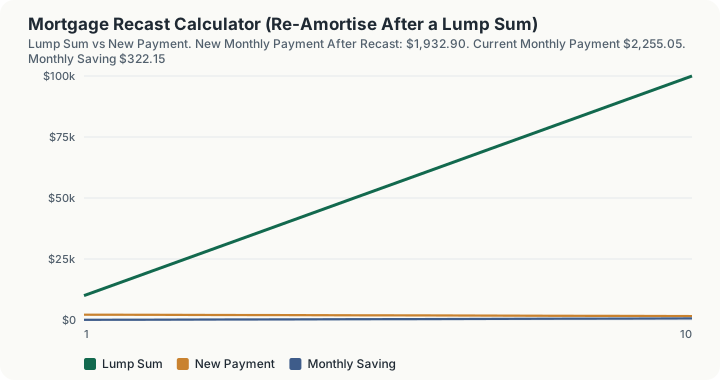
Quick Answer: Putting $50,000 against a $350,000 balance at 6% with 25 years left cuts the payment from $2,255.05 to $1,932.90: a saving of $322.15 a month, with the same rate and the same term. But if you can keep paying the old amount instead, not recasting saves $85,167.71 more in interest and clears the loan 6.7 years early.
What does this calculator do?
A recast re-amortises your existing loan after a lump sum principal payment. The rate stays, the term stays, and the payment falls. There is no new loan, no underwriting and no closing costs, just a fee of a few hundred dollars.
That makes it very different from a refinance, and especially valuable for anyone holding a legacy low rate they do not want to give up.
The decision that actually matters is not recast versus refinance, but recast versus prepay without recasting. The same $50,000 can either:
- Recast, lowering the payment to $1,932.90 and freeing $322.15 a month, or
- Prepay and keep paying $2,255.05, which retires the loan 6.7 years early and saves $85,167.71 more in interest
Both use the same money. They buy different things: one buys monthly cash flow, the other buys total interest saved.
How is this calculated?
New balance is the current balance less the lump sum.
The recast payment re-amortises that smaller balance over the unchanged remaining term at the unchanged rate:
PMT_new = ((B − L) × i)/(1 − (1 + i)⁻ⁿ)
Because the rate and term are unchanged, the payment falls in exact proportion to the balance. Reducing a balance by 14.3% reduces the payment by 14.3%.
Prepaying without recasting keeps the original payment on the smaller balance, so the term shortens. The engine solves for the number of periods and derives total interest from there.
Worked Example
A borrower has $350,000 left at 6% with 25 years to run, and an inheritance of $50,000 to put against it.
Step 1: The current payment. $350,000 amortised at 6% over 300 months = $2,255.05 a month
Step 2: The balance after the lump sum. $350,000 - $50,000 = $300,000.00
Step 3: Re-amortise that over the unchanged 300 months at the unchanged 6%. $1,932.90 a month
Step 4: The monthly saving. $2,255.05 - $1,932.90 = $322.15
Step 5: Check the proportionality. The balance fell by 14.29% and the payment fell by $322.15 / $2,255.05 = 14.29%. With the rate and term untouched, the payment tracks the balance exactly.
That is the recast. Now the comparison the recast conceals, which is what happens if the borrower makes the same payment and refuses the smaller one.
Step 6: Interest with no action at all. $326,515.00
Step 7: Interest after recasting. $279,870.00, so the lump sum saves $46,645.00 on its own
Step 8: Interest if the lump sum is paid but the payment stays at $2,255.05. $194,702.29
Step 9: What the recast costs. $279,870.00 - $194,702.29 = $85,167.71 of additional interest
Step 10: And in time. Keeping the old payment clears the loan 6.7 years early; recasting keeps the original maturity date to the month
The $50,000 does the same work either way. Step 9 is the price of taking the benefit as monthly cash flow rather than as a shorter loan, and it is nearly twice what the lump sum saved by itself in step 7.
The size of the lump sum changes the scale but not the shape:
Step 11: A $10,000 lump sum, near the minimum most servicers will recast. Payment falls to $2,190.62, a saving of $64.43 a month, and not recasting would save a further $23,349.63 and 1.6 years
Step 12: A $150,000 lump sum. Payment falls to $1,288.60, a 42.86% reduction, at the same rate and the same maturity
Step 13: The cost of recasting that one. $186,580.00 against $64,950.56, so $121,629.44 and 15.2 years are given up in exchange for the lower payment
The rate is what decides whether that trade is unreasonable:
Step 14: The same $50,000 against a legacy 3% loan. Payment falls from $1,659.74 to $1,422.63, a saving of $237.11
Step 15: What not recasting is worth at 3%. $27,117.86 and 4.9 years, against $85,167.71 at 6%
At 3% there is simply less interest for the shorter term to avoid, so taking the cash flow costs about a third as much. The recast is not a bad product; it is a bad default at a high rate. At low rates, taking the cash flow is a more reasonable choice.
What does this calculator not account for?
- The recast fee, typically $150 to $500, and lender minimums for the lump sum.
- Whether your loan is eligible. FHA, VA and USDA loans generally cannot be recast. Most conventional loans can, but jumbo terms vary.
- The opportunity cost of the lump sum. Paying down a 3% mortgage while a savings account pays 4.5% is a losing trade before tax.
- Tax deductibility. Reducing deductible mortgage interest has an after-tax cost for itemisers.
- Escrow. Taxes and insurance are unchanged by a recast, so your total monthly outgoing falls by less than the principal-and-interest saving shown here.
- Emergency liquidity. Money paid into a mortgage is very hard to get back out without borrowing again.
- PMI. A large lump sum may push you below 80% LTV and allow cancellation, which is a separate saving not modelled here.
- Whether you will actually keep paying the higher amount. The prepay-without-recast advantage depends entirely on discipline.
What mistakes do people make with this?
- Confusing a recast with a refinance. A refinance replaces the loan, changes the rate and costs thousands. A recast keeps everything and costs a few hundred.
- Recasting when you wanted interest savings. Recasting is the worse option on total interest, by $85,168 here. It is the better option only if you need the monthly cash flow.
- Prepaying a cheap legacy mortgage at all. At 3%, with savings accounts paying more, the lump sum may be better off invested. The calculator shows the mortgage side only.
- Assuming your loan qualifies. Government-backed loans generally cannot be recast, and lenders set their own minimums.
- Forgetting escrow. The payment shown is principal and interest. Taxes and insurance continue unchanged.
- Draining the emergency fund. A recast lowers the payment but the money is gone. Liquidity has value that this calculation cannot show.
Frequently Asked Questions
What is a mortgage recast?
Recast or refinance?
Should I recast or just prepay?
Which loans can be recast?
Does recasting hurt my credit?
Should I pay down a 3% mortgage at all?
Sources
- Consumer Financial Protection Bureau, Buying a house. consumerfinance.gov/owning-a-home
Also consulted: Standard loan amortisation mathematics. The recast payment is the ordinary annuity payment on the reduced balance over the unchanged remaining term; The prepay-without-recast comparison solves for the number of periods at the unchanged payment, which is the standard treatment.