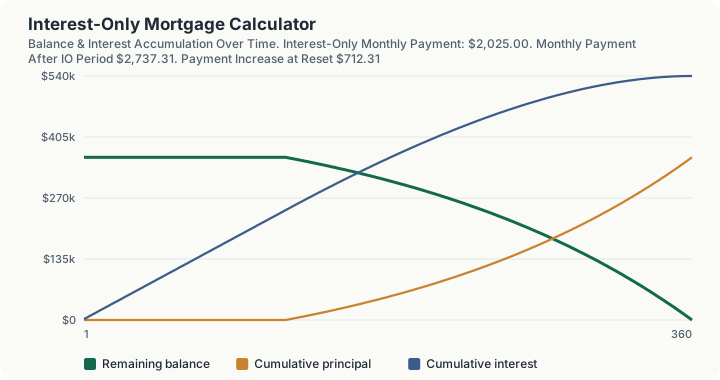
Quick Answer: On a $360,000 loan at 6.75% with a 10-year interest-only period, you pay $2,025.00 a month for the first 10 years, then $2,737.31 a month for the remaining 20 years once principal repayment begins.
Overview
An interest-only mortgage lets a borrower pay only the interest due each month for a set number of years, with no reduction of the loan balance during that window. Once the interest-only period ends, the loan converts to a standard amortizing schedule and the remaining balance is paid off over whatever term is left, which pushes the monthly payment up, sometimes sharply.
These loans show up most often in three situations: buyers who expect a large jump in income within a few years, buyers who plan to sell or refinance before the interest-only period ends, and investors who want to maximize monthly cash flow on a rental property while it appreciates. They were also widely used, and widely misunderstood, during the run-up to the 2008 housing crisis, when borrowers stretched into homes they could only afford under the artificially low interest-only payment.
This calculator models the two phases of an interest-only mortgage explicitly: the flat interest-only payment during the initial period, and the higher fully-amortizing payment that follows. It shows you both numbers side by side, along with the size of the jump between them, so the payment shock is visible before you sign anything.
How This Is Calculated
The loan amount is the home price minus the down payment. During the interest-only period, the monthly payment equals the outstanding balance multiplied by the monthly interest rate:
`
Interest-Only Payment = Loan Amount × (Annual Rate / 12)
`
Because no principal is paid down during this phase, the balance stays exactly where it started and the payment stays exactly the same every month.
Once the interest-only period ends, the loan re-amortizes over the remaining term using the standard fixed-payment amortization formula, solving for the payment that pays off the current balance (still the original loan amount, since nothing has been paid down) across the remaining number of months:
`
PMT = P × i / (1 − (1 + i)^−n)
`
where P is the balance at the start of the amortizing phase, i is the monthly interest rate, and n is the number of months left in the loan term. From that point forward, the loan behaves exactly like a normal fixed-rate mortgage: each payment splits between interest and principal, and the split shifts toward principal as the balance shrinks.
The engine builds a full period-by-period schedule so you can see the flat interest-only rows followed by the declining-balance amortizing rows in one continuous table, with running totals for interest and principal that reconcile exactly to the cent against the loan amount.
Worked Example
Take a $450,000 home with a $90,000 down payment, financed at 6.75% with a 10-year interest-only period on a 30-year total term:
- Loan amount: $450,000 − $90,000 = $360,000
- Monthly interest rate: 6.75% ÷ 12 = 0.005625
- Interest-only payment (months 1-120): $360,000 × 0.005625 = $2,025.00, unchanged every month because the balance never moves
- Remaining term once IO ends: 30 years − 10 years = 20 years = 240 months
- Amortizing payment (months 121-360): solving the standard payment formula on the still-full $360,000 balance over 240 months at 0.005625 gives $2,737.31
- Payment increase at the reset: $2,737.31 − $2,025.00 = $712.31 more per month, a jump of about 35%
- Total interest over the full 30-year term: roughly $539,954.57, combining the $243,000 paid during the interest-only decade (all of it interest, since no principal moved) with the interest embedded in the 240 amortizing payments that follow
Compare that to a standard 30-year fully amortizing loan on the same $360,000 balance at the same rate, which would carry a level payment of about $2,335 a month for the entire term and considerably less lifetime interest, since principal starts shrinking from month one instead of month 121.
What This Does Not Account For
- Rate resets on adjustable interest-only loans. This calculator assumes one fixed rate for the entire term. Many interest-only mortgages are actually adjustable-rate products where the rate itself can change when the interest-only period ends, compounding the payment shock beyond what re-amortization alone produces.
- Qualification and underwriting rules. Lenders often qualify borrowers based on the higher post-reset payment, not the initial interest-only payment. This tool shows you both numbers but does not model lender-specific underwriting standards.
- Property taxes, insurance, and HOA dues. The figures here are principal-and-interest only. Add escrow items separately to get your full monthly housing cost.
- Prepayment or extra principal payments. The calculator assumes no voluntary extra payments during the interest-only period, which is the scenario most borrowers actually experience, but paying extra during that window would reduce the balance ahead of the reset and lower the amortizing payment.
- Sale or refinance before the reset. Many borrowers who take interest-only loans plan to exit before the payment jumps. This tool shows the cost of staying in the loan for its full term; it does not model an exit scenario.
Common Pitfalls
- Assuming the initial payment is the "real" payment. The interest-only payment is temporary by design. Budgeting around it without planning for the reset is the single most common mistake with this loan type.
- Underestimating how large the jump can be. Because none of the balance has been paid down when the amortizing phase starts, the entire original loan amount has to be repaid in a shorter remaining window, which is why the post-reset payment is often 30-45% higher than the interest-only payment, not a modest step up.
- Confusing "interest-only" with "cheaper." Over the life of the loan, an interest-only mortgage typically costs more in total interest than a fully amortizing loan of the same rate and term, because the balance sits at its highest point for longer.
- Forgetting that home equity isn't building. During the interest-only years, your equity only grows through home price appreciation and the down payment you already made, not through payments. If prices fall, you can end up owing more than the home is worth.
- Not stress-testing the reset payment against your future budget. Before choosing this structure, run the numbers assuming your income does not increase as planned, since that is the scenario that causes the most financial strain.
Frequently Asked Questions
What happens to my payment when the interest-only period ends?
Does an interest-only mortgage build equity?
Is an interest-only mortgage a good idea?
How is the interest-only payment calculated?
balance × (annual rate / 12). Because the balance does not change during the interest-only period, this payment is identical every month until the amortizing phase begins.Can I pay extra principal during the interest-only period?
Sources
- Consumer Financial Protection Bureau (CFPB): Interest-only mortgage disclosures and payment-shock guidance under Regulation Z (Truth in Lending Act), 12 CFR § 1026. ecfr.gov/current/title-12/chapter-X/part-1026
- Federal Reserve Board: Consumer Handbook on Adjustable-Rate Mortgages, covering interest-only and payment-option loan structures. federalreserve.gov
Also consulted: U.S. Department of Housing and Urban Development (HUD): Guidance on non-traditional and interest-only mortgage product risk disclosures.