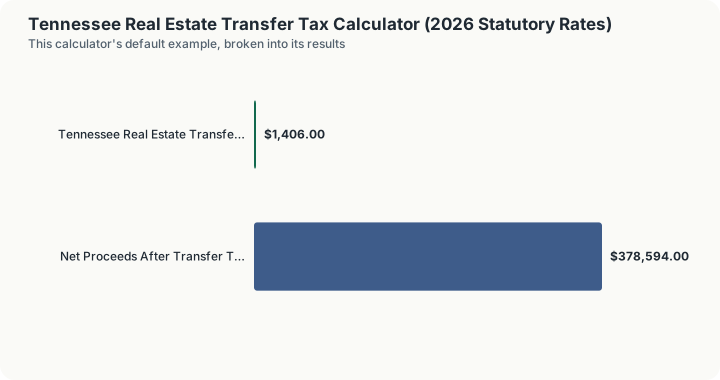
Quick Answer: A $380,000 home sale in Tennessee owes $1,406.00 in state realty transfer tax, a flat 0.37% rate applied to the full sale price with no brackets or high-value surcharge.
Overview
Tennessee's transfer tax under Tenn. Code Section 67-4-409 is set at $0.37 per $100 of consideration, 0.37% of the sale price, a flat statewide rate with no county or municipal add-on anywhere in the state. The rate happens to mirror its own per-hundred figure almost exactly, 0.37, a coincidence of statutory drafting rather than any deliberate design.
Tennessee law does not require a specific party to pay the tax; it is customarily handled as a negotiated item in the purchase agreement, and in many Tennessee transactions the buyer pays it at recording, though this varies by local custom and deal terms. At 0.37%, Tennessee's rate matches South Carolina's exactly, despite the two states arriving at that figure through entirely different statutory formulas, and it sits comfortably above the 0.1% flat rate charged by neighboring Alabama and Georgia to the south.
Because the tax is flat with no bracket schedule, county register of deeds offices apply the same 0.37% multiplication to every transaction they record, from a modest rural sale to a large commercial parcel, which keeps the calculation predictable even without a table of thresholds to consult.
How This Is Calculated
Tennessee's realty transfer tax is $0.37 per $100 of consideration, a flat 0.37% that counties are not permitted to add to.
The engine reads the 0.0037 rate under Tenn. Code 67-4-409 and multiplies the full sale price by it, reporting tax due, effective rate, and net proceeds. There is no bracket schedule and no high-value threshold, so the effective rate reads 0.370% whether the deed records at $90,000 or $9,000,000. A separate mortgage tax applies to the recorded indebtedness rather than to the sale, and is not in this figure.
Worked Example
A Nashville sale at the calculator's default, run through the realty transfer tax.
Step 1 -- The consideration. Contract sale price = $380,000
Step 2 -- The statutory rate. Tenn. Code 67-4-409, $0.37 per $100 of consideration = 0.37%
Step 3 -- Apply the rate. $380,000 x 0.0037 = $1,406.00
Step 4 -- Cross-check by the per-$100 method. 3,800 x $0.37 = $1,406.00
Step 5 -- Net proceeds after the transfer tax. $380,000.00 - $1,406.00 = $378,594.00
Step 6 -- The effective rate. $1,406.00 / $380,000 = 0.370%
Now the calculator's $1,500,000 scenario.
Step 7 -- The luxury sale. $1,500,000 x 0.0037 = $5,550.00
Step 8 -- The effective rate at $1.5M. $5,550.00 / $1,500,000 = 0.370%
Tennessee's rate is a rare case where the statutory quotation and the percentage are the same number: $0.37 per $100 simply is 0.37%, so Step 2 needs no conversion at all. In Tennessee the buyer customarily pays the transfer tax at recording rather than the seller, which inverts the assumption behind Step 5; the net proceeds figure the calculator reports is the price less the total tax regardless of who writes the cheque, so a Tennessee seller who has negotiated the standard allocation should read Step 3 as a buyer cost rather than a deduction from their own proceeds. Tennessee also levies a separate indebtedness tax on recorded mortgages, which is not part of any figure above.
The Per-$100 Statute Against the Engine's Decimal
The transfer tax config returns an empty schedule, so there is no tier table on this page. Everything below comes from sweeping the sale price input directly.
Each additional $10,000 of consideration costs $37.00. Sweeping from $350,000 to $400,000 in $10,000 steps returns $1,295.00, $1,332.00, $1,369.00, $1,406.00, $1,443.00 and $1,480.00, a $37.00 step at every point. The step does not change at $1,500,000 or at $10,000,000, where the tax is $37,000.00. Tennessee's schedule contains no bracket edge, no exemption floor and no high-value tier, so the effective rate reads 0.370% at every price the engine has been given and there is no threshold on this page to structure a closing date or a price around.
Running the question backwards. A $1,000.00 tax corresponds to a sale price of $270,270; a $2,500.00 tax to $675,675. Because the engine rounds the result to the cent, $270,271 also returns $1,000.00, so a reverse lookup identifies a narrow band of prices rather than a single figure.
The mansion tax line never moves off zero. The output panel carries a "Mansion Tax / High-Value Surcharge" field because the shared primitive supports a mansion cliff for New York and New Jersey. Tennessee has none, and the field returns $0.00 at $380,000, at $1,500,000, at $2,500,000, where the whole $9,250.00 is base tax, and at $10,000,000. A field that is structurally always zero is a property of a shared code path, not a Tennessee surcharge waiting above some price point.
Where the statutory quoting convention and the engine diverge, priced. Tenn. Code 67-4-409 quotes $0.37 per $100 of consideration, and a register of deeds applies that per started increment, rounding a partial $100 up to a whole one. The engine instead multiplies a clean 0.0037 against the exact price, with no increment rounding at any stage. On a $387,300 sale the two methods agree exactly at $1,433.01, because that price is 3,873 whole hundreds. Move the price to $387,350 and they part: the engine returns $1,433.20, while the statutory method reads 3,873.5 increments, rounds up to 3,874, and charges 3,874 x $0.37 = $1,433.38. The engine is $0.18 light.
Tennessee's per-$100 increment is small enough that this divergence can never exceed $0.37 on any deed, which is why the $380,000 default and the $1,500,000 luxury scenario both cross-check perfectly against the per-$100 method: both prices are exact multiples of $100. It only appears on odd-dollar consideration, and it is the one respect in which this page will not match a Tennessee closing statement to the penny.
What This Does Not Account For
- County recording fees. Tennessee county register of deeds offices charge separate recording fees per page or per document, unrelated to sale price, which this calculator does not include.
- Exemptions for certain transfer types. Transfers between spouses, transfers into certain revocable trusts, and transfers incident to a will or intestate succession may be exempt from the realty transfer tax under Tennessee law. This calculator assumes a standard arm's-length taxable sale.
- Rounding up to the next $100 increment. The register charges $0.37 per started $100; the engine multiplies the exact price by 0.0037. On a $387,350 sale that is $1,433.20 here against $1,433.38 at the counter, a gap bounded by $0.37.
- Title insurance, attorney fees, and survey costs. The transfer tax is only one line item on a Tennessee closing statement; title search fees, closing attorney charges, and survey costs are separate and not modeled here.
- The Tennessee mortgage recording tax. Tennessee separately imposes a tax on the indebtedness secured by a mortgage or deed of trust recorded alongside the deed, generally $0.115 per $100 above a small exempted amount. This is a distinct tax from the realty transfer tax modeled here and applies to the loan amount, not the sale price.
Common Pitfalls
- Confusing the realty transfer tax with the mortgage recording tax. These are two separate Tennessee taxes with different bases (sale price versus loan amount secured) and different rates. Mixing them up produces an incorrect total at closing.
- Forgetting who customarily pays. In most Tennessee transactions the realty transfer tax is paid by the buyer at recording, though this is ultimately a matter of contract and can be negotiated either way.
- Applying an out-of-state rate by habit. Buyers and agents relocating from bracket-heavy states like New York or New Jersey sometimes assume Tennessee's tax rises with price; it does not.
- Overlooking the tax when estimating cash-to-close. Because 0.37% is a modest percentage, buyers occasionally leave it out of their closing-cost worksheet entirely, then are surprised by the line item on the settlement statement.
Frequently Asked Questions
What is Tennessee's real estate transfer tax rate?
Who pays the real estate transfer tax in Tennessee?
Does Tennessee have a mansion tax on expensive homes?
Is the Tennessee realty transfer tax the same as the mortgage tax?
Are any property transfers exempt from Tennessee's realty transfer tax?
Sources
- Tennessee Department of Revenue: Realty Transfer Tax guidance under Tenn. Code 67-4-409. tn.gov/revenue.html