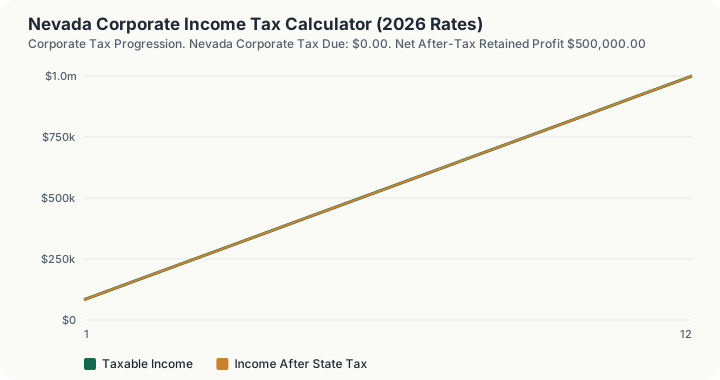
Quick Answer: On $500,000 of pre-apportioned taxable income, Nevada imposes no general state-level corporate income tax, so state tax due is $0.00 and net after-tax profit equals the full $500,000 (before any separate federal tax liability).
A Calculator Whose Answer Never Changes
Nevada is one of a small group of states with no general corporate income tax on net profit. The Nevada entry in this engine's corporate rate table is flagged as a zero-tax state with an empty bracket array, so the calculation short-circuits before any rate is applied and returns $0.00 for every input.
That is unusually literal, and the tier schedule makes it visible. Row 1 shows $83,333.33 of apportioned income against $0.00 of tax and $83,333.33 of retained income. Row 6 shows $500,000 against $0.00. Row 12 shows $1,000,000 against $0.00. The "Income After State Tax" column is a copy of the "Taxable Income" column at every row, which is the arithmetic signature of a state that does not tax this base at all.
The credit field behaves the same way. Enter $33,750 of credits, or $1, or nothing, and the answer stays $0.00, because the maximum-against-zero has nothing to subtract from. The effective rate output and the marginal rate output both read 0.00% throughout.
How This Is Calculated
There is no rate to apply, so the calculator applies none.
- Read the apportioned taxable income you entered. It is used only to populate the tier schedule and the retained-profit output.
- Look Nevada up in the corporate rate table. The entry is marked as a zero-tax state, so the function returns immediately with a zero liability and a zero marginal rate.
- Subtract credits and floor at zero. Both operations are inert here, because the tax was already zero.
- Report retained profit as the full entered income. At the $500,000 baseline that is $500,000.00.
- Build the twelve-row tier schedule, re-running step 2 at each tier and returning $0.00 twelve times.
Worked Example
Using this calculator's baseline scenario: a corporation with $500,000 in taxable income apportioned to Nevada.
- Start with apportioned taxable income. The corporation has $500,000 of taxable business income apportioned to Nevada.
- Apply Nevada's statutory corporate income tax rate. Nevada levies no general corporate income tax, so the applicable rate is 0.00%: $500,000 x 0.00% = $0.00.
- Nevada state corporate income tax due: $0.00.
- Net retained profit. With no state income tax liability, the corporation retains the full $500,000.00 apportioned to Nevada.
This calculator computes only the Nevada state corporate income tax shown above. Federal taxable income remains subject to the flat 21% federal corporate rate under IRC § 11, assessed independently of Nevada's position.
What the Flat Line Hides
A sweep that returns the same number twelve times is telling you something real, but it is a narrower statement than "Nevada does not tax business". Three points are worth putting figures against.
Nothing in this calculator scales with income, so nothing in it can be used for interstate comparison of total burden. The $500,000 baseline returns $0.00 here, $22,750.00 in a 4.55% state, $32,500.00 in a 6.50% state and $43,000.00 under New Jersey's graduated schedule. Those differences are real, and they are the whole of what this page can tell you.
The Commerce Tax is not modelled anywhere on this page, and it is not a function of profit. Nevada charges a gross receipts tax above a substantial annual Nevada revenue threshold at rates that vary by industry classification. Because its base is receipts, a Nevada business with a $500,000 loss can owe it while this calculator returns $0.00. There is no input on this page for gross revenue or industry code, so the calculator cannot even estimate it.
The Modified Business Tax is likewise absent. It falls on quarterly wages paid to Nevada employees, net of qualifying health care deductions, and a portion of Commerce Tax paid may be credited against it in following periods. Neither the wage base nor that credit interaction appears in any figure here.
The reverse question a Nevada filer should ask. Rather than "how much income can I earn before the tax steps", which has no answer here because the tax never steps, the useful question is how much Nevada gross revenue triggers the Commerce Tax filing threshold. That is a receipts question, and this calculator collects no receipts figure, so it cannot be answered on this page.
What the marginal cost of the next dollar is here. Zero, at every income level and in both directions. Adding $1,000,000 of apportioned Nevada income changes the state tax due by $0.00, and removing $1,000,000 changes it by $0.00 as well. That is the one figure on this page that is genuinely different in kind from every other state calculator in this family, where the same question returns $45.50, $65.00, $67.50, $75.00 or $90.00 per thousand depending on the schedule.
The one input that does move a number. Changing apportioned income from $500,000 to $5,000,000 leaves the tax at $0.00 but moves retained profit to $5,000,000.00 and every row of the tier schedule by the same multiple. The schedule is a scale exercise on your own entry, not a tax computation.
What This Does Not Account For
- The Nevada Commerce Tax, a gross-receipts levy with an annual revenue threshold and industry-specific rates. It is not computed, estimated or flagged here.
- The Modified Business Tax on Nevada wages, and the credit for Commerce Tax paid against it.
- Entity fees and annual report charges, including Nevada's state business license fee.
- Federal corporate income tax (21% under IRC § 11).
- Base Erosion and Anti-Abuse Tax (BEAT) and Global Intangible Low-Taxed Income (GILTI) provisions.
- Apportionment. No factors are computed. For Nevada the point is moot at 0.00%, but the income figure you enter is still assumed to be the Nevada share.
- Corporate income tax owed to other states by a Nevada-headquartered group, which is where a multistate filer's actual liability sits.
Common Pitfalls
- Assuming 0.00% means zero state tax. The Commerce Tax and the Modified Business Tax both apply on bases this calculator does not collect, and both can be owed in a loss year when this page returns $0.00.
- Reading the retained-profit figure as after-tax cash. At the baseline it prints $500,000.00, which is before federal tax at 21% and before any Nevada receipts or payroll levy.
- Entering credits and expecting a change. The credit field is inert on this page; $0.00 in, $0.00 out.
- Treating apportionment as irrelevant for a Nevada group. It is irrelevant to this figure only. Income sourced to a taxing state is taxed there, and that computation belongs on that state's page.
Frequently Asked Questions
Does Nevada have a corporate income tax?
Does that mean a Nevada corporation pays no state tax?
Why does the tier schedule show twelve identical zeros?
Do tax credits change the result?
What tax does a Nevada corporation actually compute against profit?
Sources
- Nevada Department of Taxation: Commerce Tax and Modified Business Tax Statutes and Guidance (2026). tax.nv.gov