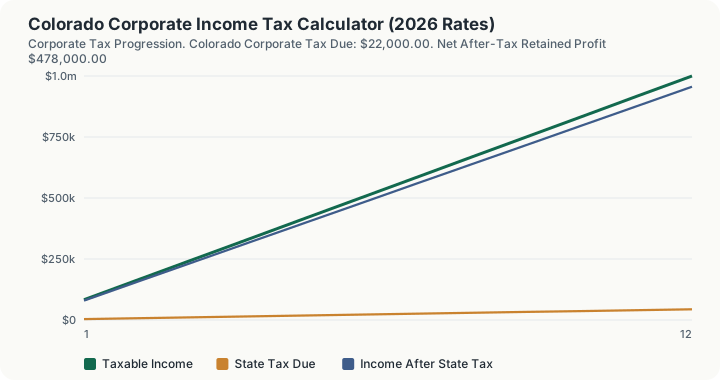
Quick Answer: On $500,000 of pre-apportioned taxable income, Colorado's flat 4.40% corporate income tax rate produces $22,000.00 in state tax due and $478,000.00 in net after-tax profit.
Colorado's 4.40% Rate Among Its Neighbours
For a corporation deciding where to locate a regional headquarters along the Front Range or elsewhere in the Mountain West, Colorado's flat 4.40% corporate income tax rate is a meaningful data point: it sits well below the national median for states that tax corporate income, and roughly a third of what a higher-rate state like Kansas ultimately collects at the margin.
The 4.40% rate applies to every dollar of apportioned taxable income with no bracket structure to navigate, so the tax bill scales linearly with income instead of accelerating the way it would under a graduated schedule. That predictability, combined with a below-median rate, is one of the more commonly cited reasons Colorado shows up in multistate site-selection comparisons alongside other low-flat-rate states such as Arizona and Utah.
Run through the calculator's $500,000 baseline, Colorado's flat rate produces $22,000.00 in state tax, well below what the same income would generate in a higher-rate neighbor like Kansas at $31,000.00. That gap holds at any income level, since neither state's rate shifts with size.
How This Is Calculated
Colorado's 4.40% flat corporate rate is not fixed by ordinary legislation alone: it is tied to the state's TABOR framework, under which surplus revenue can trigger a temporary rate reduction in a given year. The rate here is the standing statutory rate for 2026. Structurally Colorado is simple, single rate, single sales factor, market-based sourcing, so the modeling risk sits in sourcing rather than in the rate table.
The engine runs three steps. Everything else described above happens before the figure reaches this box.
- Take the income figure as entered. No single-sales-factor apportionment runs here, no market-based sourcing, no combined report, no addback schedule and no NOL carryforward. Whatever you type is treated as final Colorado taxable income.
- Multiply by 4.40%. The standing statutory rate for 2026, applied with no TABOR check: the engine does not test whether a temporary surplus-driven reduction is in effect for your filing year. $500,000 returns $22,000.00; $5,000,000 returns $220,000.00.
- Subtract credits, floor at zero, and report. $10,000 of credits against the baseline returns $12,000.00 and moves the effective rate from 4.40% to 2.40%, while the marginal rate, computed before credits, still reads 4.40%. Net retained profit is $478,000.00 at the baseline.
Worked Example
Using this calculator's baseline scenario: a corporation with $500,000 in taxable income apportioned to Colorado.
- Start with apportioned taxable income. The corporation has already apportioned $500,000 of its total taxable income to Colorado using the state's statutory apportionment formula, before any state-level tax is applied.
- Apply Colorado's flat statutory rate. Colorado taxes all C-corporation income at a single flat rate of 4.40%, regardless of income size, so no bracket lookup is required: $500,000 × 4.40% = $22,000.00.
- Colorado corporate tax due: $22,000.00.
- Net retained profit. Subtracting the state tax liability from taxable income leaves $500,000 − $22,000.00 = $478,000.00 in after-tax profit retained by the corporation, before any separate federal tax liability is applied.
Because Colorado uses a single flat rate rather than graduated brackets, the 4.40% effective rate is identical to the marginal rate at every income level: a corporation earning $50,000 and one earning $50 million both face the same 4.40% state rate on their apportioned income.
A Flat Line Through Every Point Other States Break At
Colorado has one rate, so the sweep has no edge, and saying that with figures is more useful than implying one exists. At $2,999 of taxable income the tax is $131.96; at $3,001 it is $132.04. At $24,999 it is $1,099.96; at $25,001 it is $1,100.04. At $221,999 it is $9,767.96; at $222,001 it is $9,768.04. Eight cents for two dollars in every case. The reported marginal rate is 4.40% at every income in the sweep, and the effective rate is the same 4.40% at every income too, which is a property no graduated state on this site has.
The twelve-row schedule inherits that linearity exactly: $11,000.00 of tax at $250,000.00 of income, $22,000.00 at $500,000.00, $44,000.00 at $1,000,000.00. Read down the table and the only thing it tells you is the multiplier.
Forty-Four Dollars Per Thousand, at Every Size
Each additional $1,000 of Colorado taxable income costs $44.00. The pairs: $499,000 returns $21,956.00 against $500,000 at $22,000.00; $501,000 returns $22,044.00. At ten times the step, $510,000 returns $22,440.00. At the top of the tested range, $5,000,000 returns $220,000.00, still 4.40% flat.
The reverse question -- how much can be earned before the rate steps -- returns no threshold, and that is the finding. In Colorado the only lever on the number this page produces is the size of the apportioned base. The rate itself is not fixed by ordinary legislation alone: Colorado's TABOR framework can trigger a temporary reduction in a surplus year, and this calculator applies the standing statutory 4.40% rate with no TABOR check of any kind. If a temporary reduction is in effect for your filing year, every figure on this page is high.
The Credits Field Stops Paying Before You Expect
Credits are subtracted from the computed tax and the answer is floored at zero. On the $500,000 baseline, $10,000 of credits returns $12,000.00 and moves the effective rate from 4.40% to 2.40%. $50,000 of credits returns $0.00. $1,000,000 of credits returns $0.00 as well.
Because Colorado's rate is low, that cliff arrives sooner here than on a high-rate page: the entire $500,000 baseline liability is extinguished by $22,000.00 of credits, and every dollar of credit past that point is worth nothing in this model. Enterprise zone and other Colorado credits often carry forward in practice; the engine models none of that, and the twelve-row table ignores the credit input entirely, still showing $22,000.00 in its sixth row on a credited run.
What This Does Not Account For
- Federal corporate income tax (21% under IRC § 11).
- Specialized gross receipts taxes (e.g. Ohio CAT, Washington B&O, Texas Franchise Tax) where applicable.
- Minimum entity franchise tax fees or annual report filing charges.
- Base Erosion and Anti-Abuse Tax (BEAT) or Global Intangible Low-Taxed Income (GILTI) provisions.
- Local municipal corporate earnings taxes (e.g. NYC General Corporation Tax).
- TABOR rate adjustments. The engine applies the standing 4.40% statutory rate and performs no check for a temporary surplus-driven reduction in the filing year.
- Everything that produces the base. No single-sales-factor apportionment, no market-based sourcing, no combined reporting, no nexus or P.L. 86-272 test, no addbacks and no NOL carryforward.
- Credit carryforward and refundability. $50,000 and $1,000,000 of credits both return $0.00 on the $500,000 baseline.
Common Pitfalls
- Mistaking the Flat Rate for the Final Bill: Assuming Colorado's 4.40% rate applies directly to book income rather than to apportioned taxable income after state additions, subtractions, and NOL adjustments.
- Improper Apportionment Sourcing: Applying market-based sourcing vs cost-of-performance rules incorrectly for service revenue apportioned to Colorado.
- Ignoring Unitary Group Combined Reporting: Failing to account for Colorado's mandatory combined return requirements across related entities.
- Neglecting State NOL Carryforward Caps: Overlooking Colorado's annual percentage limitations on net operating loss deductions, which still matter even at a below-median 4.40% rate.
Frequently Asked Questions
Does Colorado have a corporate income tax?
When are Colorado corporate tax returns due?
Does Colorado tax S-corporations and LLCs?
How is multi-state corporate income apportioned to Colorado?
Sources
- Colorado Department of Revenue: Corporate Tax Statutes and Guidance (2026). tax.colorado.gov
- Multistate Tax Commission (MTC): Uniform Apportionment and Allocation Guidelines. mtc.gov