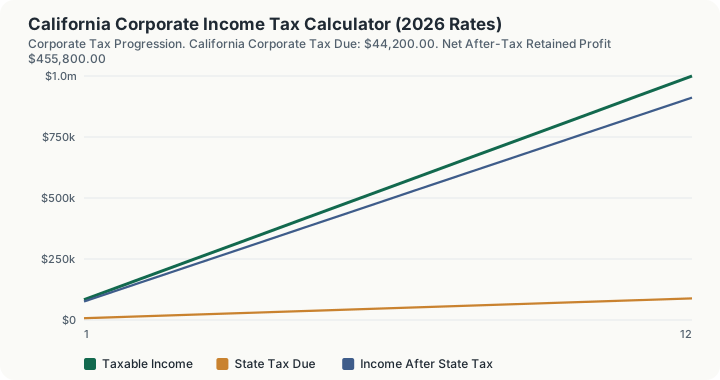
Quick Answer: On $500,000 of pre-apportioned taxable income, California's flat 8.84% corporate income tax rate produces $44,200.00 in state tax due and $455,800.00 in net after-tax profit.
An 8.84% Rate, and What Sits On Top of It
Among states with a flat corporate income tax rate above 8%, California's 8.84% sits toward the higher end: nearly a full percentage point above neighboring Arizona's, and roughly double Colorado's 4.40%. It is one of the highest flat corporate rates levied by any state in this dataset, trailing only Minnesota's 9.80% and Illinois's 9.50%.
California applies that 8.84% uniformly to all apportioned C-corporation income, without brackets, so the effective and marginal rates are identical at every income level. For companies weighing a California presence against other West Coast alternatives, the calculus typically isn't the rate alone but how apportionment rules (particularly market-based sourcing for services) determine how much income actually lands in the 8.84% bucket to begin with.
California's flat rate turns the calculator's $500,000 example into $44,200.00 of state tax, nearly twice what the identical income would generate in Arizona. Because the rate never changes with income, that ratio holds at any scale: a $5,000,000 filer owes exactly ten times as much.
How This Is Calculated
California's 8.84% general corporate rate is high, but the feature that catches filers out is the $800 minimum franchise tax, owed by every corporation doing business in California regardless of income, loss, or inactivity. California also imposes an alternative minimum tax and taxes financial corporations at a higher rate. This calculator models the 8.84% rate alone. It does not apply the $800 floor, the AMT, or the financial corporation rate, so 8.84% is the floor of the analysis rather than the whole of it.
The engine runs three steps. The base work described above must be finished before the figure reaches this box.
- Take the income figure as entered. No single-sales-factor apportionment runs here, no market-based sourcing, no combined report, no water's-edge election, no depreciation recomputation and no NOL carryforward. Whatever you type is treated as final California taxable income.
- Multiply by 8.84%. One rate, no bracket lookup. $500,000 returns $44,200.00; $5,000,000 returns $442,000.00.
- Subtract credits, floor at zero, and report. $10,000 of credits against the baseline returns $34,200.00 and moves the effective rate from 8.84% to 6.84%, while the marginal rate, computed before credits, still reads 8.84%. Net retained profit is $455,800.00 at the baseline.
The $800 minimum franchise tax is not applied by the engine. Entering $0 of income returns $0.00, not $800.00, and a run where credits exceed the tax also returns $0.00. That is the single largest gap between this page and a real Form 100.
Worked Example
Using this calculator's baseline scenario: a corporation with $500,000 in taxable income apportioned to California.
- Start with apportioned taxable income. The corporation has already apportioned $500,000 of its total taxable income to California using the state's statutory apportionment formula, before any state-level tax is applied.
- Apply California's flat statutory rate. California taxes all C-corporation income at a single flat rate of 8.84%, regardless of income size, so no bracket lookup is required: $500,000 × 8.84% = $44,200.00.
- California corporate tax due: $44,200.00.
- Net retained profit. Subtracting the state tax liability from taxable income leaves $500,000 − $44,200.00 = $455,800.00 in after-tax profit retained by the corporation, before any separate federal tax liability is applied.
Because California uses a single flat rate rather than graduated brackets, the 8.84% effective rate is identical to the marginal rate at every income level: a corporation earning $50,000 and one earning $50 million both face the same 8.84% state rate on their apportioned income.
Where the $800 Floor Would Have Bitten, and Does Not
California's schedule is flat, so the sweep has no bracket edge to find. It does have one real edge, and the calculator does not model it. At $0 of taxable income the engine returns $0.00 with an effective rate of 0.00%. A California corporation in that position owes $800.00 in minimum franchise tax. The same is true at the credit cliff: $50,000 of credits against the $500,000 baseline returns $0.00, and $1,000,000 of credits also returns $0.00, where the real filer would owe the $800.00 floor in both cases.
Above the floor the sweep is a clean straight line. At $2,999 the tax is $265.11 and at $3,001 it is $265.29. At $24,999 it is $2,209.91 and at $25,001 it is $2,210.09. At $221,999 it is $19,624.71 and at $222,001 it is $19,624.89. Eighteen cents for two dollars of income at each of the three points where graduated states break, which is 8.84% and nothing else. The reported marginal rate is 8.84% at every income in the sweep.
Eighty-Eight Dollars and Forty Cents Per Thousand
Each additional $1,000 of California taxable income costs $88.40. From the sweep: $499,000 returns $44,111.60 and $500,000 returns $44,200.00; $501,000 returns $44,288.40. Ten times the increment, at $510,000, returns $45,084.00.
That figure is the whole planning story on a flat schedule, and it is nearly twice what the neighbouring Arizona page charges per thousand. The reverse question -- how much can be earned before the rate rises -- has no answer here, because it never rises. A $3,000 filer and a $5,000,000 filer both face 8.84% on the next dollar; only the size of the apportioned base moves the bill, and the apportionment that decides it is computed elsewhere.
The twelve-row schedule scales in step: $22,100.00 of tax at $250,000.00 of income, $44,200.00 at $500,000.00, $88,400.00 at $1,000,000.00.
What the Credits Field Silently Discards
Credits are subtracted from the computed tax and floored at zero, with no carryforward and no refund of the excess. $50,000 of credits and $1,000,000 of credits against the $500,000 baseline both return $0.00, so $950,000 of credit value vanishes between the two runs. California's own credit rules frequently permit carryforward; the engine tracks none of it and reports no unused balance.
The credit input also never reaches the twelve-row table, which is computed from the 8.84% rate alone. A run with $10,000 of credits shows $34,200.00 in the headline while the table's sixth row still reads $44,200.00.
What This Does Not Account For
- Federal corporate income tax (21% under IRC § 11).
- Specialized gross receipts taxes (e.g. Ohio CAT, Washington B&O, Texas Franchise Tax) where applicable.
- Minimum entity franchise tax fees or annual report filing charges.
- Base Erosion and Anti-Abuse Tax (BEAT) or Global Intangible Low-Taxed Income (GILTI) provisions.
- Local municipal corporate earnings taxes (e.g. NYC General Corporation Tax).
- California's $800 minimum franchise tax. Not implemented: $0 of income returns $0.00, and credits in excess of the tax return $0.00 rather than $800.00.
- California's corporate alternative minimum tax, and the higher rate applied to financial corporations. Neither is computed.
- Everything that produces the base. No single-sales-factor apportionment, no market-based sourcing, no combined reporting or water's-edge election, no nexus or P.L. 86-272 test, no state modifications and no NOL carryforward.
- Credit carryforward and refundability. $50,000 and $1,000,000 of credits both return $0.00 on the $500,000 baseline.
Common Pitfalls
- Mistaking the Flat Rate for the Final Bill: Assuming California's 8.84% rate applies directly to book income rather than to apportioned taxable income after state additions, subtractions, and NOL adjustments.
- Improper Apportionment Sourcing: Applying market-based sourcing vs cost-of-performance rules incorrectly for service revenue, an especially costly mistake at California's above-average 8.84% rate.
- Ignoring Unitary Group Combined Reporting: Failing to account for California's mandatory combined return requirements across related entities.
- Neglecting State NOL Carryforward Caps: Overlooking California's annual percentage limitations on net operating loss deductions.
Frequently Asked Questions
Does California have a corporate income tax?
When are California corporate tax returns due?
Does California tax S-corporations and LLCs?
How is multi-state corporate income apportioned to California?
Sources
- California Franchise Tax Board: Corporate Tax Statutes and Guidance (2026). ftb.ca.gov
- Multistate Tax Commission (MTC): Uniform Apportionment and Allocation Guidelines. mtc.gov