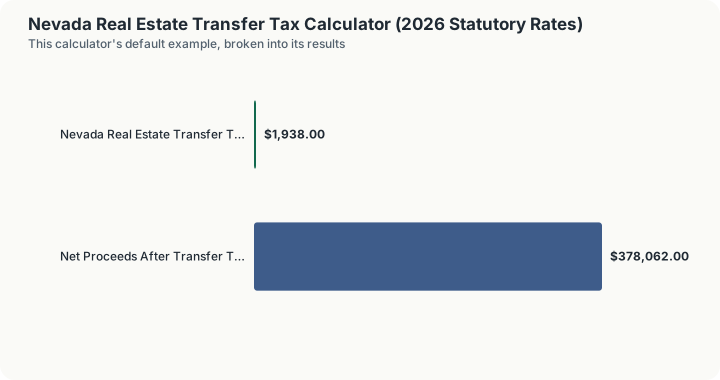
Quick Answer: Nevada charges a base Real Property Transfer Tax of 0.39% plus a Clark County (Las Vegas) local add-on of 0.12%, for a combined 0.51% baseline, so a $380,000 home sale in the state's most populous county owes $1,938 in transfer tax.
Overview
Nevada's Real Property Transfer Tax under NRS 375.020 sets a base state rate of $1.95 per $500, or 0.39%, and then varies meaningfully by county: Clark County, home to Las Vegas and the state's most populous county, adds its own $0.60 per $500 (0.12%), while Washoe County, home to Reno, adds a smaller $0.10 per $500 (0.02%) instead. A sale in Clark County therefore owes a noticeably higher combined rate than the identical sale in a rural Nevada county with no local add-on at all.
By custom, the seller typically pays at closing, though this is negotiable in the purchase agreement rather than fixed by statute. This calculator models the state rate plus Clark County's add-on as its baseline, since Clark County represents the majority of Nevada's real estate transaction volume; a rural-county transaction should generally expect a lower combined rate than the figure shown here.
How This Is Calculated
Nevada's Real Property Transfer Tax has a state base of $1.95 per $500 and a county add-on that differs by where you are: Clark County adds $0.60 per $500, Washoe adds $0.10.
The engine applies the 0.39% base rate under NRS 375.020 plus Clark County's 0.12%, used as the baseline because Clark holds most of Nevada's population. Both components are flat and apply to the entire price with no bracket and no high-value cliff. A Reno purchase carries a lower county component than the figure above, so the Washoe rate needs substituting for a northern Nevada closing.
Worked Example
A Las Vegas sale at the calculator's baseline, with the state rate and Clark County's add-on kept as separate operations.
Step 1 -- The consideration. Contract sale price = $380,000
Step 2 -- The base Real Property Transfer Tax. NRS 375.020, $1.95 per $500 (0.39%): $380,000 x 0.0039 = $1,482.00
Step 3 -- The Clark County add-on. $0.60 per $500 (0.12%): $380,000 x 0.0012 = $456.00
Step 4 -- Total transfer tax due. $1,482.00 + $456.00 = $1,938.00
Step 5 -- Net proceeds after tax. $380,000.00 - $1,938.00 = $378,062.00
Step 6 -- The effective rate. $1,938.00 / $380,000 = 0.510%
The calculator's $1,500,000 scenario, common enough in Summerlin or Henderson.
Step 7 -- Base portion on the luxury sale. $1,500,000 x 0.0039 = $5,850.00
Step 8 -- County portion on the luxury sale. $1,500,000 x 0.0012 = $1,800.00
Step 9 -- Total on the luxury sale. $5,850.00 + $1,800.00 = $7,650.00
The county component in Step 3 is Clark County's, chosen because roughly three quarters of Nevada's population and a larger share of its transaction volume sit there. Washoe County, which covers Reno, adds only $0.10 per $500 (0.02%) instead, so the Step 4 total on the same $380,000 sale would be about $1,558 in Reno rather than $1,938 in Las Vegas. Nevada has no state income tax, and the transfer tax is one of the levies that compensates, but at a combined 0.51% it is still far below Delaware's 4% or New Hampshire's 1.5%. The grantor pays at recording, and there is no bracket or mansion tier at any price.
Pricing the 0.51% Line Across the Sweep
Nevada's transfer tax combines a 0.39% statutory base with a 0.12% county add-on, and the engine sums them into a single 0.51% before touching the price. Nothing in the calculation steps, so every question about it has an arithmetic answer.
Each additional $1,000 of sale price costs $5.10. Moving from $380,000 to $381,000 moves the tax from $1,938.00 to $1,943.10. At $250,000 the tax is $1,275.00; at $1,500,000 it is $7,650.00.
The reverse question: how large must a Nevada sale be before the transfer tax reaches $2,000? At $392,156 the tax is exactly $2,000.00, and there is no statutory tier at that point.
The $500 increment, and why the calculator does not use it. Nevada's statute is written in units of $1.95 per $500 of value, with the county add-on written as $0.60 per $500. The engine converts those to a continuous 0.51% and applies it to the exact price, so a $380,250 sale returns $1,939.28 and a $380,001 sale returns $1,938.01. A county recorder computing on whole $500 increments would produce a figure at most one increment away, which at this combined rate is $2.55 on a single deed. The calculator does not round to increments and does not report which side of an increment your price falls on.
There is no high-value cliff in Nevada, and the sweep shows it cleanly. A $999,999 sale owes $5,099.99 and a $1,000,000 sale owes $5,100.00. One dollar of price costs one cent. On the New Jersey and New York pages the same dollar triggers a surcharge computed on the entire consideration, which is a step of thousands. The "Mansion Tax / High-Value Surcharge" output on this page reads $0.00 at every price, including $1,500,000.
One thing the single 0.51% conceals. The 0.12% built into it is Clark County's add-on, the state's most populous. Washoe County adds a smaller increment instead, and the calculator has no county selector, so a Reno sale is overstated here by the difference between the two county rates.
What This Does Not Account For
- There is no county selector. The 0.12% add-on baked into the 0.51% is Clark County's; a Washoe County sale carries a smaller increment and is overstated here.
- The calculator applies a continuous 0.51% and does not round to $500 increments.
- The state and county components are not reported separately; the base transfer tax output is their sum.
- County-specific rate variation outside Clark County. Washoe County uses a smaller add-on ($0.10 per $500 instead of $0.60), and other Nevada counties may differ within statutory limits; this calculator's baseline reflects only Clark County's combined rate.
- The low-income housing exemption. Nevada offers a partial exemption from a portion of the transfer tax for transfers involving certain low-income housing programs, which this calculator does not model.
- Family transfer exemptions. NRS 375.090 exempts certain transfers, such as those between spouses or to correct a title defect, from the transfer tax; this calculator assumes a standard taxable sale.
- Recording fees and escrow costs, which are separate line items from the transfer tax itself.
Common Pitfalls
- Assuming the Clark County rate applies statewide. Since Las Vegas and Clark County dominate Nevada's population and media coverage, it is easy to assume the 0.51% combined rate applies everywhere in the state, when Washoe County and other counties may use a different local add-on.
- Treating the tax as a single flat state rate. Nevada's transfer tax is genuinely two-part, base state rate plus county add-on, and quoting only the 0.39% base rate understates the real cost in most counties.
- Overlooking the low-income housing exemption where applicable, which can meaningfully reduce the tax owed for qualifying transactions.
- Confusing the transfer tax with Nevada's lack of a state income tax. Nevada has no state income tax, which sometimes leads buyers to assume other transaction taxes are similarly absent; the real property transfer tax is a real and separate cost.
Frequently Asked Questions
Why does this calculator use Clark County's rate instead of a different county?
Is Nevada's transfer tax the same everywhere in the state?
Who pays Nevada's real property transfer tax, buyer or seller?
Does Nevada have a mansion tax for expensive homes?
Are any Nevada real estate transfers exempt from the transfer tax?
Sources
- Nevada Department of Taxation, Real Property Transfer Tax (NRS 375.020) tax.nv.gov