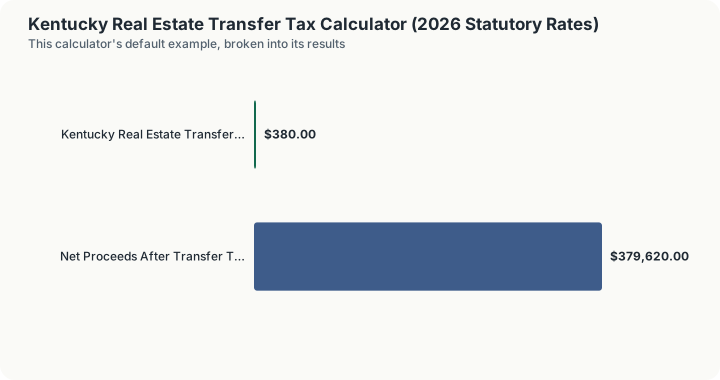
Quick Answer: A $380,000 home sale in Kentucky at the statutory deed transfer tax rate of $0.50 per $500 of value (0.10%) generates $380 in tax due.
Overview
Kentucky styles its transfer tax as a deed transfer tax under KRS 142.050, structured as $0.50 per $500 of declared value, an even 0.1% of the sale price with no bracket and no separate high-value surcharge. What sets Kentucky apart procedurally is enforcement: the county clerk will not accept a deed for recording until the tax is paid and the deed is stamped, making it a hard closing-day requirement rather than an item that can be settled after the fact.
By statute and standard practice, the seller pays Kentucky's deed transfer tax at the time of recording, a firmer rule than the negotiable customs found in neighboring Tennessee or West Virginia. A signed consideration certificate stating the sale price must accompany most deeds, a compliance document distinct from the tax itself, and certain family, gift, and corrective-deed transfers can qualify for full or partial exemption under the statute.
How This Is Calculated
Kentucky charges $0.50 per $500 of value under KRS 142.050, a flat 0.1% collected by the county clerk when the deed is stamped.
The engine multiplies the full sale price by 0.001 in exact decimal arithmetic so the figure matches the clerk's stamp to the penny. Kentucky has no bracket structure and no luxury surcharge, so the effective rate reads 0.100% at every price and the tax scales in exact proportion: double the price, double the tax.
Worked Example
A Louisville closing at the baseline $380,000, with each operation isolated so the deed tax can be checked against the settlement statement line by line.
Step 1 -- The consideration. Contract sale price = $380,000
Step 2 -- The statutory rate. KRS 142.050, $0.50 per $500 of value = 0.1%
Step 3 -- Apply the rate. $380,000 x 0.001 = $380.00
Step 4 -- The same figure by the per-$500 method. ($380,000 / $500) x $0.50 = 760 x $0.50 = $380.00
Step 5 -- Net proceeds after the deed tax. $380,000.00 - $380.00 = $379,620.00
Step 6 -- The effective rate. $380.00 / $380,000 = 0.100%
At the calculator's $1,500,000 scenario the schedule offers no second tier.
Step 7 -- The luxury sale. $1,500,000 x 0.001 = $1,500.00
Step 8 -- The effective rate, unmoved. $1,500.00 / $1,500,000 = 0.100%
Step 4 exists because Kentucky clerks quote the tax in units of $500, not as a percentage, and the two routes have to agree to the cent or one of them is wrong. They do. The proportionality in Steps 3 and 7 is exact: the tax ratio of 3.947 matches the price ratio of 3.947 to three decimal places, which is what a flat tax with no minimum, no bracket and no surcharge looks like when you test it at two widely separated prices. Kentucky custom assigns the deed tax to the seller, so Step 5 is the figure that determines what actually lands in the seller's account.
Fifty Cents per Five Hundred, All the Way Up
The Kentucky transfer tax configuration returns no schedule, so there is no twelve-row table on this page. Everything the calculation can tell you comes from moving the price field, and it moves in a straight line.
Marginal cost of the next unit. Each additional $1,000 of consideration costs $1.00 of Kentucky deed transfer tax, which is what $0.50 per $500 under KRS 142.050 works out to. Raise the entry from $380,000 to $381,000 and the tax goes from $380.00 to $381.00. The tax in dollars is the price in thousands, exactly, at every price.
No threshold exists in the Kentucky schedule. A $1,000,000 sale returns $1,000.00 and leaves $999,000.00 of proceeds, at the same 0.100% effective rate as a $50,000 sale. There is no mansion band, no graduated bracket and no local add-on in the engine's Kentucky entry, whose avgLocalRate is zero. Several states in this same primitive carry a mansion cliff that re-rates the whole price once it crosses a threshold; Kentucky has nothing of the kind, so the effective rate never moves off 0.100%.
How small this actually is. On the $380,000 default the transfer tax is $380.00, which is 0.1% of the price. The Kentucky property tax on a house of the same value, at the statewide 0.71% effective rate, is $2,840.00 a year. The transfer tax is a one-off charge worth about seven weeks of property tax, which is the right scale to hold it at when reading a closing statement.
Right base against wrong base, priced. The tax is charged on the value of the consideration, so the number to enter is the contract price. Entering a $310,000 assessed value on a $380,000 sale returns $310.00 and understates by $70.00; entering a $450,000 figure inflated by seller credits returns $450.00 and overstates by $70.00. The engine multiplies whatever it is given by 0.001 and has no way to check which figure arrived.
What This Does Not Account For
- County clerk recording fees: Separate from the deed transfer tax, Kentucky county clerks charge their own flat recording fees to file the deed, which are not part of the transfer tax calculation.
- Statutory exemptions: Kentucky law exempts certain transfers, including many transfers between spouses, transfers by gift with no consideration, and transfers to correct a prior deed, from all or part of the transfer tax; these are not captured by a simple sale-price calculation.
- Consideration certificate requirements: Kentucky requires a signed consideration certificate stating the sale price to accompany most deeds; this is a compliance document, not itself an additional tax.
- Local occupational or documentary charges: A limited number of Kentucky jurisdictions may impose narrow, unrelated local charges tied to real estate transactions that fall outside the statewide deed transfer tax framework.
- Mineral rights and severed estate transfers: Transfers involving severed mineral or timber rights can carry distinct valuation and disclosure considerations that are not modeled by a simple sale-price-based calculation.
Common Pitfalls
- Assuming the deed cannot be recorded without exact payment at the door. Kentucky county clerks require the transfer tax to be paid and the deed stamped before recording, so miscalculating the amount due can delay closing.
- Confusing the deed transfer tax with property tax. Kentucky's KRS 142.050 tax is a one-time transaction tax paid at closing; it has no relationship to the recurring annual ad valorem property tax assessed by the county.
- Forgetting the consideration certificate. Most Kentucky deeds require this signed statement of sale price to accompany the recording; omitting it can hold up the transfer tax calculation and the recording itself.
- Overlooking exempt transfer categories. Family transfers, gifts, and certain corrective deeds may qualify for full or partial exemption, and failing to claim an applicable exemption can result in overpayment.
- Applying a bracket mentality from another state. Unlike Hawaii's marginal system, Kentucky's rate is flat across the entire sale price, so there is no need to track different rates at different price tiers.
Frequently Asked Questions
What is Kentucky's real estate transfer tax rate?
Is Kentucky's deed transfer tax bracketed, or does it apply the same rate to every price point?
Who pays Kentucky's deed transfer tax, the buyer or the seller?
Are any Kentucky property transfers exempt from the deed transfer tax?
What happens if the transfer tax isn't paid at closing?
Sources
- Kentucky Department of Revenue, deed transfer tax guidance and KRS 142.050. revenue.ky.gov