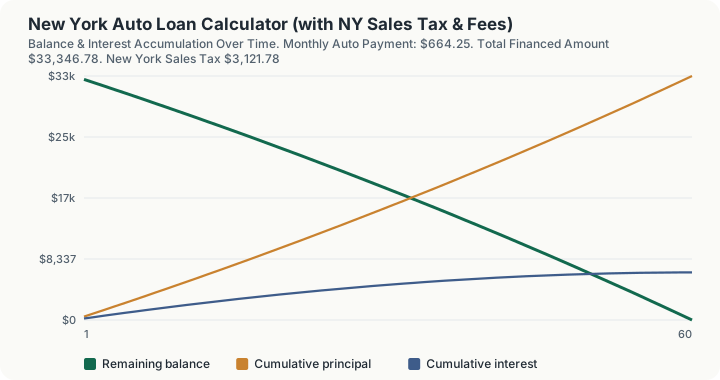
Quick Answer: A $35,000 vehicle bought by a New York City resident, with $5,000 cash down, the $175 capped dealer documentation fee, a 60-month term, and a 7.25% APR, carries a $664.25 monthly payment. That figure includes $3,121.78 of sales tax at the NYC combined rate of 8.875% and the $50 certificate of title fee, financing $33,346.78 in total.
Overview
New York charges sales tax on a car at the rate where the buyer lives, not where the dealer sits. Tax Law § 1111(i) and § 1214 source a motor vehicle sale to the purchaser's locality of residence and the place the vehicle is garaged, and the DMV collects the tax at the time you apply for title and registration. A Brooklyn resident who drives to a dealership in Rochester still pays 8.875%, not 8%. Shopping across county lines changes the price you negotiate and the financing you are offered. It does not change your tax rate.
That single rule is worth more than most New York car-buying advice, because it removes an entire category of false savings. It also means the number you need is your own home address rate, which is why this calculator asks for the local rate rather than assuming one.
New York has no separate automotive rate. Cars are taxed at the ordinary combined state and local rate, which is 4% state plus a county rate, plus in twelve downstate counties a 0.375% Metropolitan Commuter Transportation District surcharge. Combined rates in the major metros run from 8% to 8.875%, so tax on a mid-priced car lands between roughly $2,800 and $3,200.
The dealer documentation fee is capped. New York raised the cap from $75 to $175 effective 18 August 2021, and virtually every dealer charges exactly $175. It is one of the few line items in this calculation you can predict without asking.
Auto Loan APR by Credit Score
The APR columns below are national averages, not New York figures. No primary source publishes average auto loan APR by state: Experian's report has no geographic cut, the CFPB publishes state origination volume but no rates, and the New York Fed publishes state delinquency only. The payment column is the part that is specific to New York, because it runs this calculator's own New York tax and fee rules at each tier's rate.
| Credit Tier | VantageScore 4.0 | Avg New APR | Avg Used APR | Est. Payment in New York |
|---|---|---|---|---|
| Super prime | 781-850 | 4.55% | 6.30% | $622.44 |
| Prime | 661-780 | 6.23% | 8.77% | $648.26 |
| Nonprime | 601-660 | 9.67% | 14.03% | $703.12 |
| Subprime | 501-600 | 13.44% | 19.42% | $766.27 |
| Deep subprime | 300-500 | 16.01% | 21.77% | $811.11 |
Payment assumptions: $35,000 vehicle price, $0 trade-in, $5,000 cash down, $175 dealer documentation fee, 60-month term, new-vehicle APR applied to the New York delivered price including tax and statutory fees. At the 6.39% overall new-car average the same purchase costs $650.75 a month.
The score bands are VantageScore 4.0, not FICO. The same borrower can land in a different tier under each model, so a FICO score pulled from a card issuer will not always match the band here. Source: Experian, State of the Automotive Finance Market, Q1 2026, slide 45.
What Moves Your Payment
Each row changes one input and leaves the rest at the baseline below. The dollar effects are this calculator's own output for New York, not a rule of thumb.
| Factor | What Changes | Effect on Monthly Payment | Effect on Total Interest |
|---|---|---|---|
| Vehicle Price | Each extra $1,000 of price raises both the amount financed and the sales tax base, so the tax rises with it. | +$21.68 | +$212.49 |
| Trade-In Allowance | A $1,000 allowance cuts the amount financed by $1,000 and reduces the sales tax base by the same amount, so it saves tax as well as principal. | -$21.69 | -$212.48 |
| Cash Down Payment | A $1,000 larger down payment cuts the amount financed by $1,000. It never reduces the sales tax, which is assessed on the price, not on what you borrow. | -$19.92 | -$195.16 |
| Dealer Doc Fee | A $100 higher documentation fee adds $100 to the amount financed and is inside the sales tax base, so it is taxed on top of itself. New York caps the fee at $175. | +$2.17 | +$21.25 |
| Longer Term | Stretching the same balance from 60 months to 72 months spreads the principal over twelve more payments at the same rate. | -$91.71 | +$1,368.18 |
Baseline: $35,000 vehicle price, $0 trade-in, $5,000 cash down, $175 documentation fee, 60 months at 7.25% APR, giving a $664.25 payment and $6,507.95 of total interest.
How This Is Calculated
New York sources vehicle tax to where you live rather than where you buy, so the local rate follows your home address. Five steps.
1. Net taxable receipt. Tax Law § 1101(b)(3) defines the taxable receipt to exclude the value of property accepted in part payment and intended for resale, which is what a dealer trade-in is. The doc fee is treated as part of the receipt, since New York includes dealer charges for services rendered in connection with the sale.
The allowance is capped at the price of the vehicle you are buying, so an oversized trade cannot drive the receipt below zero.
2. Sales tax. The combined rate is the 4% state rate plus the county, city, and MCTD rate at your home address.
3. Title fee. A flat $50 for the certificate of title, added to the delivered price and outside the tax base.
4. Amount financed. The trade-in works twice. It lowered the taxable receipt in step one, and it also reduces the balance you borrow.
5. Amortization. The financed amount amortizes as a fixed-rate installment loan:
where $P$ is the financed amount, $i$ is the monthly rate (APR ÷ 12), and $n$ is the term in months. Each period's interest is the outstanding balance times $i$, the remainder reduces principal, and the schedule reconciles to zero at maturity.
New York Vehicle Tax Rates by Metro
These are combined state and local rates from New York State Department of Taxation and Finance Publication 718, effective 1 March 2025. The local column is what you enter in the calculator.
| Metro | County | Local Rate | State | Combined |
|---|---|---|---|---|
| New York City | All five boroughs | 4.875% | 4% | 8.875% |
| Long Island | Suffolk | 4.750% | 4% | 8.750% |
| Buffalo | Erie | 4.750% | 4% | 8.750% |
| Long Island | Nassau | 4.625% | 4% | 8.625% |
| Lower Hudson | Westchester | 4.375% | 4% | 8.375% |
| Rochester | Monroe | 4.000% | 4% | 8.000% |
| Syracuse | Onondaga | 4.000% | 4% | 8.000% |
The NYC, Nassau, Suffolk, and Westchester figures each include the 0.375% MCTD surcharge. The Westchester line is the county rate outside its cities; White Plains, Yonkers, and several others carry different rates, as do Oneida and Olean in their counties. If you live inside a city that levies its own rate, look up your jurisdiction code in Publication 718 rather than using the county line.
Publication 718 is reissued when rates change. The March 2025 edition is the most recent located. Check the current edition before you sign.
Worked Example
New York sources vehicle tax to where you live, not where you buy, so the rate below is a New York City resident's 8.875% even if the dealership is upstate. That sourcing rule is the single most important thing on this page.
- Vehicle price: $35,000
- Trade-in allowance: $0
- Cash down: $5,000
- Dealer doc fee: $175
- Local rate: 4.875% (NYC, for 8.875% combined)
- Term: 60 months at 7.25% APR
Step 1 -- The taxable receipt. Receipt including the capped doc fee, less property accepted in part payment: $35,000 + $175 - $0 = $35,175.00
Step 2 -- Combined state and local rate. 4.0% state + 4.875% New York City = 8.875%
Step 3 -- The sales tax. $35,175.00 x 8.875% = $3,121.78
Step 4 -- The certificate of title, outside the base. $50.00
Step 5 -- Total delivered price. $35,000 + $175.00 + $3,121.78 + $50.00 = $38,346.78
Step 6 -- Amount financed. $38,346.78 - $0 trade-in - $5,000 cash down = $33,346.78
Step 7 -- The monthly payment. $33,346.78 at 7.25% over 60 months = $664.25
Step 8 -- Month 1. $33,346.78 x (7.25% / 12) = $201.47 interest, $462.78 principal, balance $32,884.00
Step 9 -- Month 2. $32,884.00 x (7.25% / 12) = $198.67 interest, $465.58 principal, balance $32,418.42. Cumulative interest: $400.14
Step 10 -- The accumulation. Interest through month 12 is $2,229.33 with $27,605.11 outstanding. Over the full term, $6,507.95
Now add a $10,000 trade-in and change nothing else. The taxable receipt drops to $25,175, tax falls to $2,234.28, and the payment drops to $447.37. The trade-in saved $887.50 in tax by itself, which is the section 1101(b)(3) exclusion at work. A private sale of that same car has to beat the dealer's offer by more than $887.50 before it puts you ahead.
Move the same buyer to Rochester and the tax falls to $2,814.00, a difference of $307.78, and the payment falls to $658.12. That is the whole spread between the highest and lowest major metro rates in the state on a $35,000 car.
What This Does Not Account For
- Registration fees. New York's passenger registration fee is weight-based and biennial, running from $26.00 for a vehicle under 1,650 lbs to $140.00 above 6,951 lbs, with a $32.50 two-year minimum for six-cylinder and electric vehicles. Reading the correct bracket requires DMV form MV-202 and your vehicle's weight, so no figure is asserted here. Plan on it separately.
- Plates, county use tax, and the MCTD supplemental fee. New plates are $25. Counties levy a vehicle use tax collected at registration, $30 per two years in New York City and $10 to $60 per two years elsewhere. The twelve MCTD counties add a $50 supplemental fee per two years. None of these are financed into the loan, and none are in the calculator.
- City rates that differ from the county line. White Plains, Yonkers, Oneida, and Olean are the common examples. Use your own jurisdiction code.
- Private-party purchases. The trade-in exclusion is a dealer-sale rule. Buying from an individual gives you no trade-in credit, and you pay the tax directly to the DMV at registration using form DTF-802.
- Doc fee taxability is treated as likely, not confirmed. New York includes dealer service charges in the taxable receipt as a general matter, and this calculator applies that treatment. It has not been confirmed against a Department of Taxation and Finance advisory opinion for the documentary fee specifically. On a $175 fee the difference is $15.53 of tax at the NYC rate.
- GAP insurance, extended warranties, and aftermarket add-ons, unless you fold them into the vehicle price yourself.
Common Pitfalls
- Believing you can buy across county lines to save tax. You cannot. Tax Law § 1214 sources the sale to your residence, and the DMV collects at registration using your address. A dealer in a low-rate county cannot give you their rate.
- Using the general sales tax rate of the dealer's location. Same error from the other direction. If your estimate came off the dealership's website, it may be built on the wrong jurisdiction entirely.
- Forgetting the MCTD surcharge. The 0.375% district surcharge applies in twelve downstate counties and is already inside the Publication 718 combined rate. Adding it again overstates your tax; assuming a county rate without it understates the tax by about $132 on a $35,175 receipt.
- Treating the $175 doc fee as negotiable. It is a statutory ceiling, not a floor, but dealers charge the cap consistently. What is worth negotiating is the vehicle price, since that is what carries the 8.875% multiplier.
- Rolling negative equity forward. If you owe more on the trade than it is worth, the shortfall is added to the new loan. It raises the principal and the total interest, and it does not increase your tax credit, which follows the allowance rather than your equity.
- Judging a loan by the payment alone. Stretching this $33,346.78 balance from 60 to 72 months drops the payment to $572.54 and raises total finance charges to $7,876.19, which is $1,368.18 more interest for $91.71 a month.
Frequently Asked Questions
What is the sales tax on a car in New York?
Can I buy a car in a lower-tax county to pay less?
Does a trade-in reduce sales tax in New York?
How much can a New York dealer charge for a doc fee?
What are New York title and registration fees?
Does New York have an annual vehicle property tax?
Sources
- New York State Department of Taxation and Finance, Publication 718, New York State Sales and Use Tax Rates by Jurisdiction, effective 1 March 2025. tax.ny.gov
- Consumer Financial Protection Bureau, Truth in Lending Act (Regulation Z, 12 CFR § 1026.22) disclosure requirements for installment credit. ecfr.gov/current/title-12/chapter-X/part-1026
Also consulted: NY Tax Law Art. 28 § 1105(a) (imposition of state sales tax on retail sales); NY Tax Law § 1111(i) and § 1214 (motor vehicle tax sourced to the purchaser's locality of residence); NY Tax Law § 1101(b)(3) (taxable receipt excludes property taken in part payment for resale); New York DMV, Sales Tax Information (collection at title and registration); New York DMV, Passenger Vehicle Registration Fees, Use Taxes and Supplemental Fees ($50 title, $25 plates, county use tax, MCTD supplemental fee); New York DMV form MV-202 (weight-based biennial passenger registration fee schedule); Experian, State of the Automotive Finance Market, Q1 2026, slide 45 (average new and used auto loan APR by VantageScore 4.0 credit tier; national, no state level cut published).