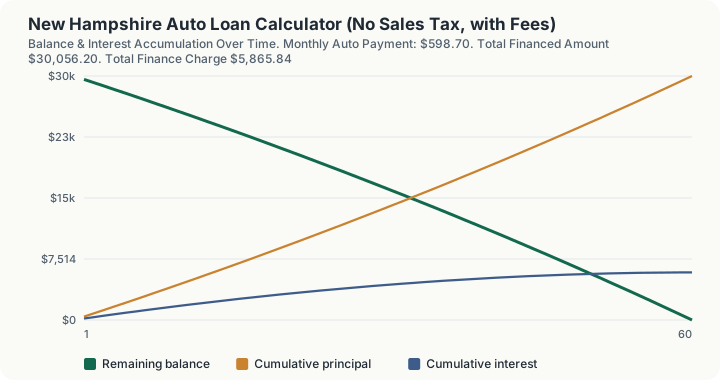
Quick Answer: New Hampshire charges no sales tax and no excise tax when you buy a car. A $35,000 vehicle with $5,000 cash down, a 60-month term and a 7.25% APR carries a $598.70 monthly payment on $30,056.20 financed. The state charges instead an annual municipal permit fee under RSA 261:153: $630 in the first model year on a $35,000 list price, falling by statute to $105.
Overview
New Hampshire is one of the few states where the purchase-tax line on a buyer's order is genuinely zero. There is no general sales tax, no use tax, and no motor vehicle excise tax on the purchase itself. No statute imposes one. If you are comparing a New Hampshire deal against a deal in a neighboring state, the sales tax difference on a $35,000 car is the entire tax, not a rate difference.
That is where most New Hampshire calculators stop, and stopping there is misleading. The state moves the cost from the purchase to the annual registration. Every New Hampshire municipality collects a motor vehicle registration permit fee under RSA 261:153, calculated from the vehicle's original manufacturer's list price on a declining mill schedule set by state statute. On a new car it is commonly several hundred dollars a year, and it is the single largest line item a New Hampshire vehicle owner pays.
Two consequences follow, and both catch buyers out.
First, the permit fee is based on the original list price when the vehicle was new, not on what you paid and not on current market value. Buying a three-year-old car at a bargain price does not lower the permit fee; only the car's age and its original sticker do.
Second, a trade-in produces no tax saving in New Hampshire. In most states a trade-in cuts the taxable price and saves you real money in tax. Here there is no purchase tax to reduce, and the permit fee ignores the transaction entirely. A trade-in reduces only what you borrow.
Auto Loan APR by Credit Score
The APR columns below are national averages, not New Hampshire figures. No primary source publishes average auto loan APR by state: Experian's report has no geographic cut, the CFPB publishes state origination volume but no rates, and the New York Fed publishes state delinquency only. The payment column is the part that is specific to New Hampshire, because it runs this calculator's own New Hampshire tax and fee rules at each tier's rate.
| Credit Tier | VantageScore 4.0 | Avg New APR | Avg Used APR | Est. Payment in New Hampshire |
|---|---|---|---|---|
| Super prime | 781-850 | 4.55% | 6.30% | $561.02 |
| Prime | 661-780 | 6.23% | 8.77% | $584.29 |
| Nonprime | 601-660 | 9.67% | 14.03% | $633.74 |
| Subprime | 501-600 | 13.44% | 19.42% | $690.66 |
| Deep subprime | 300-500 | 16.01% | 21.77% | $731.07 |
Payment assumptions: $35,000 vehicle price, $0 trade-in, $5,000 cash down, $0 dealer documentation fee, 60-month term, new-vehicle APR applied to the New Hampshire delivered price including tax and statutory fees. At the 6.39% overall new-car average the same purchase costs $586.54 a month.
The score bands are VantageScore 4.0, not FICO. The same borrower can land in a different tier under each model, so a FICO score pulled from a card issuer will not always match the band here. Source: Experian, State of the Automotive Finance Market, Q1 2026, slide 45.
What Moves Your Payment
Each row changes one input and leaves the rest at the baseline below. The dollar effects are this calculator's own output for New Hampshire, not a rule of thumb.
| Factor | What Changes | Effect on Monthly Payment | Effect on Total Interest |
|---|---|---|---|
| Vehicle Price | Each extra $1,000 of price is financed in full. New Hampshire levies no state vehicle purchase tax, so price moves the loan only. | +$19.92 | +$195.16 |
| Trade-In Allowance | A $1,000 allowance cuts the amount financed by $1,000. New Hampshire levies no state vehicle purchase tax, so there is no state tax base for it to reduce. | -$19.92 | -$195.16 |
| Cash Down Payment | A $1,000 larger down payment cuts the amount financed by $1,000. | -$19.92 | -$195.16 |
| Dealer Doc Fee | A $100 higher documentation fee adds $100 to the amount financed. New Hampshire levies no state vehicle purchase tax, so nothing is charged on top of it. New Hampshire caps the fee at $27. | +$1.99 | +$19.51 |
| Longer Term | Stretching the same balance from 60 months to 72 months spreads the principal over twelve more payments at the same rate. | -$82.66 | +$1,233.16 |
Baseline: $35,000 vehicle price, $0 trade-in, $5,000 cash down, $0 documentation fee, 60 months at 7.25% APR, giving a $598.70 payment and $5,865.84 of total interest.
How This Is Calculated
New Hampshire imposes no sales tax and no vehicle purchase tax. There is no statute creating one. Four steps.
1. Purchase tax. Zero, at every price.
The vehicle-purchase-tax primitive is still used rather than bypassed, with New Hampshire's rate of 0 supplied from the tax table. That keeps the delivered-price arithmetic identical across all fifty states and makes any future change in New Hampshire law a one-line data edit.
2. Title and state registration. A fixed $56.20, being the $25.00 first certificate of title fee under RSA 261:14 and the $31.20 state portion of the passenger registration fee under RSA 261:141 for a vehicle up to 3,000 lbs. The state portion rises to roughly $55.20 for vehicles up to 8,000 lbs and is prorated monthly.
3. Amount financed. The trade-in and the cash down both reduce the balance you borrow. Neither affects tax, because there is none.
4. Amortization. The financed amount amortizes as a fixed-rate installment loan:
where $P$ is the financed amount, $i$ is the monthly rate (APR ÷ 12), and $n$ is the term in months. Each period's interest is the outstanding balance times $i$, the remainder reduces principal, and the schedule reconciles to zero at maturity.
The RSA 261:153 Municipal Permit Fee
This is the real recurring cost of owning a car in New Hampshire, and it is not part of the loan calculation above. The rate schedule is set by statute and is uniform statewide. Towns do not set their own rates; they only collect.
The fee is expressed in mills, meaning dollars per $1,000 of original list price, and it steps down with the vehicle's model year:
| Vehicle age | Rate | Per $1,000 of list price | On a $35,000 list price |
|---|---|---|---|
| Current model year | 18 mills | $18.00 | $630.00 |
| 1st preceding model year | 15 mills | $15.00 | $525.00 |
| 2nd preceding | 12 mills | $12.00 | $420.00 |
| 3rd preceding | 9 mills | $9.00 | $315.00 |
| 4th preceding | 6 mills | $6.00 | $210.00 |
| 5th preceding and older | 3 mills | $3.00 | $105.00 |
A $5.00 minimum applies. The rate floors at 3 mills, so an older car keeps paying $105 a year on a $35,000 original list price for as long as it is registered.
Over the first six model years, a $35,000 list price vehicle owes $630 + $525 + $420 + $315 + $210 + $105, which is $2,205 in municipal permit fees. That is the figure to weigh against what a sales tax would have cost in another state, and it is why "New Hampshire has no car tax" is only half true.
The base is the original maker's list price. A buyer who picks up a four-year-old car with a $35,000 original sticker for $14,000 pays the permit fee on $35,000 at 6 mills, which is $210, not on the $14,000 paid.
Worked Example
New Hampshire imposes no sales tax and no purchase excise on a car, so the whole tax column collapses to zero and the real annual cost sits in the town permit bill instead. The steps are short for that reason.
- Vehicle price: $35,000
- Trade-in allowance: $0
- Cash down: $5,000
- Dealer doc fee: $0
- Term: 60 months at 7.25% APR
Step 1 -- Purchase tax. No statute imposes one: $0.00
Step 2 -- Title and state registration. $25.00 title + $31.20 state registration = $56.20
Step 3 -- Total delivered price. $35,000 + $56.20 = $35,056.20
Step 4 -- Amount financed. $35,056.20 - $0 trade-in - $5,000 cash down = $30,056.20
Step 5 -- The monthly payment. $30,056.20 at 7.25% over 60 months = $598.70
Step 6 -- Month 1. $30,056.20 x (7.25% / 12) = $181.59 interest, $417.11 principal, balance $29,639.09
Step 7 -- Month 2. $29,639.09 x (7.25% / 12) = $179.07 interest, $419.63 principal, balance $29,219.46. Cumulative interest: $360.66
Step 8 -- The running total. By month 12, $2,009.36 of interest paid and $24,881.16 still owed. Over the full term, $5,865.84
Add a $10,000 trade-in and the payment falls to $399.51, financing $20,056.20. Every dollar of that reduction comes from borrowing less. Unlike almost every other state, none of it comes from tax.
Add a $400 dealer documentation fee instead and the payment rises to $606.67. That fee is not taxed, because nothing is.
Separately, the town bill in year one on a $35,000 original list price is $630, which works out to about $52.50 a month set aside. Budgeting the payment alone understates the real cost of the car by roughly that much in the first year.
What This Does Not Account For
- The municipal permit fee itself. It is an annual charge collected by your town, based on original list price and model year rather than on the transaction, so it is not added to the loan. The mill schedule above lets you compute it directly.
- Registration proration. New Hampshire registrations run 5 to 16 months depending on your registration month, so a first-year bill is often not a clean twelve months of the mill rate.
- The weight bracket. The $31.20 state fee used here is for a vehicle up to 3,000 lbs. Heavier passenger vehicles run to roughly $55.20, and the full weight-bracket table was not captured.
- The municipal agent fee. Town clerks acting as municipal agents commonly add about $2.00 to a title transaction, and towns levy small plate and agent charges beyond the state fee.
- A contested title fee. RSA 261:14 sets the first certificate of title fee at $25.00, which is the figure used here. One secondary source reported $35 state plus a $2 agent fee. Confirm the current amount with your town clerk.
- Dealer documentation fees, unless you enter one. A claimed $27.00 statutory cap circulates online; it appears to be a misreading of the title and agent fee pass-through, and New Hampshire dealers in practice charge $300 to $500. This calculator does not assert a cap.
- GAP insurance, extended warranties, and aftermarket add-ons, unless you fold them into the vehicle price yourself.
Common Pitfalls
- Reading "no sales tax" as "no car tax." The mill schedule collects $2,205 over six years on a $35,000 list price vehicle. It arrives every year rather than once, which changes the cash flow but not the total.
- Expecting a trade-in to save tax. It does not, and no New Hampshire dealer can produce a tax credit for you. Compare a trade-in offer against a private sale purely on price, since there is no tax credit tipping the scale toward the dealer the way there is in most states.
- Using the purchase price to estimate the permit fee. The base is the original manufacturer's list price when new. On a used car bought below list, the fee will be higher than a price-based estimate suggests, sometimes much higher.
- Registering in the wrong town to chase a lower rate. The mill schedule is statutory and identical in every municipality, so there is no rate to chase. You must register where you actually reside.
- Rolling negative equity forward. If you owe more than the trade is worth, the shortfall is added to the new loan, raising both the principal and the total interest.
- Judging a loan by the monthly payment alone. Stretching this $30,056.20 balance from 60 to 72 months cuts the payment to $516.04 and raises total finance charges from $5,865.84 to $7,099.06.
Frequently Asked Questions
Does New Hampshire charge sales tax on cars?
What is the New Hampshire municipal permit fee?
Does a trade-in reduce my tax in New Hampshire?
How is the permit fee calculated on a used car?
How much are New Hampshire title and registration fees?
Is there a cap on dealer documentation fees in New Hampshire?
Sources
- Consumer Financial Protection Bureau, Truth in Lending Act (Regulation Z, 12 CFR § 1026.22) disclosure requirements for installment credit. ecfr.gov/current/title-12/chapter-X/part-1026
Also consulted: RSA 261:153 (annual motor vehicle registration permit fee; 18/15/12/9/6/3 mill schedule on original maker's list price, $5.00 minimum); RSA 261:14 (first certificate of title fee); RSA 261:141 (state portion of passenger vehicle registration fees, weight-based and prorated); New Hampshire DMV, Vehicle Registrations (no sales or excise tax on vehicle purchase); Town of Exeter, New Hampshire, town clerk explanation of motor vehicle fees (state fee ranges and permit fee mechanics); Experian, State of the Automotive Finance Market, Q1 2026, slide 45 (average new and used auto loan APR by VantageScore 4.0 credit tier; national, no state level cut published).