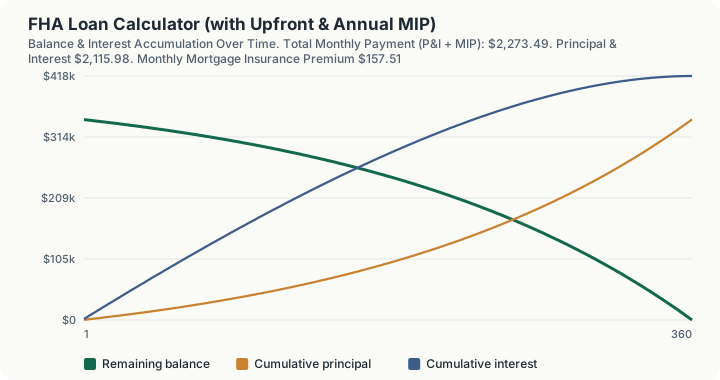
Quick Answer: A $350,000 home purchased with 3.5% down at 6.25% carries a $337,750.00 base loan, a $5,910.63 upfront Mortgage Insurance Premium financed into the loan, and a total monthly payment of $2,273.49, made up of $2,115.98 in principal and interest plus $157.51 in monthly MIP.
Overview
FHA loans, insured by the Federal Housing Administration, let borrowers buy a home with as little as 3.5% down and a credit score as low as 580. That accessibility comes with a cost: every FHA loan carries Mortgage Insurance Premium, or MIP, which protects the lender if the borrower defaults. Unlike conventional private mortgage insurance, FHA's MIP has two distinct parts, and both are set by HUD, not negotiated with the lender.
The first part is Upfront MIP, a one-time charge of 1.75% of the base loan amount. Almost all borrowers finance this into the loan rather than paying it in cash at closing, which is why the total loan amount you actually borrow and pay interest on is slightly larger than the base amount you needed to cover the purchase.
The second part is Annual MIP, a recurring charge added to the monthly payment. For most 30-year FHA loans with less than 10% down, the annual rate is 0.55% of the loan amount, and unlike conventional PMI (which cancels automatically once you reach 78% loan-to-value), FHA's annual MIP on a low-down-payment loan runs for the entire life of the loan. Put down 10% or more, and MIP instead cancels after 11 years regardless of your loan-to-value at that point. These are HUD-set figures under Mortgagee Letter 2023-05, which set the current MIP schedule.
How This Is Calculated
- Base loan amount. Purchase price minus your down payment.
- Upfront MIP. 1.75% of the base loan amount, financed into the loan rather than paid in cash.
- Total financed loan amount. Base loan amount plus upfront MIP. This is the balance your monthly principal and interest payment is actually calculated against.
- Monthly principal and interest. Standard mortgage amortization on the total financed loan amount, at your rate and term.
- Monthly MIP. The annual MIP rate applied to the total financed loan amount, divided by 12. This calculator holds the dollar amount constant against the original financed balance, which is how most consumer-facing FHA calculators present it; HUD's underlying methodology technically references the average outstanding balance for each policy year, which declines slightly over time.
- MIP duration. For down payments under 10%, monthly MIP continues for the full loan term. For down payments of 10% or more, monthly MIP stops after 132 months (11 years).
- Total monthly payment. Principal and interest plus monthly MIP.
Worked Example
A $350,000 home, 3.5% down, 6.25% APR, 30-year term:
- Down payment: $350,000 × 3.5% = $12,250.00
- Base loan amount: $350,000 − $12,250.00 = $337,750.00
- Upfront MIP: $337,750.00 × 1.75% = $5,910.63
- Total financed loan amount: $337,750.00 + $5,910.63 = $343,660.63
- Monthly rate: 6.25% ÷ 12 = 0.5208333%
- Monthly principal and interest (360 months): $2,115.98
- Monthly MIP: $343,660.63 × 0.55% ÷ 12 = $157.51
- Total monthly payment: $2,115.98 + $157.51 = $2,273.49
- Total MIP paid over the loan (assuming it runs the full term): $5,910.63 upfront + ($157.51 × 360) = $62,614.23
Now compare the same purchase with 10% down instead. The base loan shrinks to $315,000.00, upfront MIP drops to $5,512.50, and the total financed amount is $320,512.50, producing a lower monthly principal and interest payment of $1,973.45 and monthly MIP of $146.90. The meaningful difference isn't just the smaller monthly numbers: because the down payment cleared the 10% threshold, MIP cancels entirely after 132 months (11 years) instead of running for the full 30-year term, saving a substantial amount of insurance cost over the life of the loan.
What This Does Not Account For
- Property taxes, homeowners insurance, and HOA dues. This calculator covers principal, interest, and MIP only, not the full PITI payment a lender would quote.
- FHA loan limits. HUD caps the maximum FHA loan amount by county; this calculator doesn't check your inputs against those limits.
- Streamline refinance MIP refunds. Borrowers who refinance into a new FHA loan within roughly three years may be eligible for a partial refund of their original upfront MIP, which this calculator doesn't model.
- Declining-balance MIP precision. As noted above, this calculator holds the monthly MIP dollar amount flat rather than recalculating it against the slowly declining loan balance each policy year, which is a small simplification versus HUD's exact methodology.
- Seller or lender credits toward closing costs. These can reduce your effective cash needed at closing but don't change the MIP or amortization math shown here.
Common Pitfalls
- Forgetting that upfront MIP is usually financed, not paid in cash. This means your total loan balance, and the interest you pay on it, is slightly higher than the base amount needed for the purchase.
- Assuming MIP drops off at 78% loan-to-value like conventional PMI. It doesn't, unless you put down 10% or more at closing, in which case it cancels on a fixed 11-year schedule regardless of your loan balance at that point.
- Comparing an FHA total payment directly to a conventional total payment without accounting for MIP duration. A conventional loan's PMI typically cancels once you build 22% equity; a low-down-payment FHA loan's MIP can run the entire term, which matters a great deal over a 30-year horizon.
- Not checking FHA loan limits for your county before assuming eligibility. High-cost areas have higher limits than the national floor, and the loan amount you want may or may not qualify.
Frequently Asked Questions
What is the difference between Upfront MIP and Annual MIP?
Can I avoid paying MIP on an FHA loan?
Does FHA MIP ever go away automatically?
How much is the FHA upfront MIP rate, and where does it come from?
Is an FHA loan cheaper than a conventional loan with private mortgage insurance?
Sources
- Consumer Financial Protection Bureau (CFPB): FHA loan disclosure requirements and mortgage insurance consumer guidance. consumerfinance.gov
- Consumer Financial Protection Bureau, Buying a house. consumerfinance.gov/owning-a-home
- Consumer Financial Protection Bureau, "What is a loan-to-value ratio and how does it relate to my costs?" consumerfinance.gov/ask-cfpb/what-is-a-loan-to-value-ratio-how-does-it-relate-to-my-costs-en-121
Also consulted: U.S. Department of Housing and Urban Development (HUD): Mortgagee Letter 2023-05, Reduction of the Annual Mortgage Insurance Premium (MIP) Rates; U.S. Department of Housing and Urban Development (HUD): FHA Single Family Housing Handbook 4000.1, MIP calculation and cancellation rules.