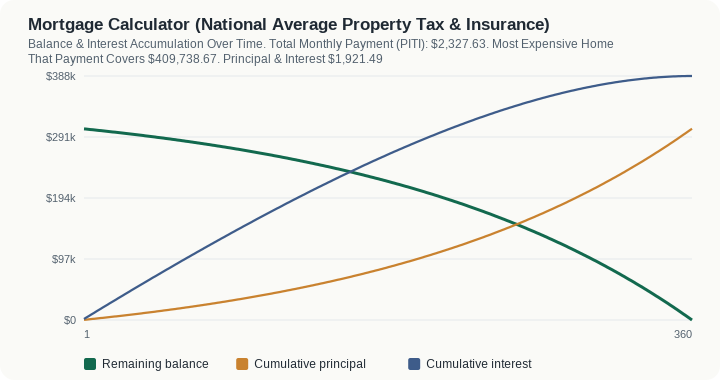
Quick Answer: A $380,000 home with 20% down at 6.5% over 30 years costs $2,347.38 a month: $1,921.49 in principal and interest, $281.14 in property tax at the 0.89% national average rate, and $144.75 in homeowners insurance at the NAIC countrywide average, with no PMI because the loan never sits above 80% of the price after the first payment. Across all 360 payments the loan charges $387,732.82 in interest.
What does this calculator do?
This calculator works out the full monthly cost of a fixed-rate home loan: principal and interest, property tax, homeowners insurance, private mortgage insurance (PMI) when the down payment is under 20%, and homeowners association (HOA) dues. It also shows what an extra principal payment each month does to the payoff date and the interest bill, and it runs the question in reverse: given the total monthly payment you can afford, what is the most expensive home that payment covers?
Property tax is the input that varies most by location, from under 0.5% of value in Hawaii and Alabama to close to 2% in New Jersey and Illinois. If you do not know your rate yet, the calculator starts from a single national number: 0.89%, the unweighted mean of the effective property tax rate across all 50 states, read directly from this platform's own state-by-state property tax table rather than typed in by hand, so it cannot drift out of step with the underlying data. Value-weighted national figures run higher, nearer 1.1%, because the high-rate states hold a disproportionate share of national home value. Once you know the county you are buying in, replace the default with its rate; the field accepts any rate from 0% to 5%.
Insurance starts at $1,737 a year ($144.75 a month), the countrywide average premium for an HO-3 homeowners policy in data year 2023 from the National Association of Insurance Commissioners (NAIC). That is an average across every state and coverage amount, not a quote, and the 50 state mortgage pages each start from their own state's NAIC figure instead, from $923 a year in Wisconsin to $3,027 in Louisiana. PMI starts at 0.5% of the loan a year, and HOA dues and extra principal at zero, so the default result is a plain 30-year loan with 20% down. Every one of those is an input you can change, along with the loan term, which can be 10, 15, 20 or 30 years.
The principal and interest math is the same amortization engine used across every mortgage and loan calculator on this platform. It charges a payment rounded to the cent and posts each month's interest to the cent, the way a lender does, and every schedule it produces repays exactly the amount borrowed.
For the formula behind the payment, and what taxes, insurance and PMI add to it, see how a mortgage payment is calculated.
How is this calculated?
- Loan amount. The down payment percentage is applied to the home price, and the remainder is the loan, rounded to the cent.
- Principal and interest (P&I). With i the annual rate divided by 12 and n the number of monthly payments (120, 180, 240 or 360 for a 10, 15, 20 or 30-year term), the scheduled payment is
Payment = P × (i(1 + i)ⁿ)/((1 + i)ⁿ − 1)
rounded half up to the nearest cent. Each month the interest charged is the opening balance times i, rounded to the cent, and the rest of the payment reduces the balance. The last payment is whatever balance remains plus that month's interest, so it differs from the others by a few dollars.
- Property tax. The home price times the annual property tax rate, divided by 12 and rounded to the cent. The rate defaults to the 0.89% national average described above.
- Homeowners insurance. The annual premium divided by 12 and rounded to the cent.
- PMI. The monthly premium is the loan amount times the annual PMI rate, divided by 12 and rounded to the cent. It is the same every month it applies. A payment carries PMI when the balance it leaves behind, after scheduled principal and any extra principal, is still above 80% of the home price. The first payment that brings the balance to 80% of the price or below carries no PMI, and neither does any payment after it. With 20% or more down, the first payment already leaves the balance below that line, so PMI never appears.
- HOA dues. Added to the monthly payment exactly as entered.
- Total monthly payment. The headline is the sum of the rounded figures from steps 2 to 6, using the first month's PMI, so the breakdown shown beside it always adds up to it to the cent. Extra principal is not included in the headline; it is shown separately in its effect on the schedule.
- Extra principal. Any extra amount is paid every month from the first payment and goes entirely to principal, so the balance falls faster, less interest accrues each month, and the loan ends early. The scheduled payment does not change. The payoff term counts every payment until the balance reaches zero; time saved is the chosen term minus that count; interest saved is the total interest on the same loan with no extra principal minus the total interest with it.
- Working back from a payment. Principal and interest, property tax and PMI all grow in proportion to the price, while insurance and HOA dues do not. So the first month's payment equals the price times a fixed factor, plus insurance and HOA. The factor is the loan share times the payment on a one-dollar loan, plus the monthly tax rate, plus the loan share times the monthly PMI rate when the first payment would carry PMI. Whether it does depends only on the down payment, rate and term, not on the price. Solving for price gives the most expensive home your target payment covers, without any extra principal. At the defaults, a $2,500 total monthly payment covers a home priced at $406,331.37.
The amortization schedule lists every payment. Its Total Payment column is the scheduled payment plus any extra principal plus that month's PMI; property tax, insurance and HOA dues are not in the schedule.
Worked Example
Using the calculator's default inputs:
- Home Price: $380,000.00
- Down Payment: 20% ($76,000.00)
- Interest Rate: 6.5%
- Term: 30 years (360 payments)
- Property Tax Rate: 0.8878% (national average)
- Insurance: $1,737 per year (NAIC 2023 countrywide HO-3 average)
- PMI Rate: 0.5%, HOA: $0, Extra Principal: $0
Step by step:
- Loan amount: $380,000 minus $76,000 equals $304,000.00
- Monthly principal and interest at 6.5% over 360 months: $1,921.49. The first payment is $1,646.67 interest and $274.82 principal. The final payment is $1,917.91.
- Property tax: $380,000 times 0.8878%, divided by 12: $281.14
- Homeowners insurance: $1,737 divided by 12: $144.75
- PMI: none. The first payment leaves a balance of $303,725.18, below 80% of the price ($304,000), so no payment carries PMI.
- Total monthly payment: $1,921.49 plus $281.14 plus $144.75 equals $2,347.38
- Total interest across all 360 payments: $387,732.82
The same home with 5% down. The loan is $361,000.00 and principal and interest rise to $2,281.77. PMI is $361,000 times 0.5% divided by 12, or $150.42 a month, so the total monthly payment is $2,858.08. Payment 123 leaves a balance of $304,158.72, still above $304,000, and payment 124 leaves $303,524.48, so the first 123 payments carry PMI (10 years 3 months) for a total of $18,501.66. Total interest over 30 years is $460,432.24.
Adding $200 a month of extra principal. On the default 20%-down loan, the balance reaches zero after 278 payments instead of 360, a payoff term of 23 years 2 months. That saves 6 years 10 months and $103,858.20 of interest; total interest falls to $283,874.62. On the 5%-down loan, the same $200 cuts PMI from 123 payments to 85 and pays the loan off in 288 payments (24 years), with total interest of $351,436.89, which is $108,995.35 less than without it.
A 15-year term. The default home on a 15-year term has principal and interest of $2,648.17 and a total monthly payment of $3,074.06. Total interest over its 180 payments is $172,669.47. At that term, a $2,500 total monthly payment covers a home priced at $305,531.72.
What does this calculator not account for?
- Your actual state and county property tax rate, unless you enter it. The 0.89% default is a 50-state unweighted mean, not a value-weighted average and not any single jurisdiction's real rate. Property tax is also held at the same amount for the whole loan; real bills change when homes are reassessed or local rates move.
- Rising insurance premiums and HOA dues. Both are held flat at the amounts entered.
- The other ways PMI ends. The calculator stops PMI at the 80% level as described above, measured against the purchase price. Under the Homeowners Protection Act, cancellation at 80% must be requested in writing and the lender can require a good payment history and evidence the home has not lost value; automatic termination happens later, at 78% of original value on the original schedule; and PMI also ends at the midpoint of the loan term. "Original value" in the statute is the lesser of the price and the appraisal. Removing PMI on the strength of appreciation needs a new appraisal and is lender policy, not modelled here.
- How PMI is actually priced. Insurers price PMI by credit score, loan-to-value band and coverage level. This calculator applies the single annual rate you enter to the original loan amount, as a flat monthly premium.
- FHA, VA and USDA loans. FHA mortgage insurance premiums, the VA funding fee and USDA guarantee fees follow different rules from conventional PMI.
- Property tax exemptions. Homestead exemptions, senior freezes, veteran exemptions and assessment caps can lower the effective rate well below both the national average and the statutory rate.
- Closing costs and prepaid escrow. This tool models the ongoing monthly payment only, not the upfront cash needed to close.
- A calendar payoff date. There is no start-date input, so the payoff is reported as a term (years, months and number of payments) rather than a calendar date.
- Adjustable rates. The calculation assumes a fixed-rate loan; adjustable-rate mortgages (ARMs) reset the interest rate on a schedule this calculator does not model.
- Lump-sum or biweekly prepayments. Extra principal is a fixed monthly amount from the first payment.
What mistakes do people make with this?
- Leaving the national average in place once you know the location. A 0.89% rate can understate a payment by hundreds of dollars a month in high-tax states and overstate it just as much in low-tax states. Enter the county rate as soon as you have it.
- Reading the first month's PMI as permanent. On a 5%-down loan, PMI is a large line item at the start but comes off once the balance reaches 80% of the price. Check the PMI Charged For figure, not just the monthly amount.
- Assuming PMI comes off by itself at 80%. In practice you have to ask for it, and the lender's conditions apply. If you do not ask, it continues until the 78% automatic termination point.
- Ignoring HOA fees when comparing a condo to a single-family home. Two properties with identical PITI can have very different total monthly housing costs once HOA dues are added.
- Comparing terms on monthly payment alone. A 15-year loan has a higher payment but a far smaller total interest bill. Look at both outputs side by side.
- Using a teaser ARM rate as if it were fixed for 30 years. Adjustable-rate loans can reset substantially higher after the initial fixed period.
Frequently Asked Questions
Does this calculator include PMI?
When does PMI stop in this calculator?
What loan terms can I choose?
How does an extra principal payment change the result?
How is the 0.89% national average calculated?
What insurance figure does this calculator use?
What does the most expensive home figure include?
Should I use this calculator or a state-specific one?
Sources
- US Census Bureau: American Community Survey, property tax and home value data. census.gov/programs-surveys/acs
- NAIC, Dwelling Fire, Homeowners Owner-Occupied, and Homeowners Tenant and Condominium/Cooperative Unit Owner's Insurance Report: Data for 2023 (July 2026), Table 4, HO-3 average premium, countrywide and by state. content.naic.org/sites/default/files/publication-hmr-zu-homeowners-report.pdf
- Homeowners Protection Act of 1998, 12 U.S.C. 4901-4910: borrower-requested cancellation at 80%, automatic termination at 78%, and final termination at the loan midpoint. law.cornell.edu/uscode/text/12/chapter-49
- Consumer Financial Protection Bureau: Regulation Z mortgage disclosure standards. ecfr.gov/current/title-12/chapter-X/part-1026