Quick Answer: A $75,000 salary in California, paid bi-weekly with $3,500 a year in pre-tax deductions, nets $2,144.56 a paycheck in 2026, or $55,758.45 for the year. California's $3,104.05 state income tax on that salary is $566.07 above the 50-state average and ranks 22nd of 50.
What does this calculator do?
The difference between your salary and your paycheck is four subtractions: FICA, federal income tax, state income tax, and whatever you put into a 401(k) or HSA before tax. Three of those are the same wherever you work. The fourth is the only one that changes when you move, and it is the one most people are trying to size up when they compare a job in Austin against a job in Portland.
This page runs the federal and FICA math once, then runs the state layer for all 50 states on the same wage so you can see where yours sits. Nine states take nothing from wages. Oregon takes the most: $5,937.25 on this salary, against California's $3,104.05 and the 50-state mean of $2,537.98.
A no-tax state is worth roughly $2,600 a year at this income compared with the average state, and about $6,000 against the top. That is real, and it is also smaller than the cost-of-living gap between most of those places, which this page does not attempt to price.
The 2026 Social Security and Medicare tax guide explains the 7.65% payroll tax, the $184,500 Social Security wage base and the Additional Medicare Tax.
Your Bi-Weekly Paycheck, Line by Line
Bi-weekly pay is the default here: 26 paychecks a year, one every two weeks. On the $75,000 California salary, each bi-weekly paycheck breaks down like this:
- Gross pay: $2,884.62
- FICA: $220.67
- Federal income tax: $265.38
- California income tax: $119.39
- Pre-tax 401(k) or HSA deduction: $134.62, the $3,500 annual figure spread across 26 checks
- Net take-home pay: $2,144.56
Switch to semi-monthly and the same salary arrives as 24 checks of $2,323.27 net. Each check is larger because there are two fewer of them, and the annual take-home of $55,758.45 is identical.
How is this calculated?
The engine runs four steps in this order, using 2026 federal figures from IRS Revenue Procedure 2025-32.
Federal Taxable = max(0, Gross − Pre-Tax Deductions − Standard Deduction)
Net Annual = Gross − FICA − Federal Tax − State Tax − Pre-Tax Deductions − Post-Tax Deductions
Net Paycheck = (Net Annual)/(Pay Periods)
- FICA on the full gross salary. Social Security at 6.2% up to the annual wage base, Medicare at 1.45% with no cap, and the additional 0.9% Medicare surtax above the filing status threshold. On $75,000 single that is $4,650.00 plus $1,087.50, so $5,737.50, or $220.67 a paycheck. Note that this is charged on the whole $75,000, not on the amount after pre-tax deductions.
- Federal income tax on gross less pre-tax deductions less the standard deduction. $75,000 minus $3,500 is $71,500; minus the $16,100 single standard deduction leaves $55,400, which through the 2026 brackets gives $6,900.00, or $265.38 a paycheck.
- State income tax on gross less pre-tax deductions. The same $71,500 runs through the selected state's rate schedule. For California that is $3,104.05, or $119.39 a paycheck. With Married Filing Jointly selected, the state's joint schedule is used wherever the state tax table holds one (18 states, California among them, give couples wider brackets); elsewhere the single schedule applies. No state standard deduction, personal exemption or state-specific credit is applied, which is a simplification described under What This Does Not Account For.
- Subtract everything from gross and divide. $75,000 minus $5,737.50, $6,900.00, $3,104.05 and the $3,500 you set aside leaves $55,758.45 a year. Across 26 bi-weekly periods that is $2,144.56 a paycheck.
Hourly pay and post-tax deductions. Gross is the salary entered while Pay Type is left at Salary. With Pay Type set to Hourly, gross is the hourly rate × hours per week × 52, the salary field is ignored, and all four steps run on that figure. Post-Tax Deductions (Roth 401(k) contributions, after-tax insurance premiums, garnishments) are the last subtraction in step 4, taken from annual net after every tax and before the division into paychecks. They sit in no tax base, so no tax line and no state ranking moves when they change; they are left out of the Total Effective Tax Rate and counted in the schedule's Cumulative Deductions column. Every worked figure on this page uses the salary path and the field's $0 default.
The national comparison repeats step 3 alone, for all 50 states, on the same $71,500 and the same filing status.
- Average and rank. The mean state income tax across the 50 states is $2,537.98, including the nine states that charge nothing. California, at $3,104.05, is $566.07 above that and ranks 22nd, where rank 1 is the largest bill. Tied states share a rank, so all nine no-tax states sit together at rank 42.
Worked Example
Same $75,000 salary, same $3,500 in pre-tax deductions, single filer, comparing three states.
- The parts that do not move. FICA is $5,737.50 and federal income tax is $6,900.00 in every state, because neither depends on where you work.
- California. State tax $3,104.05. Annual net $55,758.45, bi-weekly net $2,144.56, total effective tax rate 20.99%.
- Texas. State tax $0.00. Annual net $58,862.50, bi-weekly net $2,263.94, total effective tax rate 16.85%. The gap against California is $119.38 a paycheck.
- Oregon. State tax $5,937.25, the highest of the 50 states on this wage. Annual net $52,925.25, bi-weekly net $2,035.59, total effective tax rate 24.77%.
- The spread. Between Texas and Oregon, the same job at the same salary differs by $5,937.25 a year in take-home, or $228.35 a paycheck.
Switching California to monthly pay changes nothing about the tax. The annual net is still $55,758.45; it simply arrives as twelve payments of $4,646.54 instead of twenty-six of $2,144.56.
Carrying The California Case Across The Year
The state input drives everything that varies here, and it defaults to California. Read the cumulative schedule as a template: the federal and FICA lines are identical in all fifty states, and only the state column moves when the input changes.
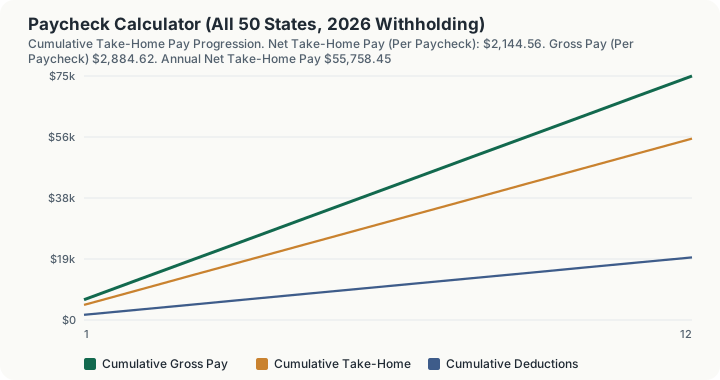
Step 6: Two months of cumulative pay. With California selected, the schedule opens at $6,250.00 of cumulative gross against $4,646.54 of cumulative take-home. Row two doubles both: $12,500.00 gross, $9,293.08 take-home, $3,206.93 accumulated on the deduction side.
Step 7: The full year. Month twelve reaches $75,000.00 of cumulative gross and $55,758.45 of cumulative take-home, growing by $4,646.54 in each of the twelve rows.
Step 8: What the year withheld. The cumulative deduction column ends at $19,241.55, and that column carries the $3,500 pre-tax 401(k) contribution alongside the tax. Tax alone is $19,241.55 - $3,500 = $15,741.55, an effective total tax rate of 20.99%.
Step 9: Why the monthly increment never changes. The rows advance in identical steps by construction. FICA is settled on the annual wage first (6.2% up to the $184,500 Social Security base, 1.45% on everything, and a further 0.9% above $200,000 for a single filer) and only the annual total is divided across twelve months. The mid-year rise a real pay stub shows when Social Security withholding stops is therefore not modeled at any salary. On $75,000 it would not occur in reality either, since gross falls $109,500 short of the wage base.
$55,758.45 is the annual result with California selected. Changing the state moves only the state column; the federal and FICA share of the $15,741.55 tax total is the same in all fifty.
What does this calculator not account for?
- State standard deductions, exemptions and credits. The state layer applies the rate schedule to your wages after pre-tax deductions and stops there. Most states allow a standard deduction or a personal exemption credit, so this overstates state tax in those states, and the overstatement is largest at low incomes where the deduction is a big share of the base.
- Local income tax. City and county income taxes exist in Ohio, Pennsylvania, Maryland, New York City, Kentucky, Indiana, Michigan and elsewhere, and none of them are here.
- FICA treatment of pre-tax deductions. Section 125 health premiums and HSA contributions through a cafeteria plan are exempt from FICA in reality. This charges FICA on the full gross, so it slightly overstates FICA when the deduction you entered is not a 401(k).
- Itemized deductions and other income. One salary, standard deduction, no investment income, no side income, no dependents.
- Hourly pay is straight time. Hourly gross is rate × hours per week × 52: no overtime premium, no unpaid weeks and the same hours every week.
- W-4 withholding versus liability. This computes tax owed on an annual salary. Actual withholding follows your W-4 entries, and the two rarely match to the dollar, which is why refunds exist.
- Reciprocity between states. If you live in one state and work in another, withholding follows agreements between those two states. This applies one state.
What mistakes do people make with this?
- Reading a no-tax state as free money. Nine states take nothing from wages, worth about $2,600 a year against the average state at this salary. Property tax and sales tax in several of them run well above average, and the housing cost differences dwarf both.
- Confusing marginal and effective rates. The 22% bracket applies only to income above $50,400 of taxable income. The total effective rate here, federal plus FICA plus state, is 20.99% in California.
- Forgetting that pre-tax deductions reduce two of the four subtractions. A dollar into a traditional 401(k) cuts federal and state taxable income but does not cut FICA, and it does not reach your paycheck either. It lowers take-home by less than a dollar, but it does lower it.
- Assuming the extra paychecks are extra money. Bi-weekly pay produces 26 or occasionally 27 paychecks; the annual total is what it is. Comparing bi-weekly to semi-monthly on the size of a single check will mislead you.
- Using a bi-weekly figure to budget monthly. Twenty-six paychecks across twelve months means ten months with two and two months with three.
Frequently Asked Questions
Which states have no income tax on wages?
Which state takes the most out of a paycheck?
What is the average state income tax on a $75,000 salary?
Why is my real paycheck smaller than this?
How many bi-weekly paychecks are in a year?
What is a bi-weekly paycheck on $25 an hour?
Does the pay frequency change my total tax?
Sources
- IRS Revenue Procedure 2025-32: 2026 federal income tax brackets and standard deduction amounts. irs.gov/pub/irs-drop/rp-25-32.pdf
- Social Security Administration: Contribution and Benefit Base, the 2026 wage base of $184,500 and the 6.2% OASDI rate. ssa.gov/oact/cola/cbb.html
Also consulted: State departments of revenue: state income tax rate schedules, as compiled in this platform's 2026 state tax tables.