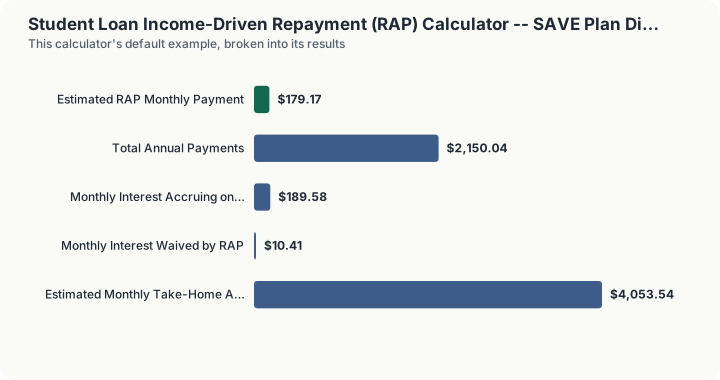
Quick Answer: The SAVE Plan is no longer available; a borrower with $55,000 AGI and one dependent now sees an estimated $179.17 monthly payment under the Repayment Assistance Plan (RAP), the income-driven plan that replaced SAVE on July 1, 2026, and RAP automatically waives the $10.41 of that month's interest the payment does not cover.
Overview
If you came looking for a SAVE Plan calculator, the honest first thing to tell you is that the SAVE Plan is gone. It was blocked by a federal court in June 2024, ruled unlawful by the Eighth Circuit Court of Appeals in February 2025, and a further court order in March 2026 ended the Department of Education's ability to implement it at all. Borrowers who were enrolled in SAVE spent months in an interest-accruing forbearance while the litigation played out, and as of mid-2026 those borrowers are being actively moved off SAVE and into a legally available repayment plan. If you are on this page trying to estimate a SAVE payment, that plan simply does not exist anymore, and any calculator that still lets you compute one is giving you a number for a program that is not available to you.
What replaced it is the Repayment Assistance Plan, or RAP, created by the FY2025 reconciliation law (the "One Big Beautiful Bill Act") and launched on July 1, 2026. RAP is now, alongside the older Income-Based Repayment (IBR) plan, one of the two income-driven repayment options available to federal student loan borrowers going forward, and it is what this calculator actually computes. RAP works differently from SAVE in an important way: instead of basing your payment on "discretionary income" (income above a poverty-line threshold), RAP bases your payment on a direct percentage of your total Adjusted Gross Income, with the percentage rising in tiers as your income rises, plus a per-dependent reduction and a built-in feature that waives interest your payment doesn't cover so your balance can't grow from unpaid interest.
How This Is Calculated
Step 1: Determine your bracket rate. RAP's percentage rises by 1 percentage point for every $10,000 of AGI above $10,000, capped at 10% once AGI exceeds $100,000:
- AGI of $10,000 or less: flat $10 per month, regardless of bracket.
- AGI $10,001-$20,000: 1% of AGI. AGI $20,001-$30,000: 2%. And so on, up one percentage point per $10,000 bracket, up to AGI above $100,000: 10%.
Step 2: Calculate the annual payment, then divide by 12.
Step 3: Apply the dependent reduction. Each dependent reduces the monthly payment by $50, though the payment can never drop below the $10 monthly floor:
Step 4: Check RAP's interest waiver. RAP is designed so unpaid interest cannot make your balance grow. Every month, the calculator compares your RAP payment to the interest actually accruing on your loan balance at your loan's rate. If your payment falls short, RAP waives the uncovered portion rather than adding it to your balance.
Step 5 (context only): estimate take-home pay. Using the shared payroll primitive, the calculator estimates your FICA taxes (Social Security and Medicare) on your AGI as a proxy for gross wages, to show roughly how much of your paycheck is left after FICA and your RAP payment. This is illustrative context, not a full paycheck calculation, since it does not include federal or state income tax withholding.
Worked Example
Take a borrower with $55,000 AGI, one dependent, a $35,000 federal loan balance, and a 6.5% interest rate.
- Bracket: AGI falls between $50,001 and $60,000, which is the 5th $10,000 bracket above the $10,000 floor, so the bracket rate is 5%.
- Annual payment: $55,000 × 5% = $2,750.
- Monthly base payment: $2,750 ÷ 12 = $229.17.
- Dependent reduction: $229.17 − ($50 × 1) = $179.17.
- Monthly interest accruing on the loan: $35,000 × 6.5% ÷ 12 = $189.58.
- Interest waived: since the $179.17 payment falls $10.41 short of the $189.58 accruing, RAP waives that $10.41 rather than adding it to the balance.
- Estimated take-home context: FICA on $55,000 (6.2% Social Security plus 1.45% Medicare) is $4,207.50 a year, leaving about $4,232.71 a month before income tax; after the $179.17 RAP payment, about $4,053.54 remains.
A borrower at $8,000 AGI, below the $10,000 threshold, pays the flat $10 minimum regardless of dependents. A borrower at $150,000 AGI hits the capped 10% top bracket: $15,000 a year, or $1,250 a month, with no dependent deduction applied in that scenario.
Carrying the First Twelve Payments
Step 8 -- Month one. Payment $179.17, interest accruing that month $189.58, paid to date $179.17
Step 9 -- Month two. Payment $179.17, interest still $189.58, paid to date $358.34
Step 10 -- Month six. Paid to date $1,075.02
Step 11 -- Month twelve. Paid to date $2,150.04, which is the annual payment total
A year of payments comes to $2,150.04 and the balance in every row of the schedule is still $35,000. That is not an error in the illustration, it is the mechanic: the payment is smaller than the interest accruing, so it retires no principal, and the $10.41 monthly gap is waived under RAP rather than capitalised. The borrower is not going backwards, which is what the old unsubsidised plans did, but they are not going forwards either. Progress toward forgiveness here is measured in months of qualifying payments, not in balance reduction, and the schedule illustrates the payment stream rather than an amortisation.
What This Does Not Account For
This calculator estimates a monthly RAP payment using the plan's published income bands; it does not access your actual federal loan servicing account, so it cannot confirm your specific loan types are RAP-eligible or reflect any payments, forbearance, or loan status already on file with your servicer. It does not model the separate loan forgiveness timeline RAP provides after a set number of qualifying payments, which is a long-horizon feature this monthly-payment tool does not project. It does not model Income-Based Repayment (IBR), the other plan still available long-term, which uses a different discretionary-income-based formula; borrowers who last borrowed before July 1, 2026 may have access to both IBR and RAP and should compare both. The take-home pay estimate uses AGI as a stand-in for gross wages and FICA only, omitting federal and state income tax, retirement contributions, and other paycheck deductions, so treat it as a rough directional figure, not a paycheck calculator.
Common Pitfalls
The single biggest pitfall right now is assuming SAVE is still an option, or worse, budgeting around a SAVE payment estimate from an old calculator or a bookmark that has not been updated. SAVE is not available, and borrowers who do not respond to their servicer's transition notice within the window provided can be automatically enrolled into a plan that was not chosen with their specific forgiveness timeline in mind. It is also easy to confuse RAP's AGI-based percentage with older plans' discretionary-income formulas; RAP does not subtract a poverty-line exemption before applying its percentage, it applies the percentage to your AGI directly (above the $10,000 floor), which is a materially different calculation than the old REPAYE or IBR-style formulas. Borrowers also sometimes assume the dependent deduction is unlimited; it is capped by the $10 monthly floor, so a large family with a modest income cannot use dependents to reduce the payment to zero. Finally, do not assume interest waived under RAP is the same as forgiveness; the waiver simply stops your balance from growing due to that month's unpaid interest, it does not reduce your principal.
Frequently Asked Questions
Is the SAVE Plan really gone, or could it come back?
What happened to borrowers who were on SAVE?
How is RAP different from the old IBR or PAYE plans?
Will RAP forgive my loan the way SAVE was supposed to?
Can I choose between RAP and IBR?
Sources
- U.S. Department of Education, press release on federal student loan repayment options and the SAVE Plan.
- Congress.gov, Congressional Research Service, "The Repayment Assistance Plan (RAP) in P.L. 119-21, the FY2025 Reconciliation Law".
Also consulted: P.L. 119-21 (FY2025 Reconciliation Act / "One Big Beautiful Bill Act"), RAP statutory payment formula and effective dates; The Institute for College Access & Success (TICAS), "Explainer: Student Loan Repayment Changes Starting July 1, 2026".