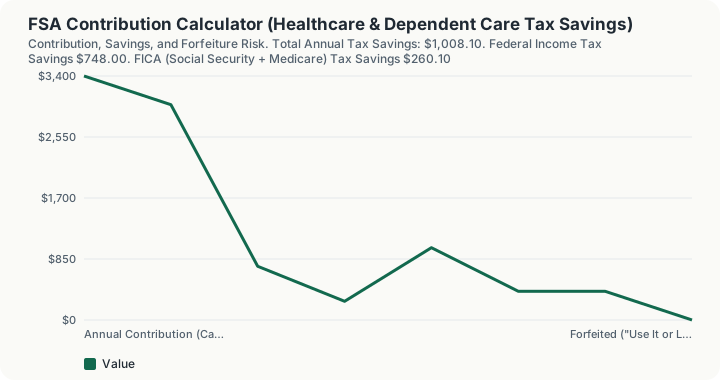
Quick Answer: A single filer earning $90,000 who contributes the full 2026 Healthcare FSA limit of $3,400 saves $748 in federal income tax and $260.10 in FICA payroll tax, a total of $1,008.10 in tax savings, roughly 29.7% of the contribution. If they expect only $3,000 in eligible expenses, the unused $400 fits entirely within the 2026 carryover limit, so nothing is forfeited.
Overview
A Flexible Spending Account (FSA) lets you set aside money from your paycheck before federal income tax and FICA payroll tax are calculated, then use it tax-free for eligible expenses during the plan year. This calculator supports the two most common FSA types:
- Healthcare FSA: reimburses eligible out-of-pocket medical, dental, and vision expenses (copays, prescriptions, eyeglasses, and similar costs not covered by insurance).
- Dependent Care FSA (DCFSA): reimburses eligible child or dependent care expenses (daycare, before/after-school care, summer day camp) that let you, and your spouse if married, work or look for work.
Both are governed by IRS rules under a "cafeteria plan" (Internal Revenue Code Section 125), and both carry the same core trade-off: the tax savings are attractive, but unlike a 401(k) or HSA, unused Healthcare FSA money is subject to a strict "use it or lose it" rule at the end of the plan year, softened only by whatever carryover or grace period your specific employer plan offers.
How This Is Calculated
Federal income tax savings compares your total federal tax with and without the contribution excluded from taxable income, correctly accounting for bracket-straddling rather than just multiplying by a flat rate:
FICA payroll tax savings works the same way, using the actual 2026 Social Security wage base and Additional Medicare threshold, since FSA contributions are excluded from FICA wages too, a real advantage a 401(k) does not offer:
Forfeiture risk compares your contribution against your expected eligible expenses. Any unused amount, up to the carryover limit (Healthcare FSA only, if your plan offers one), rolls to next year; anything beyond that is forfeited under the use-it-or-lose-it rule:
Because the tax exclusion applies to the whole contribution regardless of whether it is ultimately spent, overcontributing relative to your actual expected expenses can turn a positive tax benefit into a net loss once forfeiture is netted out, which is exactly what the "Net Value After Forfeiture Risk" output is built to surface.
Worked Example
An FSA election is really two calculations pulling in opposite directions: the tax exclusion, which rewards electing more, and the forfeiture rule, which punishes it. Three elections are worked below, from clearly good to clearly bad.
Healthcare FSA, election matched to spending
Single filer, $90,000 of household taxable income, $3,400 elected (the 2026 maximum), $3,000 of expected eligible expenses.
Step 1 -- The election after the IRS cap. $3,400 requested against a $3,400 limit, so $3,400 is elected
Step 2 -- Federal income tax with the election. Tax on $90,000: $14,512.00 Tax on $86,600: $13,764.00 Federal savings: $748.00
Step 3 -- FICA saved on the same dollars. $3,400 x 7.65% = $260.10
Step 3 is the part that separates an FSA from a 401(k). A traditional 401(k) deferral avoids income tax but still pays Social Security and Medicare; an FSA election avoids both.
Step 4 -- Total tax savings. $748.00 + $260.10 = $1,008.10
Step 5 -- The effective savings rate. $1,008.10 / $3,400.00 = 29.7%, against a 22.0% marginal federal bracket
Step 6 -- Unused contribution. $3,400.00 - $3,000.00 = $400.00
Step 7 -- Carryover and forfeiture. $400.00 is within the $680 Healthcare FSA carryover, so carried over: $400.00, forfeited: $0.00
Step 8 -- Net value. $1,008.10 - $0.00 = $1,008.10
The same election against much lower spending
Step 9 -- Keep the $3,400 election but expect only $1,200 of expenses. Tax savings are unchanged at $1,008.10, because the exclusion applies to the whole election whether or not it is spent
Step 10 -- Unused contribution. $3,400.00 - $1,200.00 = $2,200.00
Step 11 -- Carryover rescues only part of it. Carried over: $680.00 (the 2026 cap) Forfeited: $2,200.00 - $680.00 = $1,520.00
Step 12 -- Net value. $1,008.10 - $1,520.00 = -$511.90
The election that looked identical in steps 2 through 5 is now worth less than not electing at all. Nothing about the tax treatment changed between step 8 and step 12; only the spending forecast did.
Dependent Care FSA, where no carryover exists
Married filing jointly, $120,000 of income, $7,500 elected (the 2026 maximum), $5,000 of expected expenses.
Step 13 -- Tax savings on the larger election. Federal: $1,650.00. FICA: $7,500 x 7.65% = $573.75. Total: $2,223.75
Step 14 -- Unused contribution. $7,500.00 - $5,000.00 = $2,500.00
Step 15 -- Carryover available. Dependent Care FSAs are outside the IRS carryover provision, so the carryover limit is $0.00 and the full $2,500.00 is forfeited
Step 16 -- Net value. $2,223.75 - $2,500.00 = -$276.25
Compare step 16 with step 8. The Dependent Care election produces more than double the tax savings and still finishes underwater, because there is no $680 cushion behind it. The right election is not the maximum; it is the amount you are confident you will actually spend, and the arithmetic above is why that has to be decided at open enrollment rather than in December.
The 2026 Contribution Limits
| FSA Type | 2026 Limit | 2025 Limit | Change |
|---|---|---|---|
| Healthcare FSA | $3,400 | $3,300 | +$100 |
| Healthcare FSA Carryover | $680 | $660 | +$20 |
| Dependent Care FSA (household) | $7,500 | $5,000 | +$2,500 |
| Dependent Care FSA (married filing separately) | $3,750 | $2,500 | +$1,250 |
The Healthcare FSA limit and its carryover are adjusted annually for inflation under IRS Revenue Procedure 2025-32. The Dependent Care FSA limit is different: it is a statutory dollar figure fixed under Internal Revenue Code Section 129, not previously inflation-indexed, which is why it sat at $5,000 unchanged since 1986 until legislation (the One, Big, Beautiful Bill Act) raised it to $7,500 for 2026, the first increase in nearly forty years.
Understanding "Use It or Lose It"
The use-it-or-lose-it rule (formalized in Treasury regulations and IRS Notice 2013-71) exists because FSAs are technically employer-sponsored benefit plans, not personal savings accounts, and the IRS requires a genuine risk of forfeiture for the pre-tax treatment to apply in the first place. Employers are allowed, but not required, to soften this in one of two ways for a given plan year, never both:
- Carryover: up to $680 (2026) of unused Healthcare FSA funds can roll into the next plan year, on top of whatever you contribute that next year.
- Grace period: instead of a carryover, some plans give you an extra 2.5 months after the plan year ends to incur and submit new eligible expenses against the prior year's unused balance.
Dependent Care FSAs are generally excluded from the carryover provision under IRS guidance; a Dependent Care FSA plan may offer a grace period instead, but this calculator does not separately model grace-period timing, only the carryover-versus-forfeit calculation, since grace period rules vary considerably by employer and this calculator treats any amount not carried over as effectively at risk unless spent by the plan's actual deadline.
Check your own Summary Plan Description before enrolling. Some employer plans offer neither a carryover nor a grace period, in which case every unused dollar above zero is forfeited at year-end.
What This Does Not Account For
- State income tax. Most states follow the federal pre-tax treatment of FSA contributions, but not universally; this calculator computes federal income tax and FICA savings only.
- Employer plan specifics. Whether your plan offers a carryover, a grace period, or neither is set by your employer, not the IRS uniformly; this calculator assumes the maximum IRS-allowed carryover ($680) is available for Healthcare FSAs and models no rescue mechanism for Dependent Care FSAs.
- Mid-year eligibility changes. A new job, marriage, divorce, or the birth of a child can trigger a qualifying life event that lets you change your election mid-year; this calculator models a single static annual election.
- Dependent Care FSA earned-income and care-provider rules. Eligibility for the Dependent Care FSA also requires both spouses (if married) to have earned income (with narrow exceptions) and the dependent care must enable work; this calculator does not verify your eligibility, only the tax-savings math once you are eligible.
- HSA interaction. You generally cannot contribute to a Healthcare FSA and a Health Savings Account (HSA) in the same year unless the FSA is a Limited-Purpose FSA; this calculator does not check for that conflict.
Common Pitfalls
- Setting the contribution from memory instead of a real expense estimate. Overestimating a "typical year" of medical or dependent care costs is the single most common cause of forfeited FSA money.
- Forgetting that Dependent Care FSA money is generally not carried over. Unlike a Healthcare FSA, most Dependent Care FSA plans offer no rescue mechanism at all for an overestimate.
- Ignoring the FICA savings entirely. Because FSA contributions also avoid Social Security and Medicare tax, the real tax savings rate (commonly a combined ~30%-ish for many households) is meaningfully higher than federal income tax savings alone.
- Not checking your plan's actual carryover or grace-period policy. The IRS sets a maximum allowed carryover; your employer's plan document sets what you actually get, which can be $0.
- Missing the claims deadline. Even a Healthcare FSA with a generous carryover or grace period still has a hard submission deadline; expenses incurred within the window but never filed as claims are forfeited just the same as if they were never eligible.
Frequently Asked Questions
Can I contribute to both a Healthcare FSA and a Dependent Care FSA in the same year?
Does the Dependent Care FSA limit apply per person or per household?
What happens to unused FSA money with no carryover or grace period?
Is FSA money "pre-tax" the same way a 401(k) is?
Why did the Dependent Care FSA limit jump so much for 2026?
Sources
- IRS Revenue Procedure 2025-32: 2026 Healthcare FSA contribution limit ($3,400) and carryover limit ($680). irs.gov
- IRS Publication 969, Health Savings Accounts and Other Tax-Favored Health Plans: general FSA eligibility and use-it-or-lose-it framework. irs.gov/publications/p969
- Internal Revenue Code Section 129 and the One, Big, Beautiful Bill Act: 2026 Dependent Care FSA limit increase to $7,500 ($3,750 married filing separately). law.cornell.edu/uscode/text/26/129
- IRS Revenue Procedure 2025-32 and Social Security Administration 2026 wage base data: federal income tax brackets and FICA rates/thresholds used in this calculator. ssa.gov
Also consulted: IRS Notice 2013-71: Healthcare FSA carryover provision.