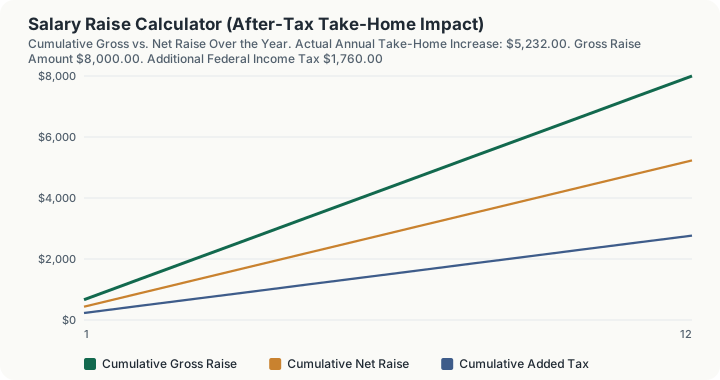
Quick Answer: A 10% raise on an $80,000.00 single-filer salary in Illinois ($8,000.00 gross) survives federal income tax ($1,760.00), FICA ($612.00), and Illinois's flat 4.95% state income tax ($396.00) to leave $5,232.00 in actual additional take-home pay, an effective marginal rate of 34.6% on the raise itself.
Overview
A raise is never worth its full face value. Every dollar of a salary increase is taxed at your marginal rate, not your average rate, and it also carries FICA (Social Security and Medicare) and state income tax where applicable. A $10,000 raise for someone deep in the 24% federal bracket, in a state with a meaningful income tax, can lose 35-40% of its value to combined taxes before it ever reaches take-home pay.
This calculator isolates that marginal impact instead of just reporting the gross number. It computes federal income tax, FICA, and state income tax both at your current salary and at your salary after the raise, using this platform's progressive-bracket tax engine for both federal and state calculations, and reports the difference: the actual increase in take-home pay you should expect to see.
Because marginal tax brackets are cumulative, a raise that pushes part of your income into a new, higher bracket is only taxed at that higher rate on the portion that crosses the line, not on your entire salary. This calculator handles that correctly by computing full tax liability at both salary levels and taking the difference, which automatically captures any bracket-crossing without needing you to figure out which bracket you're "in."
How This Is Calculated
- Raise amount. Either a percentage of current salary or a flat dollar amount, depending on which input mode you choose.
- Federal income tax increase. Progressive tax is computed on taxable income (salary minus the standard deduction) both before and after the raise; the difference is the marginal federal tax on the raise.
- FICA increase. Social Security (6.2%, up to the annual wage base) and Medicare (1.45%, plus 0.9% Additional Medicare above the filing-status threshold) computed before and after, and differenced the same way.
- State income tax increase. The same progressive-bracket approach applied to your selected state's own tax brackets. States with no wage income tax (Texas, Florida, and similar) contribute $0; Washington, which taxes capital gains but not wages, also contributes $0 here.
- Net take-home increase. Gross raise minus the sum of the three tax increases.
Worked Example
Using the calculator's default inputs:
- Current Salary: $80,000.00
- Raise: 10% ($8,000.00)
- New Salary: $88,000.00
- Filing Status: Single
- State: Illinois (flat 4.95% state income tax)
Step by step:
- 2026 single standard deduction is $16,100. Taxable income before: $80,000 − $16,100 = $63,900 (inside the 22% federal bracket, $50,400-$105,700). Taxable income after: $88,000 − $16,100 = $71,900 (still inside the same 22% bracket).
- Since the raise doesn't cross a bracket boundary, federal tax increase is simply $8,000.00 × 22% = $1,760.00.
- Both salaries are far under the Social Security wage base and the Additional Medicare threshold, so FICA applies at the standard combined 7.65% rate: $8,000.00 × 7.65% = $612.00.
- Illinois taxes wage income at a flat 4.95% with no bracket structure: $8,000.00 × 4.95% = $396.00.
- Total additional tax: $1,760.00 + $612.00 + $396.00 = $2,768.00.
- Net take-home increase: $8,000.00 − $2,768.00 = $5,232.00, or about $436.00 more per month.
- Effective marginal rate on the raise itself: $2,768.00 ÷ $8,000.00 = 34.6%, notably higher than this earner's overall effective tax rate on their full salary, because the raise is taxed entirely at the margin.
Carrying the Raise Across Twelve Months
Step 8 -- Month one. Gross raise received $666.67, net of tax $436.00, added tax $230.67
Step 9 -- Month two, cumulative. Gross $1,333.33, net $872.00, added tax $461.33
Step 10 -- Month six, cumulative. Gross $4,000.00, net $2,616.00, added tax $1,384.00
Step 11 -- Month twelve, cumulative. Gross $8,000.00, net $5,232.00, added tax $2,768.00
Because nothing here crosses a bracket, the three columns advance in a straight line: $230.67 more tax every month, without exception. Half a year in, $1,384.00 of the raise has already gone before it reached the account. That is the figure to hold against the negotiation, not the $8,000.00 headline.
Why the Marginal Rate on a Raise Looks So High
Your effective tax rate on your whole salary blends the 10%, 12%, and 22% brackets (in this example) that apply to different slices of your income. A raise, however, lands entirely on top of your existing income, so it's taxed at your marginal rate for every dollar, not the blended average. That's why a raise can feel like it "disappears" faster than expected: the new dollars are the most heavily taxed dollars you earn.
What This Does Not Account For
- Changes to pre-tax deductions. If a raise also changes your 401(k) contribution percentage, HSA elections, or other pre-tax deductions, your actual taxable income shift will differ from the raw raise amount modeled here.
- Bonus versus base salary treatment. This calculator assumes the raise is added to base salary and taxed via standard payroll withholding; one-time bonuses are often withheld at a flat supplemental rate (22% federally for bonuses under $1 million) that can differ from your marginal rate at tax-filing time.
- Local and municipal income taxes. Some cities (New York City, Philadelphia, and others) levy their own local income tax on top of state tax; this calculator models state tax only.
- Itemized deductions. This tool uses the standard deduction for both the before and after scenario; itemizers with deduction phase-outs tied to income could see a slightly different marginal impact.
- Employer benefit changes tied to salary. Some benefits, like disability insurance payouts or 401(k) matching formulas, scale with salary; a raise can therefore be worth more than the net cash figure shown here once those are factored in.
Common Pitfalls
- Assuming the whole raise lands in take-home pay. As this calculator shows, the effective marginal rate on a raise is often meaningfully higher than your overall effective tax rate, particularly once state tax and FICA are added to federal tax.
- Confusing "moving into a higher bracket" with "my whole salary is now taxed higher." Only the portion of income inside the new bracket is taxed at that bracket's rate; this is the single most common misunderstanding about progressive taxation, and this calculator's bracket-difference method avoids it automatically.
- Forgetting FICA entirely. FICA (7.65% combined, before any Additional Medicare surtax) applies to nearly every dollar of a raise for most earners and is easy to overlook when mentally estimating a raise's value.
- Ignoring state tax differences when comparing job offers across states. The same raise in Texas (0% state tax) and California (up to 13.3% marginal) produces very different net outcomes; always model the specific state, not a national average, when comparing offers.
- Using gross salary instead of taxable income when estimating your bracket. The standard deduction shifts where your taxable income actually falls relative to the published bracket thresholds, which are stated in taxable-income terms, not gross-salary terms.
Frequently Asked Questions
Why is the tax on my raise higher than my overall tax rate?
Does this calculator account for a raise that pushes me into a new tax bracket?
What if my state has no income tax?
Should I use my salary before or after 401(k) contributions?
Does a raise affect my FICA tax the same way regardless of income level?
Sources
- Internal Revenue Service: Revenue Procedure 2025-32, 2026 federal income tax brackets and standard deduction amounts. irs.gov
- Internal Revenue Service: Publication 15-T, federal income tax withholding methods. irs.gov/publications/p15t
- Social Security Administration: 2026 wage base and FICA rate fact sheet. ssa.gov