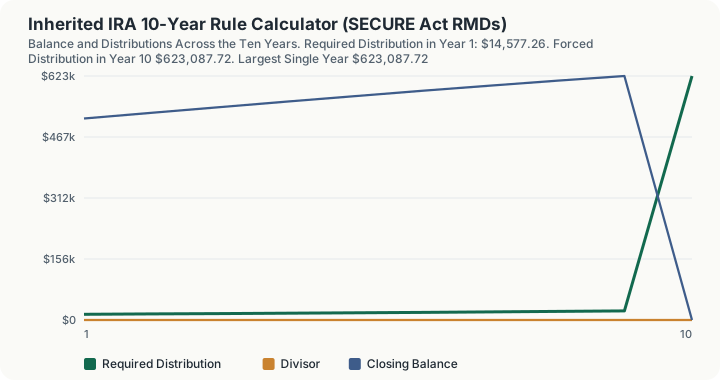
Quick Answer: A $500,000 IRA inherited by a 52-year-old from an owner who died at 78, after their required beginning date, must distribute $14,577.26 in year 1, using a life expectancy divisor of 34.3. Annual RMDs run through years 1 to 9 and the account must still be emptied by year 10, which at 6% growth forces $623,087.72 out in that final year. Total distributed across the ten years is $790,599.61.
What does this calculator do?
The SECURE Act replaced the "stretch IRA" for most non-spouse beneficiaries with a ten-year rule: the inherited account must be fully distributed by 31 December of the year containing the tenth anniversary of the owner's death.
The question everybody gets wrong is whether annual distributions are required inside those ten years. It is not a question about you. It is a question about the person who died.
- If the owner died before their required beginning date, no distribution is required in any year before the tenth. You may take nothing for nine years and then empty it.
- If the owner died on or after their required beginning date, the at-least-as-rapidly rule survives. You must take an annual life-expectancy RMD starting the year after death and still empty the account by the end of year ten.
Either way the account is gone in ten years. So the planning question is never whether to pay the tax. It is which brackets to pay it in, and the default answer, do nothing until forced, is usually the worst one, because growth makes the final year larger, not smaller.
How is this calculated?
RMD_(year n) = (opening balanceₙ)/(divisor₁ − (n − 1))
Year 10 distribution = entire remaining balance
Level alternative = (PV × g)/(1 − (1 + g)⁻¹⁰)
Step by step:
Step 1: Decide whether annual RMDs apply. Read the single input about the decedent: did they die on or after their required beginning date. If not, the divisor is zero in every year and nothing is distributed until year 10.
Step 2: Look up the beneficiary's divisor. Their single life expectancy from the IRS Single Life Table, Publication 590-B Appendix B, Table I, at their age in the year after death. These are the divisors prescribed by Treas. Reg. section 1.401(a)(9)-9(b). They are deliberately not taken from any SSA population table, which produces different figures.
Step 3: Look up the owner's remaining life expectancy, if annual RMDs apply. Table I at the owner's age in the year of death, less one, because distributions begin the following year.
Step 4: Take the longer of the two. The year-1 applicable denominator is the greater of the beneficiary's figure and the owner's reduced figure. A beneficiary older than the decedent may find the owner's life is the longer one.
Step 5: Compute the year-1 distribution. Opening balance divided by that divisor.
Step 6: Reduce the divisor by one each year. It is a fixed-term subtraction, not a fresh table lookup each year.
Step 7: Grow whatever remains at the assumed rate, and repeat through year 9.
Step 8: Force out the whole balance in year 10.
Step 9: Price the level alternative. The equal annual withdrawal that exhausts the account over the same ten years at the same growth rate, as an ordinary annuity payment.
Step 10: Report the spike removed by levelling. Largest single year under the required schedule, minus the level withdrawal.
Worked Example
Using the defaults: $500,000 balance, beneficiary aged 52 in the first distribution year, owner died at 78 on or after their required beginning date, 6% growth.
Step 1: Establish the rule. The owner had already begun their own RMDs, so annual life-expectancy distributions are required in years 1 through 9 as well as the year-ten payout.
Step 2: Look up the beneficiary's Table I divisor at age 52. 34.3
Step 3: Look up the owner's divisor. Table I at age 78 is 12.6, less one for the year of death. 12.6 − 1 = 11.6
Step 4: Take the longer. max(34.3, 11.6) = 34.3, so the divisor comes from the beneficiary's own life expectancy.
Step 5: Compute the year-1 required distribution. $500,000 ÷ 34.3 = $14,577.26
Step 6: Grow the remainder. ($500,000 − $14,577.26) × 1.06 = $514,548.10 to open year 2.
Step 7: Compute year 2. Divisor 34.3 − 1 = 33.3. $514,548.10 ÷ 33.3 = $15,451.89
Step 8: Follow the same pattern to year 9. The divisor falls to 26.3 and the opening balance has grown to $611,052.54. $611,052.54 ÷ 26.3 = $23,233.94, leaving $623,087.72 to open year 10.
Step 9: Empty the account in year 10. The entire $623,087.72 must be distributed by 31 December.
Step 10: Total the ten years. $790,599.61 was distributed in total from a $500,000 starting balance, because the account grew faster than the required distributions removed from it.
Step 11: Price the level alternative. The 6% ten-year annuity factor is 7.360087. $500,000 ÷ 7.360087 = $67,933.98 a year
Step 12: Measure the spike removed. $623,087.72 − $67,933.98 = $555,153.74
That is the whole planning case in one line. The required schedule is legal and it is also the worst available outcome: it hands a beneficiary in their early sixties a $623,000 single-year distribution, almost certainly at the top marginal rate, when the same account could have been drained at roughly $68,000 a year.
What does this calculator not account for?
- Income tax. This page produces distribution amounts, not tax. Every dollar of a traditional inherited IRA is ordinary income to the beneficiary.
- Eligible designated beneficiaries. Surviving spouses, minor children of the account owner, disabled or chronically ill individuals, and beneficiaries no more than ten years younger than the owner are all outside the ten-year rule and get life-expectancy treatment instead. The calculator models the ordinary designated beneficiary case only.
- Inherited Roth IRAs. A Roth owner has no required beginning date, so the before-RBD branch always applies, and the distributions are not taxable. This calculator's tax framing does not apply to them.
- The IRS transition relief. Notice 2022-53 and its successors waived the missed annual RMDs for 2021 through 2024 without penalty. Annual RMDs under this branch of the rule are enforced for distribution calendar years beginning on or after 1 January 2025.
- The 25% excise tax under section 4974 for a missed RMD, reduced to 10% if corrected within the correction window.
- Successor beneficiaries and what happens when the ten-year beneficiary dies inside the window.
- State income tax.
- A variable return path. Growth is a flat annual rate.
- RMDs from other accounts and the aggregation rules across multiple inherited IRAs.
What mistakes do people make with this?
- Assuming no annual RMDs are required. That is only true when the owner died before their required beginning date. Get this wrong on an account where the owner had started RMDs and you have missed nine years of required distributions.
- Testing the beneficiary's age instead of the decedent's status. The rule turns entirely on a fact about the person who died.
- Waiting until year 10 on purpose. Growth means deferral makes the final distribution larger. Here it is $623,087.72 rather than a level $67,933.98.
- Re-looking up the divisor each year. The year-1 divisor is fixed and reduced by one annually. It is not a fresh Table I lookup.
- Using the wrong table. Beneficiaries use the Single Life Table (Table I). Account owners taking their own RMDs use the Uniform Lifetime Table. They are different, and the SSA population life tables are different again.
- Missing that year 10 is a calendar year end. The deadline is 31 December of the tenth year, not the anniversary of the death.
- Rolling an inherited IRA into your own. Only a surviving spouse may do that.
Frequently Asked Questions
Do I have to take annual RMDs during the ten years?
Which life expectancy table do I use?
Why is the year-10 distribution so large?
Should I just take the minimum each year?
What if I am older than the person who died?
What happens if I miss a required distribution?
Sources
- IRS Publication 590-B, irs.gov/pub/irs-pdf/p590b.pdf: the "10-year rule" and "Owner Died on or After Required Beginning Date" discussions, including "no distribution is required for any year before the 10th year" for the before-RBD case, and Appendix B Table I (Single Life Expectancy) for the divisors.
- Final regulations, Required Minimum Distributions, 89 FR 58886 (19 July 2024), federalregister.gov/documents/2024/07/19/2024-14542/required-minimum-distributions: Treas. Reg. section 1.401(a)(9)-5(d), effective for distribution calendar years beginning on or after 1 January 2025, which confirms that annual life-expectancy distributions continue where the owner died on or after their required beginning date.
- Treas. Reg. section 1.401(a)(9)-9(b): the regulation prescribing the Single Life Table used here. The divisors are held in
engine/tables/2026/irs-life-expectancy.json, verified 2026-08-30. law.cornell.edu/cfr/text/26/1.401(a)(9)-9 - IRC section 401(a)(9)(B)(i): the at-least-as-rapidly rule that survives the SECURE Act for owners who had reached their required beginning date. law.cornell.edu/uscode/text/26/401