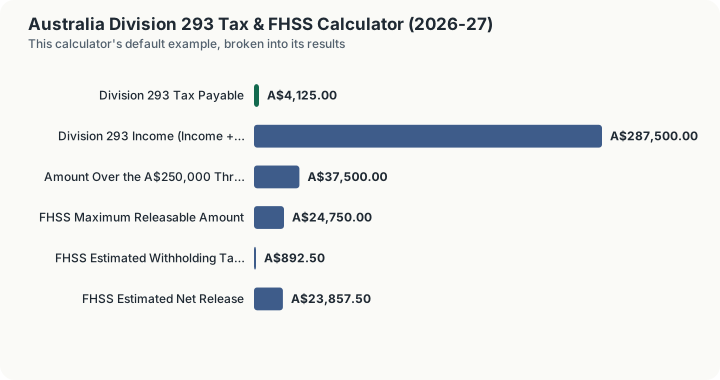
Quick Answer: A high earner with A$260,000 of income excluding super and A$27,500 of concessional contributions has Division 293 income of A$287,500, A$37,500 over the A$250,000 threshold, and owes A$4,125.00 of Division 293 tax (15% on the lesser of contributions or the excess). Separately, A$15,000 concessional plus A$10,000 non-concessional and A$2,000 of deemed earnings give an FHSS releasable amount of A$24,750.00.
Overview
This calculator combines two distinct, unrelated superannuation topics that both matter for high-income earners and first-home savers respectively: Division 293 tax, an additional tax on concessional super contributions for people earning above a fixed threshold, and the First Home Super Saver (FHSS) scheme, which lets anyone use voluntary super contributions as a tax-advantaged way to save for a home deposit.
Division 293 tax exists because concessional (before-tax) super contributions are only taxed at 15% inside the fund -- a substantial discount versus ordinary marginal tax rates for high earners. Division 293 claws back some of that discount: if your "Division 293 income" (broadly your income plus your low-tax contributions) exceeds a fixed A$250,000 threshold, an additional 15% tax applies to the lesser of your contributions or the amount you're over the threshold. Notably, this threshold has been frozen at A$250,000 since 2017 with no indexation mechanism, meaning more people are drawn into it over time purely through wage growth (a phenomenon often called "bracket creep").
The FHSS scheme, unrelated to Division 293 but sharing the same superannuation system, lets you make voluntary contributions -- concessional or non-concessional -- specifically earmarked for a future home deposit, then withdraw them (plus deemed earnings) when you're ready to buy. Concessional contributions released count at 85% of the contributed amount (since 15% was already deducted as contributions tax inside the fund) and are taxed again at your marginal rate less a 30% offset on release; non-concessional (after-tax) contributions come out tax-free, since they were already taxed before going in.
How This Is Calculated
Division 293 tax:
- Division 293 income. Your income for surcharge purposes plus your low-tax (concessional) super contributions for the year.
- Amount over threshold. Division 293 income minus A$250,000, floored at zero.
- Taxable contributions. The LESSER of your concessional contributions or the amount over the threshold.
- Tax payable. Taxable contributions × 15%.
FHSS release:
- Eligible components. Concessional contributions made count at 85% (after the 15% contributions tax already deducted); non-concessional contributions count at 100%.
- Gross releasable amount. Eligible concessional plus eligible non-concessional plus cumulative deemed associated earnings.
- Lifetime cap. The gross amount is capped at A$50,000 -- if your contribution history exceeds this, the release is capped and each component is scaled down proportionally for the tax calculation.
- Withholding tax. The concessional-sourced portion of the release is taxed at your marginal rate less a 30% offset; the non-concessional-sourced portion is tax-free.
Worked Example
Using the calculator's default inputs (A$260,000 income, A$27,500 concessional contributions, A$15,000 FHSS concessional + A$10,000 FHSS non-concessional + A$2,000 deemed earnings, 37% marginal rate):
Division 293: 1. Division 293 income: 260,000 + 27,500 = A$287,500. 2. Amount over threshold: 287,500 − 250,000 = A$37,500. 3. Taxable contributions: the lesser of 27,500 (contributions) or 37,500 (excess) = A$27,500. 4. Division 293 tax: 27,500 × 15% = A$4,125.00.
FHSS: 1. Eligible concessional: 15,000 × 85% = 12,750. Eligible non-concessional: 10,000 × 100% = 10,000. 2. Gross releasable: 12,750 + 10,000 + 2,000 (earnings) = A$24,750 -- under the A$50,000 cap, so no scaling needed. 3. Estimated withholding tax on the concessional-sourced portion, at 37% − 30% = 7% effective rate: A$892.50. 4. Estimated net release: 24,750 − 892.50 = A$23,857.50.
Below the Division 293 Threshold
Someone with A$220,000 of income and the same A$27,500 contributions has a Division 293 income of 247,500 -- under the A$250,000 threshold -- and owes A$0 in Division 293 tax.
A Large FHSS Contribution History, Capped
Several years of maximum voluntary contributions (A$45,000 concessional + A$30,000 non-concessional + A$5,000 earnings) would gross up well past A$50,000, but the release is capped at the A$50,000 lifetime maximum, with each component scaled down proportionally for the withholding-tax calculation.
What This Does Not Account For
- The A$250,000 Division 293 threshold has no indexation mechanism and has been frozen since 2017 -- this calculator applies the current fixed figure; watch for any future legislative change to this threshold.
- Division 293 assessments are issued by the ATO after your tax return is processed, and can be paid from your super fund or personally -- this calculator estimates the liability, not the actual assessment or payment mechanics.
- FHSS eligibility conditions (never having owned property in Australia before, being 18 or over, not having made a prior FHSS release) are assumed satisfied rather than independently verified.
- The real ATO-set deemed rate on FHSS contributions changes quarterly -- this calculator takes your cumulative deemed earnings as a direct input rather than simulating the quarterly deeming calculation itself.
- The $15,000/year eligible-contribution cap for FHSS purposes is a scheme-specific limit distinct from (and generally lower than) the broader annual concessional contributions cap -- this calculator assumes your entered totals already respect that cap.
- Combining FHSS with other first-home-buyer schemes (state stamp duty concessions, the federal Home Guarantee Scheme) is not modeled -- this calculator computes the FHSS release amount only.
Common Pitfalls
- Assuming Division 293 only affects very high income earners. Because the A$250,000 threshold isn't indexed, ordinary wage growth over time draws more people into it who wouldn't have been affected years ago at the same real income level.
- Forgetting Division 293 tax is capped at your contributions, not the full excess over threshold. Someone far over the threshold with modest contributions only owes tax on those modest contributions, not the full excess amount.
- Confusing FHSS's 85%/100% component treatment. Concessional contributions released are worth less (85%) because tax was already deducted inside the fund; non-concessional contributions come out at full (100%) value since they were already after-tax money.
- Not realizing FHSS has its own $50,000 lifetime cap, separate from ordinary super contribution caps -- a large multi-year voluntary contribution history for FHSS purposes specifically can exceed this scheme's own release ceiling even while staying under the ordinary annual caps.
- Assuming FHSS withdrawals are entirely tax-free. Only the non-concessional-sourced portion is tax-free; the concessional-sourced portion is taxed at your marginal rate less a 30% offset, a real (if reduced) tax cost.
Frequently Asked Questions
Is Division 293 tax the same as the ordinary contributions tax on super?
Who pays the Division 293 tax assessment?
Can I use FHSS if I've owned property before?
Why is the concessional portion of an FHSS release taxed again?
Is the FHSS $50,000 cap the same as my normal super contribution caps?
Sources
- Australian Taxation Office, Super for individuals and families. ato.gov.au/individuals-and-families/super-for-individuals-and-families
Also consulted: Division 293 tax's A$250,000 income threshold (frozen since 2017, no indexation mechanism) and 15% rate, and the "lesser of contributions or excess over threshold" taxable-amount rule; First Home Super Saver scheme's A$50,000 lifetime maximum releasable amount, A$15,000/year eligible contribution cap, 85% concessional / 100% non-concessional release percentages, and 30% withdrawal tax offset.